The DuPont schedule is the pattern people bring up when someone says a 12-hour rotation can never give you real time off. It ends with an entire week away from the post — seven consecutive days, every four weeks — and that promise does a lot of recruiting work on its own. It also asks for the roughest stretch of any common security rotation right before it pays out, and it punishes any operation that tries to run it a crew short.
How the DuPont schedule works
The cycle is four weeks long and runs on four crews, all working 12-hour shifts. Written out for one crew, a common form of the rotation looks like this:
- Week 1: four night shifts, then three days off
- Week 2: three day shifts, one day off, then three night shifts
- Week 3: three days off, then four day shifts
- Week 4: seven consecutive days off
Each of the four crews is on a different week of that cycle at any given time, so at every hour of every day one crew is on days, one is on nights, one is in a rest period, and one is on its long break. Over the full four weeks each crew works fourteen 12-hour shifts and covers the post continuously.
That final week off is the headline. It is a real vacation-shaped block that arrives on a known date every four weeks, without touching PTO. For officers with families out of state, a second commitment, or school, it is genuinely hard to match.
Because the cycle spans four weeks with uneven weekly loads, hours per calendar week vary considerably — one week runs short, others run long. Whether that triggers overtime obligations depends on your defined workweek and on the wage and hour rules in your jurisdiction, which vary and can be stricter than the federal baseline. Confirm with payroll and employment counsel before you price a contract around this pattern. Nothing here is legal advice.
What it demands from the operation
Headcount that is not negotiable
Four crews per 24-hour post, full stop. Not three crews and a supervisor who fills in. Not four crews on paper where one is really two people and a maybe. The pattern’s structure means every crew is genuinely off during its rest and long-break weeks — that is not slack you can borrow against, it is the mechanism that makes fourteen shifts in four weeks possible at all.
The moment you pull someone off their long week to fill a gap, you have broken the deal you used to hire them, and you will hear about it. Operations that repeatedly raid the off-week crew lose exactly the officers the pattern was supposed to retain.
A bench, separately
Because there is no slack inside the pattern, callout coverage has to come from outside it: part-time officers, a flex pool, cross-trained officers from other accounts on the same client campus. Build that list before you launch the rotation, not the first time someone’s transmission fails at 5 a.m.
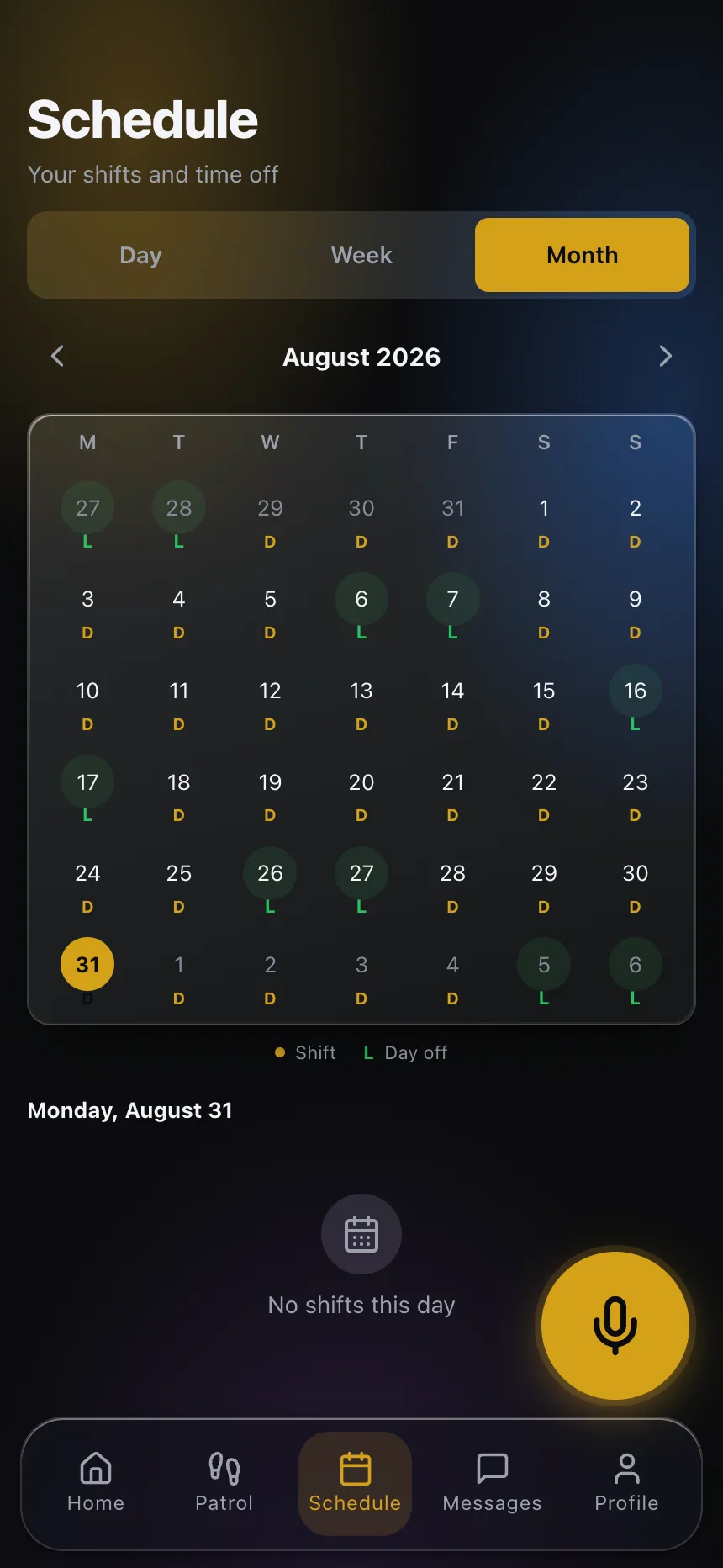
Every officer needs to be able to see months of the cycle at a glance, because the whole point is planning around it. A four-week rotation across four crews is exactly the kind of thing that gets miscopied when a supervisor rebuilds it by hand each month. Guard scheduling software that generates the pattern forward and publishes it to each officer’s phone removes an entire class of “I thought I was off” callouts.
Fatigue management on the ugly stretch
Week 2 is the problem: three day shifts, a single day off, then three night shifts. That single day is not enough to flip a sleep cycle. Officers coming off three days and going onto nights with roughly 24 hours to turn around are, in practice, working that first night impaired.
You cannot fix that with a memo. What you can do:
- Put the least demanding post in the rotation on that night if the account allows it.
- Increase check-in cadence and tour frequency on those nights, so the officer is in motion rather than sitting.
- Give supervisors a specific instruction to physically check the first flip night, not just call it.
- Make it easy for an officer to say they are not fit for duty, and mean it — a shift you fill at 8 p.m. is cheaper than an incident at 3 a.m.
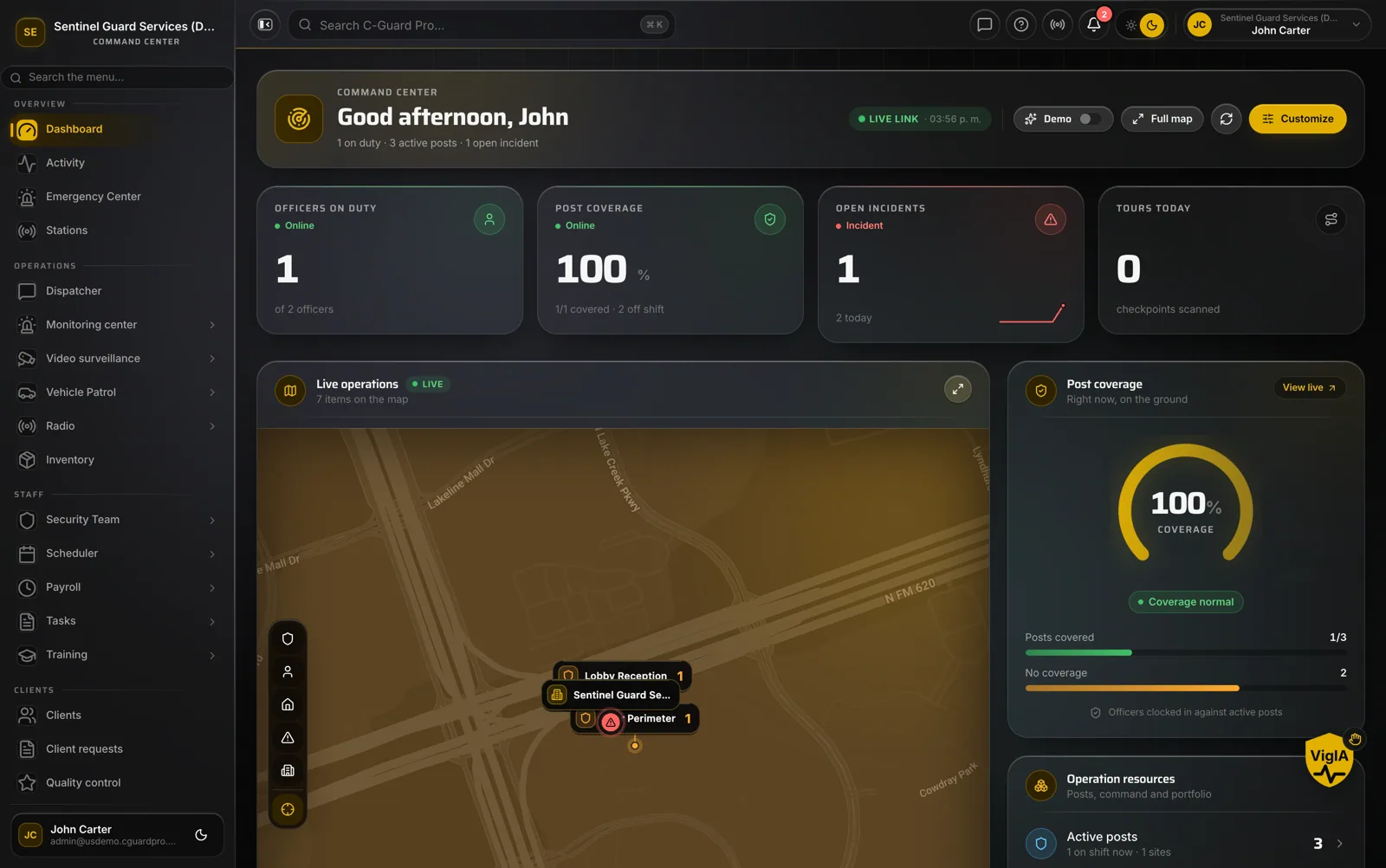
Timed tour checkpoints and live location on the operations view do double duty here. They give the client the proof they are paying for, and they tell dispatch quickly when an officer on the flip night has gone quiet longer than they should have. GPS guard tracking is not surveillance of the officer so much as a smoke detector for the shift.
Where it breaks down for smaller guard forces
Most of the DuPont schedule’s failure modes are the same failure: not enough people.
One post, one company, thin roster. If a small firm has a single 24-hour account and eight officers, the pattern nominally works and there is no bench at all. The first callout is filled by breaking someone’s rest week, and the second one is filled by a supervisor. Within two months the rotation exists only on the schedule printout.
Client-driven schedule changes. Accounts that add a post for an event, extend hours for a project, or move a shift by two hours are fighting the pattern. DuPont is rigid by design; that rigidity is what produces the week off. Sites with frequently changing requirements are better served by a simpler pattern with a deliberate flex pool.
High turnover posts. Onboarding into a four-week rotation is confusing for a new officer, and if the account churns people, someone is always mid-cycle and unsure. Patterns with shorter cycles are easier to slot people into.
Supervision spread thin. Four crews per post means any given officer sees a supervisor infrequently, and the crew on nights during their flip week is the one you most need to see. Small operations with one field supervisor across a district will struggle to cover that.
When it is the right call
DuPont fits a stable, genuinely round-the-clock post at a mature account, staffed by officers who value long blocks of time off, in a company with enough depth that the off-week crew is truly off. Industrial sites, data centers, utilities, campuses with steady requirements — places where the post orders do not change monthly and the client is not asking for schedule flexibility.
It fits badly at a small firm covering one 24-hour account with the minimum body count, or at any site where the requirement moves.
If the roster math does not support it, the honest alternatives are a Panama 2-2-3, which gives alternating three-day weekends with shorter working stretches, or a 4-on 4-off, which is simpler to explain and easier to staff. Both give up the week off. Neither asks an officer to flip from days to nights on 24 hours’ notice.
Whatever pattern you land on, the deciding factor is the same: build it from the post requirement and the headcount you actually have, publish it far enough ahead that officers can plan, and keep a real bench outside the rotation. If you want to see how a fixed multi-crew rotation looks when the schedule, the clock and the field record share one system, explore CGuardPro or get in touch.