Ask a group of officers what schedule they would pick if the pay were identical, and a lot of them say the same thing: four on, four off. The 4 on 4 off schedule is one of the most durable patterns in 24-hour security work, and for good reason — it is simple enough to explain in one sentence and it hands people blocks of time off that are actually usable. It also has failure modes that only show up once you are running it, and most of them involve what happens when one person does not show.
How the 4 on 4 off schedule works
The officer works four consecutive 12-hour shifts, then takes four consecutive days off, then repeats. The cycle is eight days long, which means it does not sync with the calendar week. That single fact drives almost everything else about the pattern, good and bad.
To cover a 24-hour post you need four crews: days A and B, nights A and B. While days-A is working its four, days-B is off. When days-A rotates off, days-B rotates on. The same on the night side. Every hour of every day is owned by exactly one crew, and the handover happens at the same two times each day.
Some operations run a fixed version — the same crew always works days, the same crew always works nights. Others swap crews between days and nights at the end of a block. The fixed version is far easier on the body and on supervision; the swapping version distributes the misery of nights more evenly and tends to be what officers ask for when night differential is thin.
Over the eight-day cycle each officer works four 12s. Averaged out, that lands in the neighborhood of a standard full-time load, but it does not distribute evenly across calendar weeks — some weeks the officer works three shifts, some weeks four. Whether that crosses an overtime threshold depends on where your workweek boundary sits and on the wage and hour rules that apply to you. That is a question for payroll and counsel before you launch the pattern, not after.
Why officers like it
Four days off is a real break. Two consecutive days off is a weekend; four is enough for a trip, a second job, a class, or genuine recovery from a night block. Posts running 4-on 4-off tend to attract volunteers rather than requiring persuasion — you will hear it from your own applicants.
The pattern is predictable forever. Because the cycle is fixed, an officer can tell you what they are working eight months from now. That predictability is worth a lot to people arranging childcare, and it removes an entire category of scheduling friction.
Fewer commutes. Half the shifts of an 8-hour pattern means half the drives. For officers working posts on the far edge of a metro, that is real money and real time.
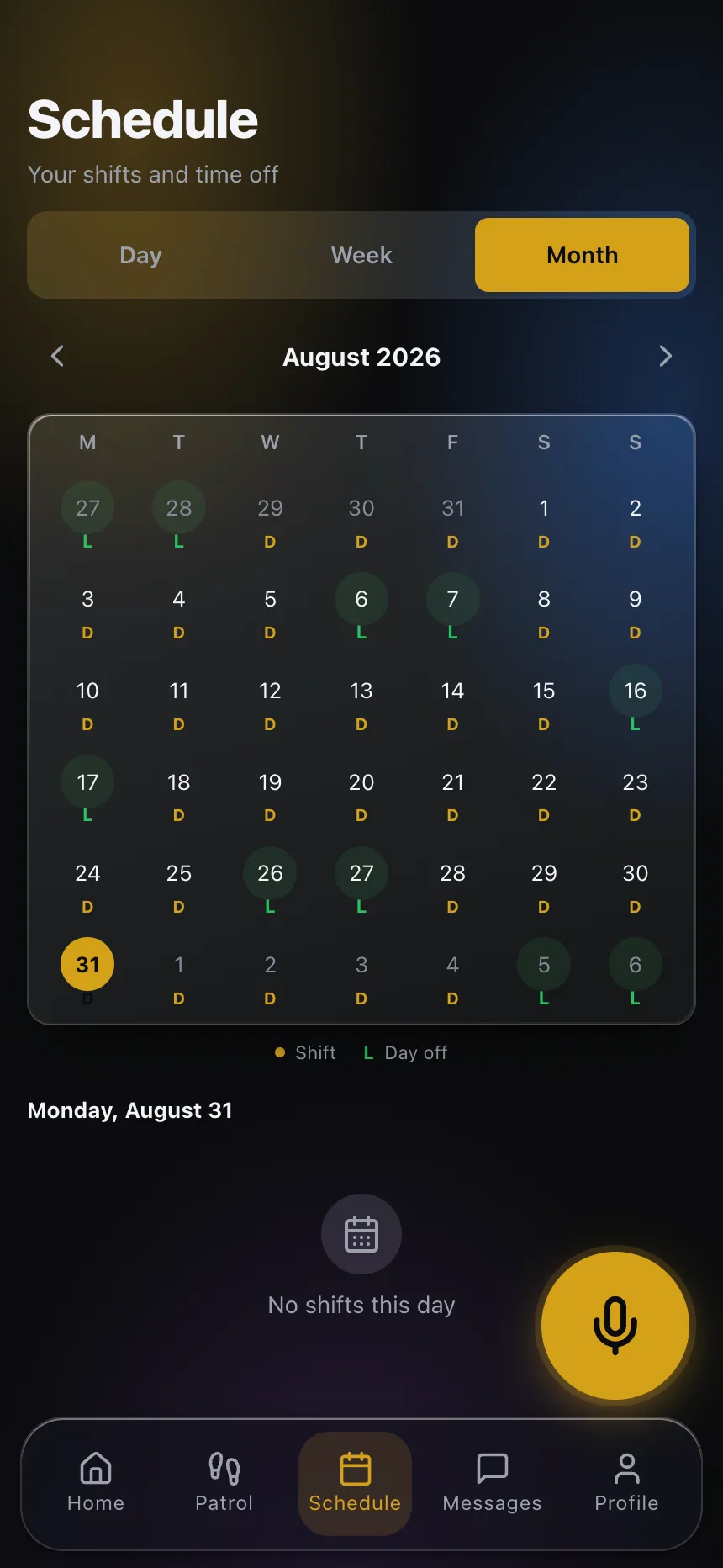
The predictability only pays off if officers can actually see the schedule. A pattern published on a break room wall gets copied wrong. Pushing assignments to the officer’s phone, with changes arriving as notifications, is what turns “fixed rotation” from a theory into something people plan their lives around. Guard scheduling software built for rotating patterns will generate the eight-day cycle forward indefinitely rather than making a supervisor rebuild it every month.
Where it hurts
Twelve hours is a long time on a static post
On an active site — a hospital, a busy lobby, a patrolling assignment — twelve hours passes. On a quiet gate at 4 a.m. in hour eleven, alertness is genuinely hard to maintain, and the fourth night of a block is worse than the first. If you run 12s, your patrol and check-in structure has to do more work: scheduled tour rounds, required check-ins, something that puts the officer in motion. A QR guard tour system with timed checkpoints is not primarily an anti-loafing tool on a 12-hour night post — it is a wakefulness structure that also happens to produce proof for the client.
Weekends and holidays fall wherever they fall
An eight-day cycle drifts against a seven-day calendar. Every crew eventually works every day of the week, which is fair in the long run and irritating in the short run. Christmas lands on whoever the rotation says, and there is no negotiating with the pattern without breaking it. Decide the holiday premium policy up front and publish it with the rotation, because the first December will surface it whether you are ready or not.
The callout math is brutal
This is the one that catches people. In an 8-hour pattern, a callout leaves an 8-hour hole, and an officer coming off shift can sometimes absorb part of it. In 4-on 4-off, a callout leaves a 12-hour hole, and your natural options are ugly:
- Hold the outgoing officer over, producing a 24-hour stretch you probably should not allow.
- Call in someone from the off-going crew, who is on day one of their four days off and will not be pleased.
- Split the shift between two people, which means two people’s plans instead of one.
- Send a field supervisor, which fixes tonight and leaves the district unsupervised.
There is no clever version of this. What there is, is preparation: a standing callout list that is ordered by who is genuinely available rather than by who answers first, and clarity about who can authorize the premium hours at 2 a.m.
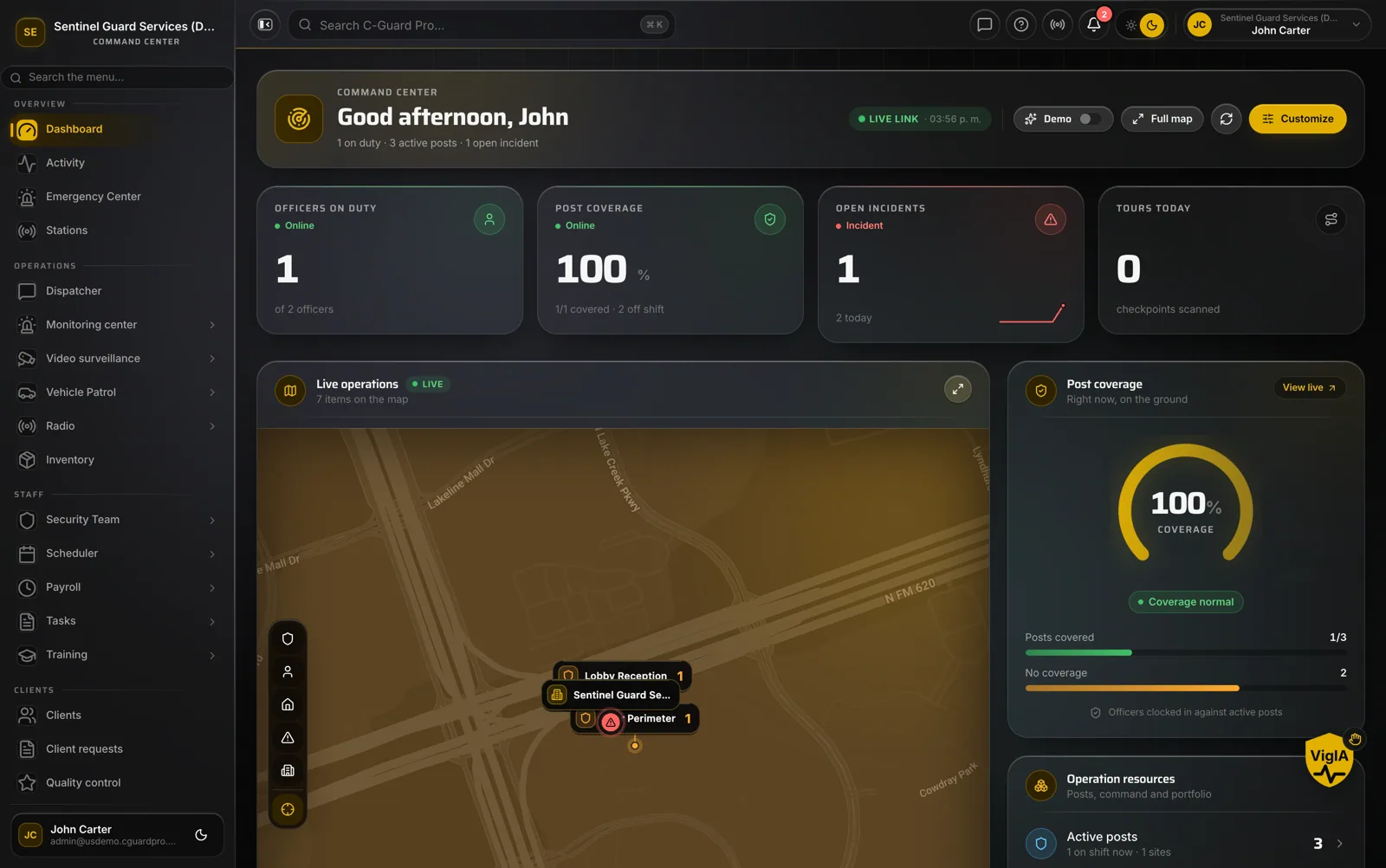
The practical requirement is that dispatch can see, right now, who is on, who is off, and who is where in their block. Reconstructing that from a printed rotation while a client is on the phone is how the wrong person gets called.
Supervision windows shrink
Four crews means any given officer sees a supervisor rarely, and the night crews may go long stretches without a face-to-face. If your quality program depends on a supervisor showing up, build the ride-along cadence into the rotation deliberately — otherwise the night-B crew becomes a place where habits form unobserved. GPS tracking and timestamped activity records fill part of that gap, but they do not replace someone standing at the post at 3 a.m. once in a while.
Is it right for your post?
The pattern fits when the post is genuinely 24/7, the site is stable, and the work has enough movement to sustain twelve hours of attention. It fits badly when the post is seasonal, when hours shift frequently at client request, or when your officer pool for that account is so thin that a single callout has no answer.
The honest test is headcount. If you cannot staff four crews plus at least a partial bench for the post, 4-on 4-off will run on overtime from the first month, and the officers you recruited with the promise of four days off will spend those days answering the phone. Run the arithmetic on the roster before you promise the pattern to the client.
Compare it against the alternatives with the same rigor: a Panama rotation gives shorter blocks and more frequent weekends off, and a DuPont rotation gives an entire week off at the cost of a punishing stretch beforehand. None of them is free.
If you want to see how a fixed rotation, live coverage and callout handling work together in one operation, explore CGuardPro or get in touch.