A guard company’s workers’ compensation position is decided long before a claim is filed. It is decided by how the payroll is classified, by what kind of posts the company sells, by whether officers are trained for the hazards they actually meet, and — more than most owners expect — by what documentation exists in the first hour after someone gets hurt. Workers compensation security company costs behave like a slow-moving average, which means today’s discipline shows up in next year’s numbers and there is no way to fix it quickly.
This post is general orientation for operators. It is not legal, insurance or claims advice. Workers’ compensation is administered state by state, and the differences are substantial: whether participation is mandatory, how payroll is classified, how rates and experience modifiers are calculated, what an employer must post and report, how injuries must be reported and within what timeframe, and how disputes are resolved all vary by jurisdiction and change over time. Texas in particular handles employer participation differently from most states, and the consequences of that choice are significant in both directions. Verify your specific obligations with your state’s workers’ compensation authority, your carrier, your broker and counsel before acting on anything here.
Classification is where the money starts
Premium is generally driven by payroll, by the classification assigned to that payroll, and by your own claims history relative to similar employers. Operators tend to focus on the third and ignore the first two, which is backwards, because classification is the input you can most easily get wrong and most easily correct.
The subtlety in contract security is that not all guard payroll is the same work. An unarmed officer at a reception desk in an office tower, an armed officer at a cash-handling site, a patrol officer driving between accounts all night, and an alarm response officer who enters buildings after break-ins are doing jobs with genuinely different injury profiles. Office and administrative staff are different again. How your carrier and your state’s rating organization treat each of these is a question for your broker, not for a blog post — but the operational point stands: if your payroll records cannot separate these populations cleanly, you have no ability to have that conversation intelligently.
Two practical habits pay for themselves. Keep payroll records that clearly distinguish job duties, not just job titles. And review classification with your broker when your mix of business changes materially — when you win a large patrol account, add armed posts, or move into alarm response, you have changed your risk profile whether or not anyone updated a form.
What actually injures security officers
Understanding the claim drivers in guard work explains why the prevention program looks the way it does.
Slips, trips and falls. This is the quiet giant. Officers walk. They walk at night, on wet loading docks, down poorly lit stairwells, across construction sites, through parking garages with uneven curbs. A patrol officer covering a large industrial property in the dark encounters more walking hazards in a shift than most workers meet in a month. Most of these claims are not dramatic; they are ankles, knees, backs and wrists.
Motor vehicle incidents. Any company running vehicle patrol carries road exposure, and it is the exposure with the highest severity. Fatigue is the aggravating factor nobody controls well — a patrol officer at 0400 on the back half of a twelve is a tired driver, and tired drivers have crashes.
Assault and confrontation. Officers are placed where confrontation is expected. Trespass removals, intoxicated individuals, domestic situations spilling into a lobby, theft interventions. Severity here is unpredictable and the psychological aftermath is real.
Animal encounters, weather and environment. Dogs on industrial properties. Heat exhaustion at outdoor posts in summer. Cold at gatehouses in winter. These are seasonal and largely preventable with post-specific planning.
Repetitive and static strain. Long standing posts, poorly set up gatehouses, officers who never sit and officers who never stand.
Notice how many of these are shaped by the post, not by the officer. That is the leverage point: the most effective injury prevention in guard work is site-specific, done during the post survey, and written into post orders.
The first hour decides the claim
Claims are expensive along two axes: medical cost and time away from work. Documentation influences both, and the window that matters most is the hour immediately after the injury — the hour when the officer is on site, the scene is intact, witnesses are present, and nobody has had time to construct a story.
What you want from that hour is specific: what the officer was doing, exactly where, what the surface and lighting conditions were, what footwear and equipment they had, who saw it, what was said, whether the officer reported pain at the time or reported none, and photographs of the location as it was. Photographs matter enormously. A photo of the actual step, taken at the actual hour, with the actual lighting, is worth more than any narrative written three days later.
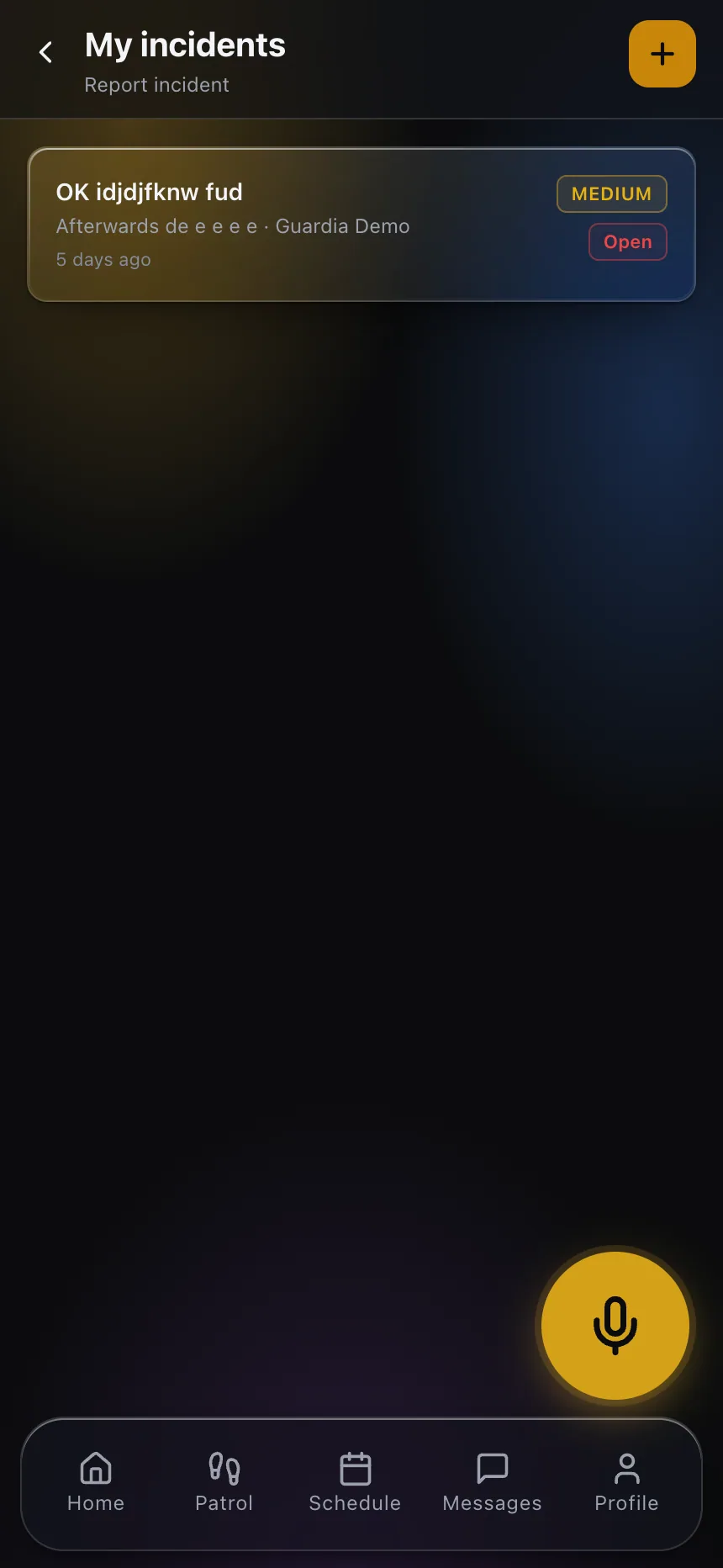
The reason this belongs in the field reporting tool rather than in a paper packet in the supervisor’s truck is friction. An injured officer and a supervisor under pressure will do whatever is fastest. If the fastest path is a structured form on a phone that timestamps itself, geotags the location, prompts for photographs and pushes the report to the office immediately, you get a usable record. If the fastest path is “call me and I’ll write it up tomorrow,” you get a paragraph.
Structured incident reporting also produces something a paper packet never does: comparable data. When every injury report captures location, time and mechanism the same way, you can see that three officers have now turned an ankle at the same loading dock, which is a fixable problem rather than three unlucky people.
Return to work is an operations problem
The claim cost driver most within your control is lost time. An officer sitting at home heals no faster than an officer doing modified duty, and every day away is cost and disconnection.
Contract security has an advantage here that many industries lack: the work is genuinely varied. An officer who cannot walk a patrol may still be able to sit a console, run access control at a lobby desk, monitor cameras, or handle visitor management. A modified-duty program is not charity; it is a cost control and it keeps a trained officer inside the company rather than drifting toward another employer.
Two conditions make it work. First, you need real light-duty posts identified in advance, not invented under pressure. Second, your scheduler has to be able to see restrictions when building coverage, so a restricted officer is never accidentally placed at a post that violates them. That second failure — putting an injured officer back on a post they are medically restricted from — turns a manageable claim into a serious one.
Building the loop back into prevention
Claims data is the most honest feedback a guard company gets about its own operation, and most companies never read it. The loop is straightforward: capture injuries in a structured form, review them monthly by site and mechanism, and push what you learn back into the post survey and post orders.
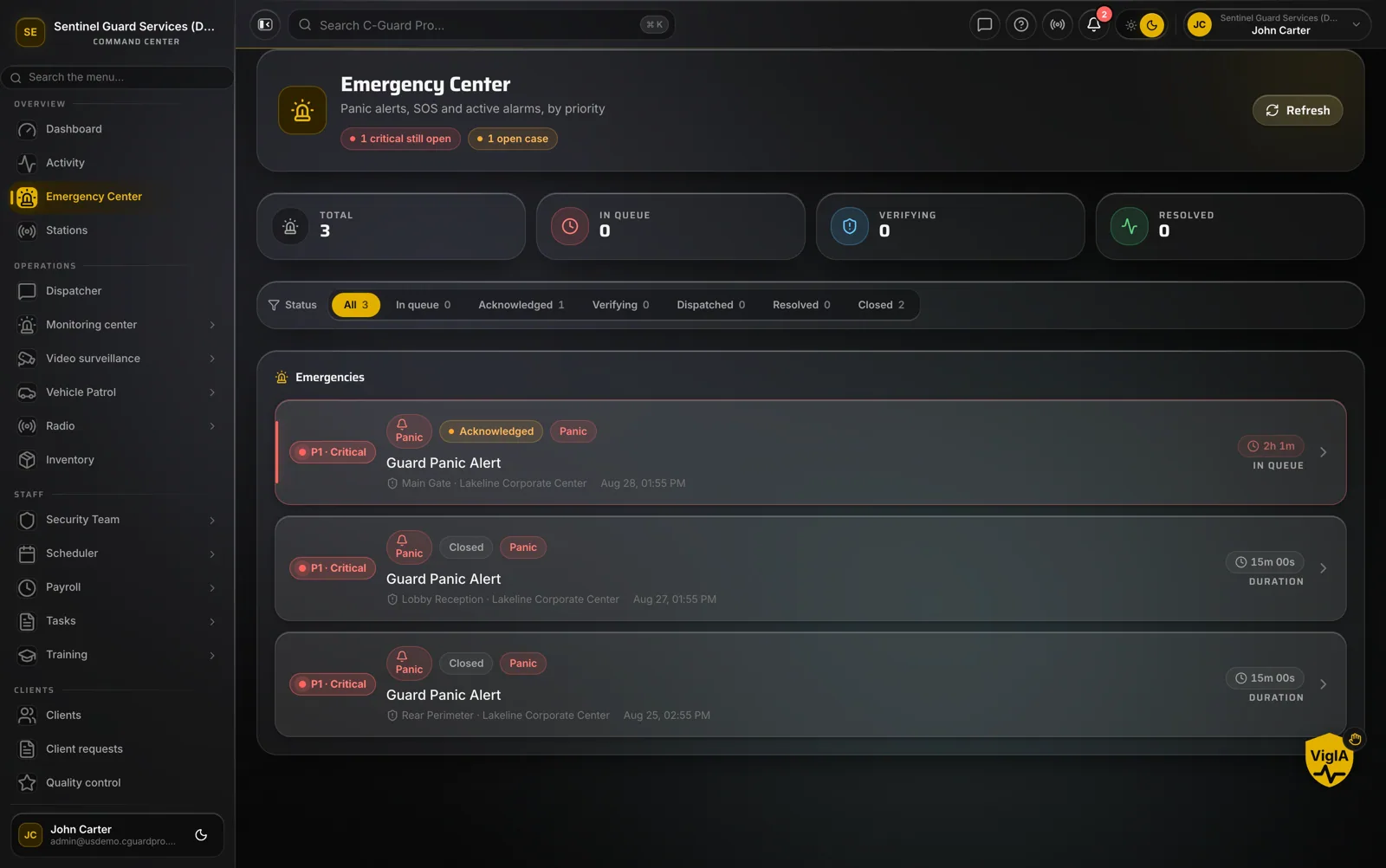
Three sprains at the same account means a walkthrough with the client about lighting or surface conditions. A pattern of vehicle incidents on the back half of night shifts means a conversation about rotation design and break policy. A confrontation injury at a post that has no duress capability means the officer needs a way to summon help immediately — a panic button on the phone they already carry is a far more realistic answer than a radio call to a base that may not be staffed at 3 a.m.
None of this makes claims disappear. Guard work puts people in places where things happen. What it does is make each claim shorter, better documented, and less likely to repeat at the same post — and over the multi-year window that experience rating actually measures, that is the whole game.
Talk to your broker about classification and to counsel about your reporting obligations. Then fix the loading dock.
If you want to see how field incident capture and the office review queue work together, explore CGuardPro or get in touch.