The objection is never really about the technology. When an officer pushes back on GPS, what they are usually saying is that they do not trust what will be done with it — that a manager will pull up their location on a Sunday afternoon, or use a five-minute gap in the trail to write them up, or that the whole thing exists because the company assumes they are lying. GPS tracking employee privacy is, in practice, less a legal problem than a trust problem with a legal floor underneath it. Companies that get the trust part right rarely have the legal part go wrong. Companies that deploy tracking quietly and hope nobody notices tend to get both wrong at once.
This is general orientation, not legal advice. Rules governing employee location tracking vary by state and are actively changing — some states have enacted specific requirements around notice or consent for tracking employees or tracking vehicles, some address electronic monitoring more broadly, and consumer privacy laws in several states create obligations around collecting and retaining personal information including precise location. Requirements differ for company-owned vehicles versus personal devices, and for on-duty versus off-duty periods. Verify current requirements in every state where you operate with employment counsel before deploying or changing a tracking program.
Why guard companies track at all
It is worth being honest about the reasons, because a policy built on a stated reason nobody believes will not hold.
The first reason is proof of service. A client pays for coverage of a property. When they ask whether the perimeter was walked at 0300, “the officer says he did” is a weak answer and everybody knows it. Location and checkpoint data turn coverage from an assertion into a record — which protects the officer as much as the client, because the officer who did walk it now has evidence.
The second reason is officer safety. An officer alone on an industrial property at 3 a.m. who stops responding is a genuine emergency, and the first question dispatch will ask is “where is he.” Without location, the answer is a guess across forty acres.
The third reason is dispatch efficiency. When an alarm response comes in, knowing which patrol unit is closest is operationally useful and reduces response time.
The fourth reason — the one that causes trouble — is verification of individual officers. Legitimate in principle, corrosive when it becomes the primary use, because it turns a safety tool into surveillance and officers read that shift immediately.
The order matters. A company that introduces tracking as “so we can find you if something happens, and prove to the client you did the work” gets a different reception than one that says “so we know you are not sitting in your car.”
Scope: the only rule that matters
If there is one design principle that resolves most of the privacy tension, it is this: track on duty, at the post, for the purposes stated — and stop.
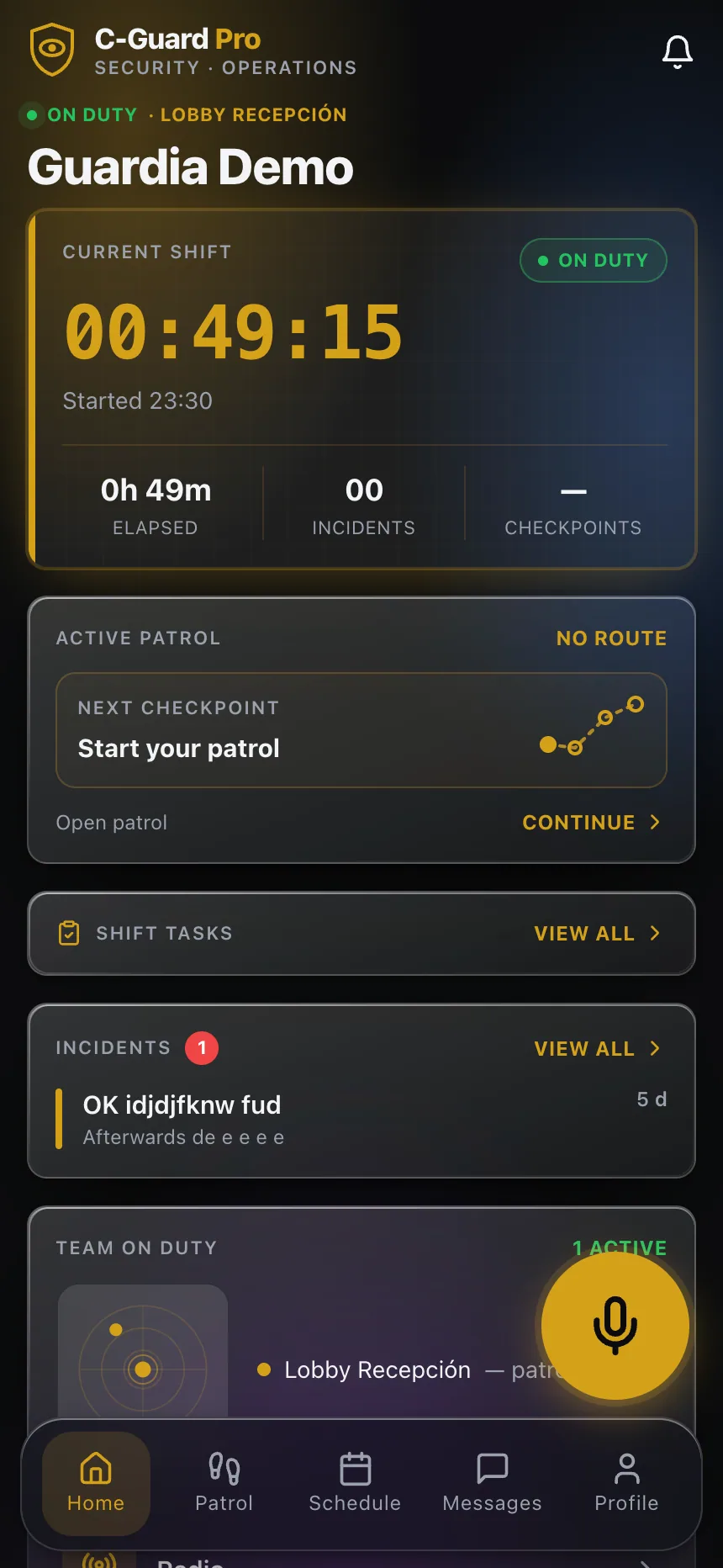
On duty only. The tracking should begin when the officer starts a shift and end when they end it. Not on the drive home. Not on their days off. This is both the practical expectation of employees and, in several jurisdictions, close to a legal requirement. It is also technically achievable: location capture tied to shift status rather than running continuously in the background.
Work locations, not personal ones. An officer on a meal break who leaves the site is doing something you generally do not need to know about. Consider whether your program pauses during breaks, and be able to explain what happens if it does not.
Purpose-limited. Write down what location data will be used for, and hold to it. If the stated purposes are proof of service, safety and dispatch, using the trail to reconstruct personal errands breaches your own policy — and it will be discovered.
Retention-limited. Location history is sensitive personal information, and keeping it forever is a liability with no operational benefit. Decide how long you need it — long enough to settle a billing dispute or investigate an incident — then delete it on a schedule that runs by itself.
Access-limited. Who can see the trail? Dispatch during a live shift, an account manager investigating a specific question, and nobody else on a whim. Access that is logged is access that stays honest.
Personal devices are a different conversation
If officers use company-issued phones, the analysis is simpler. If they use their own — common in this industry, and often the only realistic option — you are placing software with location permissions on a device the employee owns and uses for their entire personal life.
That deserves more care, not less. The officer should understand precisely when the app collects location and when it does not. The permission model on modern phones makes this visible to them anyway, so any gap between what you say and what the app does will be noticed. If your app can collect location while the officer is off shift, saying that it does not is a claim you should be able to demonstrate rather than assert.
There is also a fairness question separate from the legal one. Requiring an employee’s own device and data plan to do the job raises reimbursement questions that vary by state. Raise it with counsel before it is raised with you.
Writing a policy officers actually accept
A tracking policy that works reads less like a warning and more like an explanation. The elements worth including:
What is collected. Location while on duty, timestamps, and checkpoint scans. Be specific and be complete — omissions found later destroy credibility.
When collection starts and stops. Tied to shift start and end. State it plainly.
Why. The four reasons above, in plain language, with safety first because it is the one that is true and that officers care about.
Who can see it. Named roles, not “management.”
How long it is kept. A number of days or months, and what happens then.
What it will not be used for. This section builds more trust than any other. Not used to monitor off-duty movement. Not used to reconstruct personal activity. Not the sole basis for discipline without a conversation with the officer first.
How an officer raises a concern. A named person, and a commitment to answer.
Have officers acknowledge it in writing at hire and again when it changes, and keep those acknowledgments in the officer file. Then — this is the part companies skip — actually brief it. A policy handed over in a stack of onboarding paperwork is a document. A five-minute explanation in orientation is a policy.
The management discipline that keeps it clean
Technology does not create the trust problem. Managers do, usually in small ways.
Do not use location as the first line of a discipline conversation. If the trail shows an officer stationary for ninety minutes, ask them what happened before you conclude anything. The answer is frequently a client request, a medical issue, a dead vehicle, or a hazard they were dealing with. Officers who see location used as an opening question rather than a verdict stop resenting it.
Do not treat a gap in the trail as proof of anything. Buildings block signal. Basements, stairwells, elevator lobbies, steel structures and rural properties all produce gaps. Any supervisor who does not understand this will discipline good officers for the behavior of radio waves. This is where checkpoint scanning and location complement each other: a scan at a fixed point is deliberate evidence of presence that does not depend on signal quality.
Do not let location quietly become the timeclock without saying so. If arriving at the site is what starts the paid shift, that is a wage policy and it belongs in writing. Keep time and attendance an explicit act by the officer, and use location to verify it rather than to replace it.
And use the tool for the officer’s benefit visibly. When GPS supervision is what lets dispatch send help to a specific gate rather than a general address after a missed check-in, officers see the point. Pair it with a panic button they can actually reach, and the conversation about tracking changes character entirely — it stops being about whether the company trusts them and starts being about whether the company can find them.
Where to start
Read your policy as an officer would. If it reads like a threat, rewrite it. Confirm with counsel that your scope, notice and retention meet the requirements in every state where you operate. Then check that the app does what the policy says, because that gap is the one that costs you.
If you want to see how on-duty location, checkpoints and officer safety fit together in one operation, explore CGuardPro or get in touch.