Payroll week in a contract security company has a distinctive sound: a phone ringing at a client site because nobody can read a sign-in sheet, a supervisor reconstructing Tuesday night from memory, and someone in the office deciding whether an officer really worked until 7:15 or wrote 7:15 because the pen was already in their hand. Security guard timesheets are where operations, payroll and billing all meet, and they are also where a week of good field work quietly turns into a dispute.
The errors are not random. They enter in a small number of predictable places, and every one of them has a fix that costs less than the argument.
Where security guard timesheets go wrong
The paper sign-in sheet
A sheet at the desk, filled in by the officer, collected weekly by a supervisor who may or may not have been there. Every value on it is self-reported and unverified. Handwriting is ambiguous. Sheets go missing when a client changes the desk layout. And because the officer often fills in the whole week on Friday, the times reflect what the schedule said rather than what happened.
This is not primarily a dishonesty problem. It is a memory problem. Ask anyone to recall exactly when they left a post nine days ago and you will get the scheduled time, because that is what the brain reaches for.
Rounding
Rounding practices vary and can be legitimate, but they compound. If a system rounds punches to a fixed interval and always rounds in the employer’s favor, that is a wage exposure. If it rounds in the officer’s favor, it is a margin leak repeated across every shift on every account. Either way it is worth knowing your rounding rule, applying it consistently, and being able to show the raw times underneath it. Permissible rounding practices are governed by wage and hour rules that vary by jurisdiction and change over time — confirm yours with payroll and employment counsel. Nothing here is legal advice.
Missed punches
An officer forgets to clock out, or their phone dies, or the app was closed. Now someone has to decide what happened. In most operations that decision gets made days later by a person who was not there, using the schedule as the default answer — which means the timesheet stops recording reality and starts recording intention.
Missed punches are a major source of manual edits in attendance records, and manual edits are where the audit trail either exists or does not.
Coverage that never made it onto the sheet
A supervisor stands a post for three hours during a callout. An officer holds over past shift end waiting for late relief. A shift gets split between two people at 2 a.m. All of these are real worked hours. Whether they land on a timesheet depends entirely on whether the person who arranged them wrote it down at the time, and at 2 a.m. that is not a safe assumption.
Overtime nobody approved
Hours accumulate across the period, invisible until close. The hold-over on Monday, the extra shift on Thursday, the swap that landed on someone already near the top of their week. None of it was individually a bad decision; collectively it is a premium bill nobody authorized.
Shifts that cross midnight
A 6 p.m. to 6 a.m. post belongs to two calendar days. Systems and spreadsheets built for office hours handle this badly, and the classic result is a night shift counted twice, counted zero times, or split across two workweeks in a way that changes the overtime math. Every 24-hour security operation eventually finds this bug in its own process.
What the fix looks like
Capture at the moment, at the post
The core change is moving from recording to capturing. Instead of an officer writing a time, the punch happens on their phone at the post, with location and a photo attached, at the moment it occurs. Now the timesheet is not a memory exercise — it is a log, generated as the shift happens.
This is what removes most of the error categories at once. There is no handwriting to read, no sheet to lose, no Friday reconstruction, and no ambiguity about whether the officer was at the site.
Make the schedule the baseline, not the answer
The schedule says what was supposed to happen. The punches say what did. The gap between them is the interesting part, and it should be visible as a short list of exceptions rather than buried in a grid of numbers.
An exception list for a period should be readable in a few minutes: shifts with no clock-in, shifts with no clock-out, punches outside the geofence, punches materially different from the scheduled time, and hours that crossed an overtime threshold.
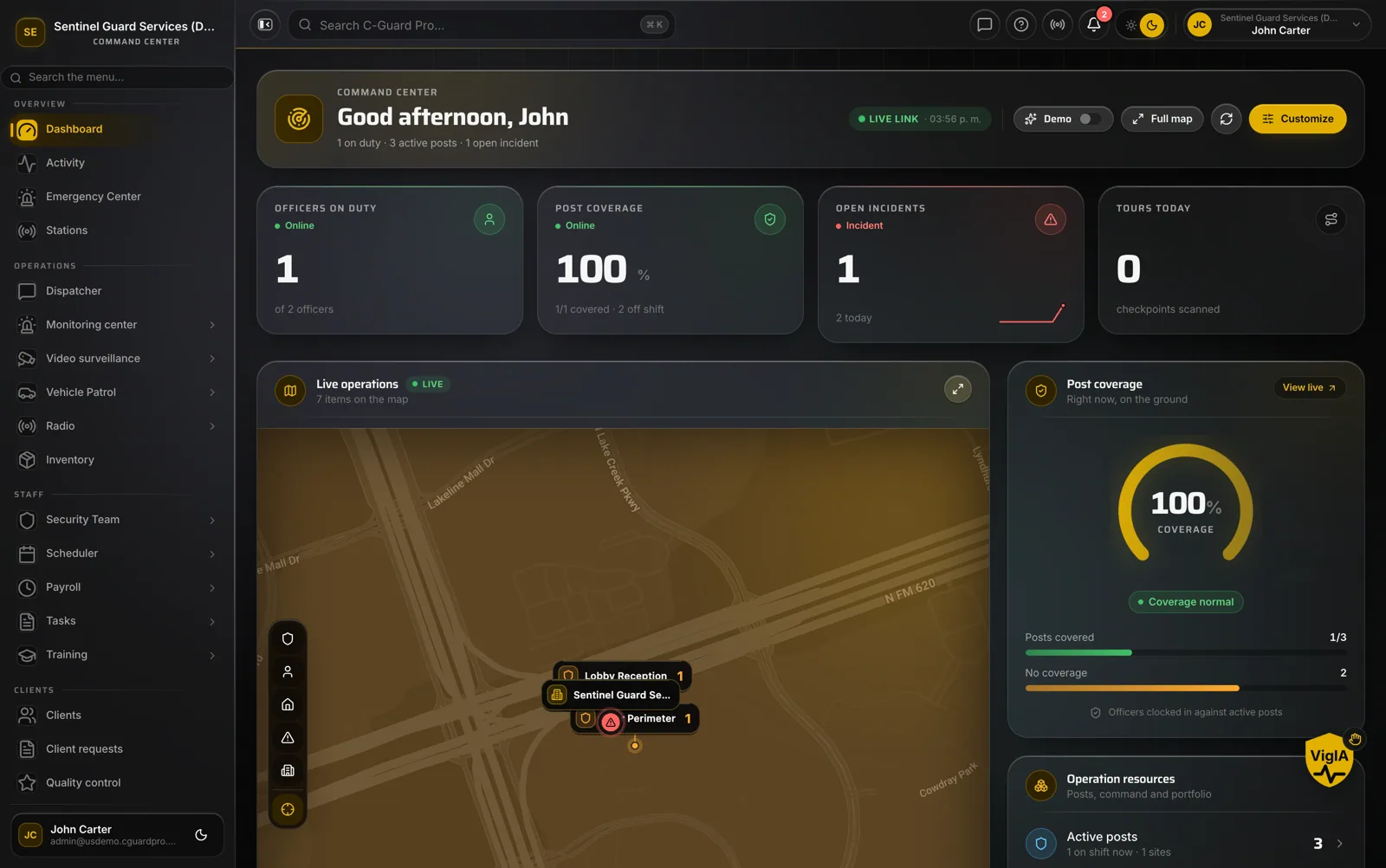
If those hour totals update live rather than at close, most of the exceptions get handled the day they happen, by the person who knows what happened. Real-time guard time and attendance does not eliminate exceptions — it moves them from payroll week, when nobody remembers, to the shift itself, when everybody does.
Handle missed punches with a defined procedure
Write it down: who can correct a punch, what evidence is required, and that every correction is logged with the name of the person who made it and the reason. A correction with an audit trail is a normal part of running an operation. A correction without one is a liability in any wage dispute.
Reasonable evidence includes tour checkpoint scans, activity reports filed during the shift, radio traffic and supervisor confirmation. If an officer scanned a checkpoint at 5:52 a.m., you know they were on the post at 5:52 a.m., regardless of whether the clock-out registered.
Approve overtime before the period closes
Overtime approval that happens at close is not approval, it is acceptance. Set a threshold at which the system flags an officer’s accumulating hours, route it to a named role, and record the decision. The point is not to refuse the hours — the post still needs covering — it is to make the decision visible while it can still be made differently.
Reconcile against the bill, not just the pay
The last step of a clean close is comparing hours paid to hours billable per account. Hours that were worked but not billed are a margin leak; hours billed but not worked are a client credit waiting to happen. Both come from the same root cause, which is coverage arranged verbally and never entered anywhere. Running both sides off one set of shift records is the only reliable way to keep them in agreement. Scheduling and attendance that live in the same system make that comparison a report rather than a project.
What a clean period close looks like
By the time payroll runs, the exception list should be empty and every item on it should have a name attached to its resolution. Specifically:
- Every scheduled shift has a matching clock-in and clock-out, or a documented correction.
- Every correction names who made it and why.
- Every hold-over, split shift and supervisor-covered post is in the record, entered when it happened.
- Every premium hour was flagged and approved before close.
- Overnight shifts are attributed to the correct workweek under your defined boundary.
- Paid hours and billable hours reconcile per account, with any difference explained.
None of that requires heroics. It requires the record to be created at the post instead of at the desk, and someone reviewing exceptions daily instead of weekly.
Timesheets are not administrative overhead. They are the evidence that the service you sold was delivered. If you want to see what capturing that at the post looks like in practice, explore CGuardPro or get in touch.