Contract guarding is a labor pass-through business. You buy hours and you sell hours, and the difference between the two prices has to cover payroll taxes, workers’ compensation, general liability, uniforms, equipment, supervision, dispatch, administration and whatever is left over for the owner. There is no product margin hiding anywhere. Which means security company margin is not a pricing question — it is an operations question, and it is decided by four things that happen in the field every week.
Owners who chase margin usually attack it from the wrong end. They raise bill rates, which is slow, contested and sometimes loses accounts. Or they cut pay rates, which produces turnover that costs more than the savings. The four levers below sit between those two extremes, and every one of them is inside your control without a single client conversation.
Lever one: overtime you did not intend to buy
Overtime is the fastest margin leak in a guard company and the one that hides best, because it happens at night, in pieces, decided by a tired dispatcher solving an immediate problem.
Here is the mechanism. An officer calls out at 10:40 p.m. The dispatcher works the list. The officer who says yes is the one already at 38 hours this week, because the reliable people are always the ones already near the line. The shift gets covered, the client never knows, and the hours land on the payroll at a premium the bill rate does not reflect. Repeat that a few times a week across a dozen accounts and it is not a rounding error anymore.
Overtime obligations are governed by the Fair Labor Standards Act and by state wage and hour law, which vary — some states impose daily overtime rules, some have rules about consecutive days, and some industries and jurisdictions have additional requirements. Verify what applies to your operation with counsel. Nothing here is legal advice. What is true operationally regardless of jurisdiction is that unplanned premium hours are the most expensive hours you buy.
Three practices contain it:
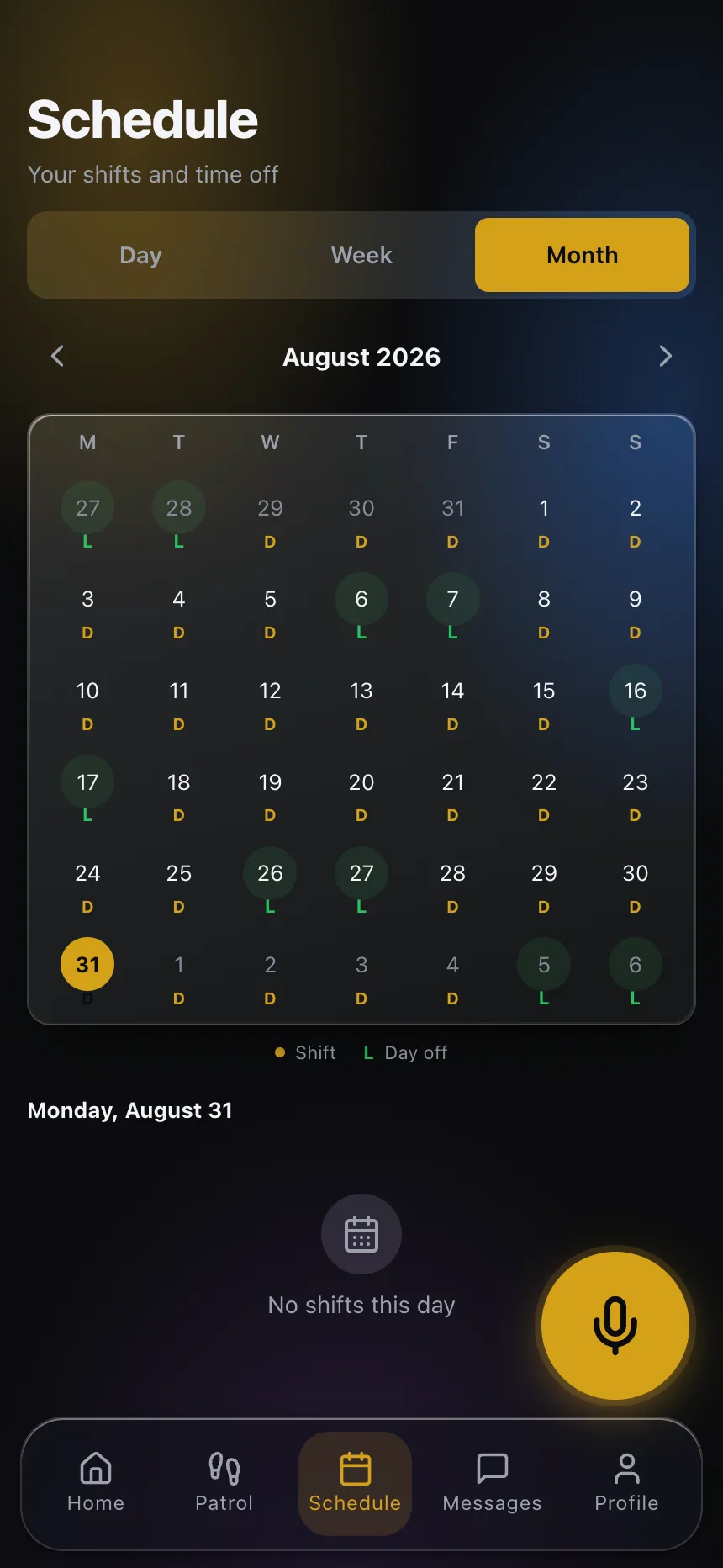
Make hours visible at the moment of the fill. The dispatcher needs to see, while making the call, how many hours each candidate already has this week. Without that, they cannot make a good decision no matter how motivated they are. A scheduling system that surfaces projected hours next to availability turns an invisible cost into a choice.
Build the schedule to leave headroom. A schedule where most of the force is already near full time has no absorption capacity. One callout immediately becomes premium hours. Deliberately keeping some part-time capacity and some officers with room in their week is not inefficiency — it is the buffer that keeps callouts cheap.
Distinguish overtime you sold from overtime you ate. Some overtime is billable — client-requested extra coverage, special events, holiday posts. Some is coverage failure. If both land in one bucket on the P&L, you cannot tell whether overtime is a revenue line or a wound. Tag it at the source.
Lever two: unbilled hours
Every guard company gives away hours. Almost none of them know how many.
The sources are mundane. An officer stays late covering the gap until relief arrives and gets paid for it, but the invoice was built from the schedule, not from actual hours. A supervisor sits a post for three hours during a callout and nobody records it against the account. A client asks for extra coverage over the phone during an event, the shift happens, and the request never becomes a change order. A post starts at a new site a week before the contract paperwork catches up.
None of those feel like losses in the moment. Each is a small act of good service. Collectively they can be the difference between a healthy account and a marginal one, and they are almost always concentrated on the accounts where the client relationship is warmest — you give the most to the people you like the most.
The remedy is structural, not motivational. Bill from actual recorded hours rather than from the schedule, and reconcile the two every period. Where actual exceeds scheduled, someone must categorize it: billable extra, absorbed by us as a service gesture, or a scheduling error. That single review, done weekly, surfaces the leak. Time and attendance records tied to the post and the account are what make it a five-minute review instead of a project.
Then put a rule around verbal requests: extra coverage requested by phone gets confirmed in writing before the shift is worked. That is not distrust; it avoids a conversation two months later where a client genuinely does not remember asking.
Lever three: the true cost of turnover
Turnover cost is real money that never appears as a line item, which is why companies tolerate turnover rates they would never tolerate as an expense.
Walk through what replacing one officer actually consumes: recruiter time sourcing and screening, background and license verification, onboarding administration, uniform issue, paid training and orientation hours, the ride-along or double-coverage during the officer’s first shifts, supervisor time on the new officer for weeks afterward, and — the expensive one — the coverage gap in between, which is usually filled with overtime.
Add the quality cost. A post with constant churn has officers who do not know the site, which produces weak reports, missed tours, and eventually a client conversation.
Because none of that is a purchase order, it is invisible. Make it visible by building your own replacement cost estimate — using your own actual hours and your own actual rates, not a figure from an article — and multiplying it by last quarter’s separations. The margin point is this: reducing turnover cuts overtime, cuts recruiting spend and improves service quality at the same time. It is the only lever that moves three costs at once.
Lever four: supervision efficiency
Supervision is your largest non-billable labor cost, and most of it is spent driving.
The math is geometric. A supervisor covering accounts scattered across a metro spends the majority of the shift in a vehicle. The same supervisor covering a tight cluster can visit several times more posts in the same hours. Nothing about the supervisor changed — only the account geography did.
Which means margin is affected by which accounts you win, not just how you run them. A new account that sits an hour from every other account you have is not as profitable as the bill rate suggests, because it drags supervision capacity with it. Companies that grow by clustering geographically are structurally more profitable than companies that grow by taking whatever comes.
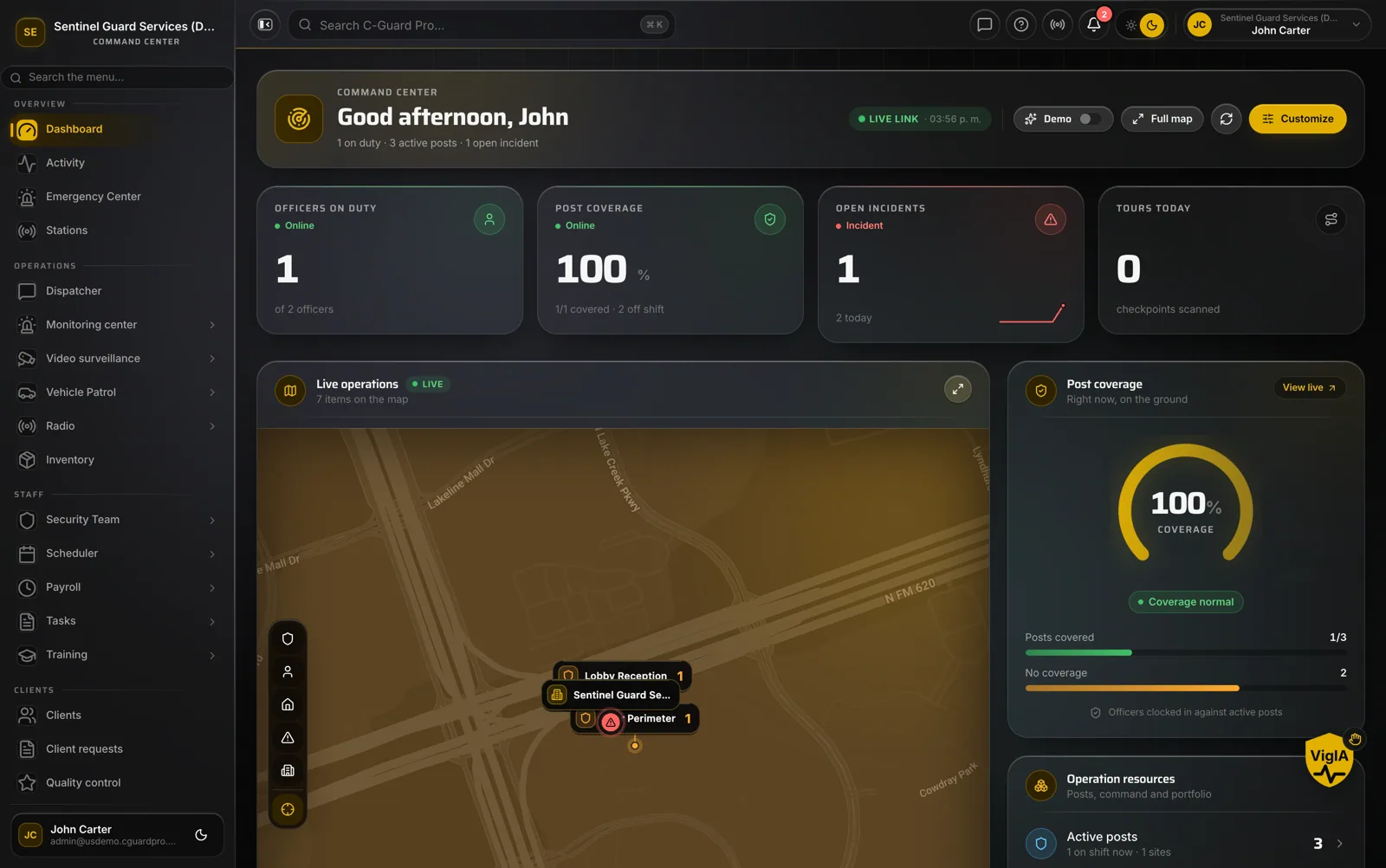
For the accounts you already have, two adjustments help. First, route by cluster rather than by account manager tradition — many supervisor routes are historical accidents nobody has revisited. Second, use remote verification for the things that do not require a body. Tour completion, on-time starts and report quality can be checked from the office; only coaching, inspections and relationships require the drive. Seeing where supervisors actually are and where their hours actually go, through GPS tracking of supervisor routes, usually reveals that visits are concentrated on a handful of convenient accounts while the awkward ones go untouched for months.
The fifth thing, which is not a lever but a precondition
None of the above is actionable without a reliable weekly picture of scheduled hours versus worked hours versus billed hours, by account. That comparison is the whole ballgame. Every one of the four levers shows up in it: overtime as worked exceeding scheduled at premium, unbilled hours as worked exceeding billed, turnover as churn in who worked, supervision inefficiency as non-billable hours climbing.
Most companies cannot produce that view because the three numbers live in three places — a schedule, a payroll file and an invoicing spreadsheet — maintained by different people at different times. Getting them into one operational picture is less about software preference than about arithmetic finally being possible.
Once it is possible, the discipline is a standing weekly review of the exceptions only: which accounts had worked hours over scheduled, which had premium hours, which had hours nobody billed. Ten minutes a week, and the leaks stop being invisible.
What not to cut
Two costs get cut for margin and reliably cost more than they save: supervision and training. Both are non-billable, both are easy to reduce without an immediate consequence, and both produce their damage on a delay of one to two quarters — as turnover, callouts, weak reports, and eventually a lost account. If margin pressure is forcing a decision between raising bill rates and cutting supervision, raise the rates and be prepared to defend the value with the reporting the client actually sees.
If you want to see scheduled, worked and billable hours in one operational picture, explore CGuardPro or get in touch.