Every contract security company that runs mobile patrol eventually discovers that the vehicle is the second-hardest thing to manage after the roster. A patrol truck is a rolling post that nobody watches. It gets driven by four different officers in a week, fueled on a company card by whoever happens to be behind the wheel, and returned to the yard with a check-engine light that three shifts in a row decided was somebody else’s problem. Then a client asks why the 2 a.m. drive-by did not happen, and the answer is that the vehicle was down and nobody in dispatch knew it.
Why security fleet management is different from ordinary fleet work
A delivery company’s fleet exists to move goods. A security company’s fleet exists to produce presence, and presence is what the client is buying. That difference changes what you have to control.
A parcel van that breaks down delays a package. A patrol vehicle that breaks down means a site on a mobile patrol contract silently goes uncovered, and nobody finds out until the client’s own camera review shows an empty lot at the hour your invoice says you were there. The failure is not just operational — it is a billing integrity problem and a contract renewal problem.
The second difference is custody. Patrol vehicles typically carry things you would rather not lose track of: site keys or fobs, a first aid kit, flares, a fire extinguisher, sometimes a client’s gate remote, sometimes a company phone or tablet. The vehicle is a mobile equipment cage as well as transportation. Anything that lives in it needs an owner on every shift, which means the vehicle handoff and the post handoff are really the same event.
The third difference is evidence. Mobile patrol is the service line where clients are most likely to doubt you, because they cannot see the work. A stationary officer at a lobby desk is visibly there. A patrol officer who drives through a business park at 3:12 a.m., checks four doors and leaves is invisible unless you can produce the record. That makes route evidence part of fleet management, not a separate topic.
Assignment: one vehicle, one accountable officer, every shift
The single highest-value control is boring: a written assignment record that says which officer had which vehicle, from when to when, with the odometer at handoff.
Most companies think they have this. What they usually have is a clipboard in the yard that gets filled in retroactively on Fridays. The test is simple — pick a random date six weeks back and ask who was driving unit 7 at 11 p.m. If it takes more than a minute to answer, you do not have an assignment record, you have a habit.
The assignment record should capture, at minimum:
- Officer name and the shift the vehicle is tied to
- Time out and time in
- Odometer out and in
- Fuel level or a note that fueling occurred
- A pre-trip condition check: lights, tires, body damage, warning lights, cleanliness
- Equipment inventory in the vehicle, confirmed present
That last line is where the leakage lives. If the extinguisher, the flashlight and the client’s gate remote are not confirmed at handoff, then when one goes missing you have a roster of everyone who touched the vehicle in a month and no way to narrow it. Confirming inventory at handoff turns a mystery into a two-person question.
Photos make the condition check honest. A pre-trip that requires four quick photos — front, rear, both sides — creates a timestamped record of body damage that ends the “it was already like that” argument. Officers actually like this once they understand it protects them from inheriting someone else’s dent.
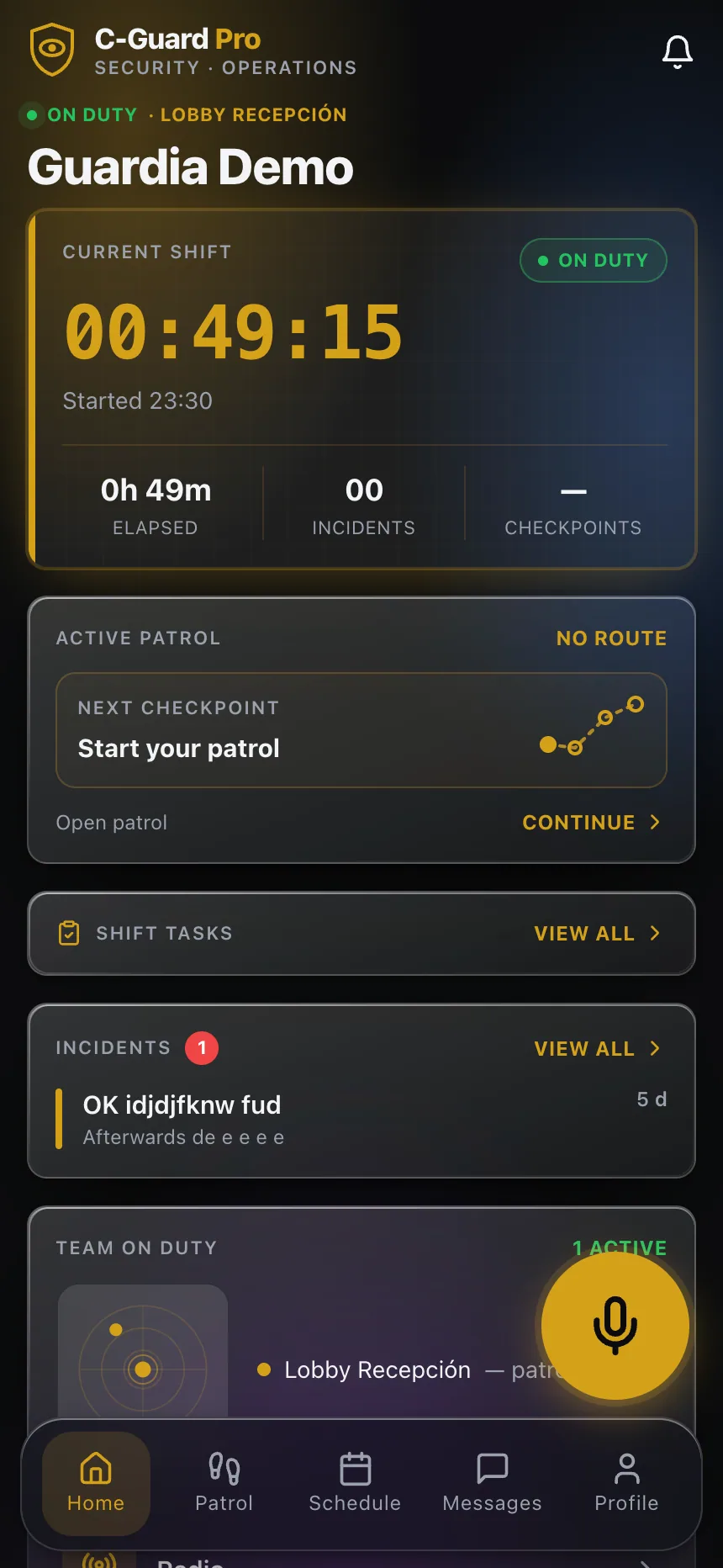
If your officers already start their shift in a phone app for time and attendance, the vehicle check belongs in the same flow. Nobody fills out a second form. The clock-in becomes: verify identity, confirm post, confirm vehicle, complete the pre-trip. One sequence, one record, and dispatch can see at a glance which units went out and which did not.
The handoff nobody schedules
The worst vehicle problems happen at the seam between shifts, especially when a patrol vehicle transfers directly officer-to-officer at a gas station or a parking lot rather than returning to a yard. That is a handoff with no supervisor present.
Build the seam into the process. The outgoing officer closes the vehicle record with odometer, fuel and any new damage or defect. The incoming officer opens a new record and either confirms the same condition or flags a discrepancy. When the two records disagree, that is a supervisor’s callout — and it is far better to have the conflict surface at 11 p.m. than to discover a cracked bumper in three weeks.
Maintenance: intervals that survive a 24-hour operation
Fleet maintenance schedules assume a vehicle has an owner who notices things. Patrol vehicles do not. They run hard, idle for hours, get short-tripped constantly, and are driven by people who are not being evaluated on how well they treat the truck.
Two practical adaptations:
Trigger on odometer, not the calendar. A supervisor’s SUV that covers three metro counties and a static site’s runabout that circles a campus accumulate wear at wildly different rates. Calendar-based service intervals will over-service one and under-service the other. Capture the odometer at every handoff and the service trigger takes care of itself.
Separate defect reporting from complaint. Officers under-report vehicle problems because reporting feels like volunteering for paperwork or, worse, like being blamed. Make the defect report a two-tap item with a photo and a severity — safe to drive, drive with caution, do not drive — and route “do not drive” straight to dispatch as an alert rather than into a queue somebody reads in the morning. A brake complaint that sits unread for nine hours is a liability event waiting to happen.
Keep the maintenance history with the vehicle, not in a folder in the office. When an officer reports a shimmy in unit 4 and the record shows two prior shimmy reports from two other officers, you have a pattern. Three unrelated complaints in three shoeboxes is nothing.
Fuel accountability without treating officers like suspects
Fuel is where the trust conversation gets awkward. Fuel cards get shared, receipts vanish, and the monthly statement shows a fill that does not match any patrol you can account for.
The mechanism that works is reconciliation, not surveillance. If you have odometer readings at every handoff and fuel purchases with timestamps, you can compare fuel consumed against miles driven per vehicle over a month. You are not looking for a precise number — patrol driving is stop-and-go and idle-heavy, so consumption varies. You are looking for a vehicle whose ratio is wildly out of line with its own history and with comparable units. That is a conversation starter, and it is a fair one, because it rests on the vehicle’s own baseline rather than on an accusation.
Require the odometer at fueling and require a receipt photo. Not because a receipt cannot be faked, but because the friction of faking it consistently is higher than the benefit, and the requirement itself removes ambiguity about what is expected.
Using the patrol route to justify the vehicle
Here is the part most operators leave on the table. The vehicle is a cost line the client sees. Mobile patrol contracts get cut when the client cannot connect the vehicle to any result. So make the route the product.
GPS tracking of the patrol vehicle and the officer produces a timeline of where the unit went and when. On its own that is telemetry — interesting internally, meaningless to a client. It becomes valuable when it is tied to actual checks: a scan at each checkpoint, a photo of the gate, a note on the condition found.
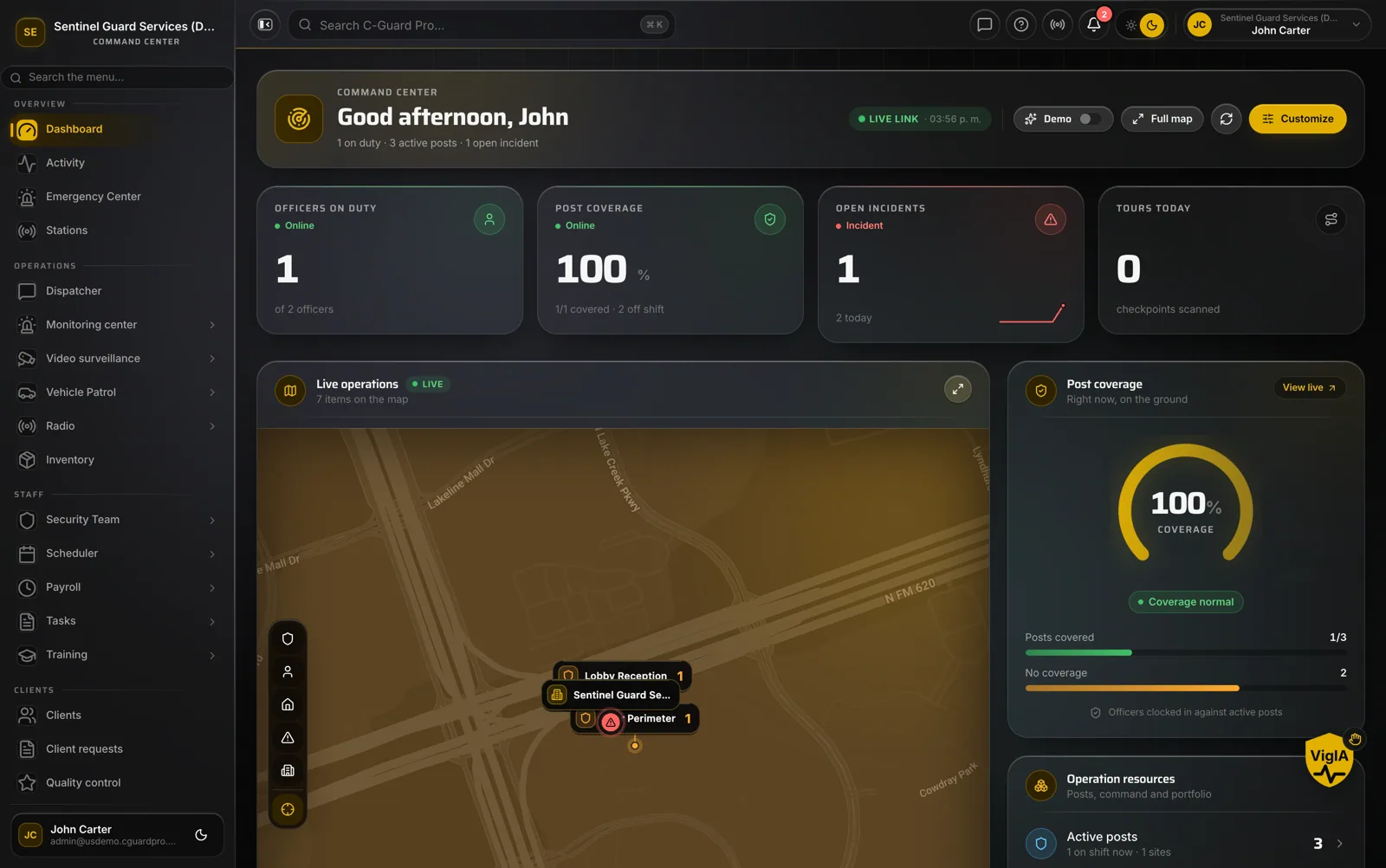
A patrol log that shows a vehicle entered the property at 2:47 a.m., that the officer scanned the rear dock, the electrical room and the north gate, that one door was found unsecured and photographed, and that the unit cleared at 3:04, is a defensible service record. Pair GPS supervision with QR checkpoint tours and the drive-by becomes an inspection with evidence.
Then give the client access to it. When a property manager can open a client portal and see last night’s patrol times and the photo of the propped door, the renewal conversation stops being about price per drive-by and starts being about what you caught.
What to do when the route did not run
Be equally disciplined about failures. A vehicle down, an officer callout, a road closure — patrols get missed. The companies that lose contracts over missed patrols are usually not the ones that missed them; they are the ones the client discovered had missed them. Log the miss, log the reason, notify the client proactively, and credit it if the contract calls for it. A documented miss with a stated cause reads as control. A silent gap reads as fraud.
Start with the assignment record
If you are building this from nothing, do not attempt a full fleet program. Start with the handoff record — officer, times, odometer, condition, equipment confirmed. Run it for a month. It will surface your real problems, and they will not be the ones you expected. Maintenance intervals, fuel reconciliation and route evidence all get easier once every mile has a name attached to it.
If you want to see how vehicle checks, patrol routes and officer records fit into one operation, explore CGuardPro or get in touch.