Two officers on the same account, hired eight weeks apart, both trained by whoever happened to be on shift. One says “10-50 at the north gate.” The other has no idea whether that means a vehicle accident, a disturbance, or a request for a supervisor, because at his last company it meant something else entirely. Dispatch guesses. That guess is the whole argument in the radio codes vs plain language debate, and it is why public safety agencies spent years moving away from the codes that private security still copies out of habit.
Where ten-codes came from and why they made sense
Ten-codes were not invented to be secretive. They were invented for bandwidth and for equipment limitations. Early radio systems had a lag at the start of a transmission that clipped the first syllable, so a leading “ten” gave the receiver something disposable to lose. Channels were shared, noisy and congested, and a two-syllable code carried a full sentence of meaning in a fraction of the airtime. Under those constraints, codes were a genuine engineering solution.
They also carried a secondary benefit that people came to value more than the original one: a code is opaque to bystanders. An officer could report an ambulance request without the person in front of them understanding, or flag a difficult subject without saying so out loud.
Both rationales have weakened. Modern digital radio and app-based push-to-talk do not clip transmissions or ration syllables the way 1940s equipment did. And the discretion argument is weaker than it looks, because anyone who spends time around a guard force learns the common codes quickly — including the people you were hiding them from.
Why public safety moved toward plain language
The turning point in public safety was multi-agency response. When police, fire, EMS and mutual aid from neighboring jurisdictions converge on one incident, every agency arrives with a different code list, and the same number means different things across departments. Under pressure, on a shared channel, that ambiguity is not a minor inconvenience — it is the mechanism by which the wrong resource gets sent to the wrong place.
Federal incident management guidance has for years encouraged plain language for multi-agency incident communications for exactly that reason, and many agencies have adopted it wholesale while others retain a small set of codes for internal traffic. Requirements and adoption vary by agency and jurisdiction; if you work under a client contract that references a public safety standard, verify what it actually requires rather than assuming.
The underlying logic is what matters for private security: codes optimize for a closed, stable, well-trained group on a private channel. They fail as soon as the group is open, changing or shared.
Contract security has the open, changing, shared version of the problem
Look honestly at how a guard force is composed. Officers move between accounts, often within a week. New hires arrive continuously and many come from other security companies with other code lists in their heads. A single dispatcher may cover a dozen client sites that were each set up by a different account manager. And the people you most need to understand a transmission — the client’s own staff, a responding police unit, an EMS crew asking your officer where the patient is — were never trained on your codes at all.
That is the worst possible environment for a coded system. It is not that codes are inherently bad; it is that codes require a training investment and a stability that this industry, with its turnover and its multi-site structure, structurally does not have.
What plain language actually means
Plain language does not mean rambling, and this is where implementations go wrong. Replacing a code with three unstructured sentences makes traffic worse, not better. Plain language means common words in a disciplined structure.
A workable pattern for security operations:
Who you are calling, then who you are. “Dispatch, Post 4.” Wait for acknowledgment before the message. This has nothing to do with codes and everything to do with the receiver being ready to hear.
What, where, then what you need. “Vehicle accident, north gate visitor lane, no injuries, requesting a supervisor.” One transmission, complete, no follow-up questions.
Priority stated in words at the front when it matters. “Emergency traffic” or “priority” spoken plainly, then the message. Everyone on the channel understands it instantly, including a client employee holding a spare radio.
Keep the small conventions that genuinely work and are widely shared: the phonetic alphabet for plates and names, “copy,” “stand by,” “say again,” “clear.” Those are not codes; they are error-correction, and they survive turnover because they are used identically almost everywhere.
Where a small set of codes still earns its place
The honest position is not code abolition. There is one category where a private signal is defensible: duress.
An officer who needs help but cannot say so — a subject standing next to them, a situation where announcing the request would escalate it — needs a way to signal that does not sound like a signal. A single agreed duress phrase, trained hard and used never, is a legitimate exception. So is a discreet way to request a welfare check on another officer.
Keep the list to that. The moment it grows to twenty, it becomes untrainable and you are back where you started.
For anything that genuinely needs to be silent and unambiguous, the better answer is not a code at all. A panic alert sent from the officer’s device reaches dispatch with identity and location attached, requires no words, and cannot be misheard by a subject or by a dispatcher. That is a cleaner solution to the discretion problem than any coded vocabulary, and it does not depend on the officer remembering the right number under stress.
Making the transition without breaking the account
If you are moving a guard force off codes, three practical things matter.
Write it down once, centrally. Radio protocol should live in one document that applies to every account, not in each site’s post orders where it will drift. The whole point is that an officer moving from one client to another does not have to relearn how to talk.
Bridge, do not flip. For a transition period, dispatch answers coded traffic in plain language and repeats the meaning: officer says “10-50,” dispatch says “copy, vehicle accident, north gate, supervisor en route.” Nobody gets corrected on the air, and the plain phrasing is modeled every time.
Fix the client’s expectations. Some clients like hearing codes because it sounds professional. Explain that plain language is what a responding police officer, a paramedic and the client’s own night manager will understand, and that clarity during an emergency is the service they are buying.
Radio discipline is the thing you were actually missing
Companies that argue about codes are often arguing about the wrong variable. Bad radio traffic is usually not a vocabulary problem; it is a discipline problem — officers keying up without knowing what they are going to say, stepping on each other, holding conversations on a channel meant for dispatch, or using the radio for things that belong in a written record.
That last one is worth stating plainly. The radio is for coordination now. It is not the record. Anything that needs to survive the shift — a condition found, a person contacted, an item recovered — belongs in the daily activity report, where it has a time, a location and an author. Operations that use radio as their memory lose everything at shift change.
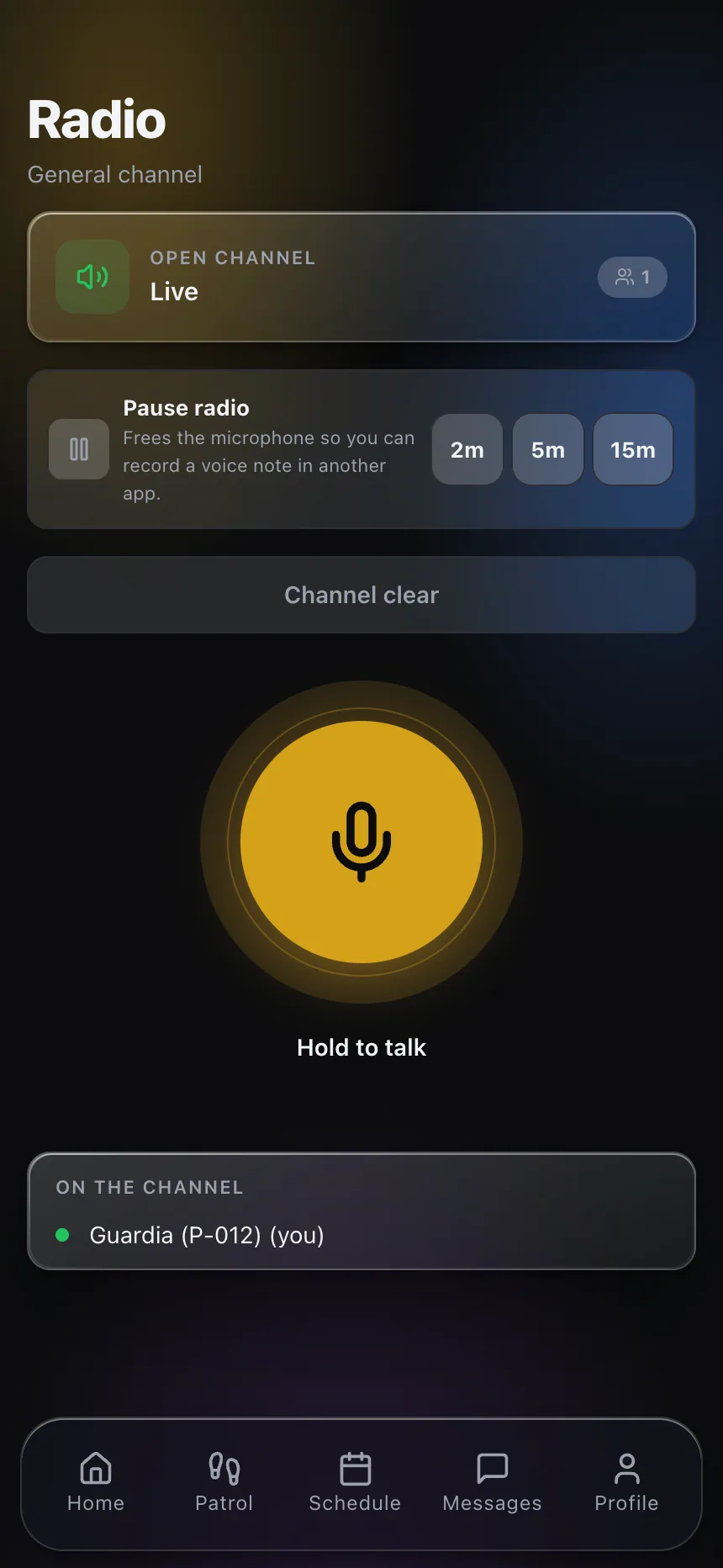
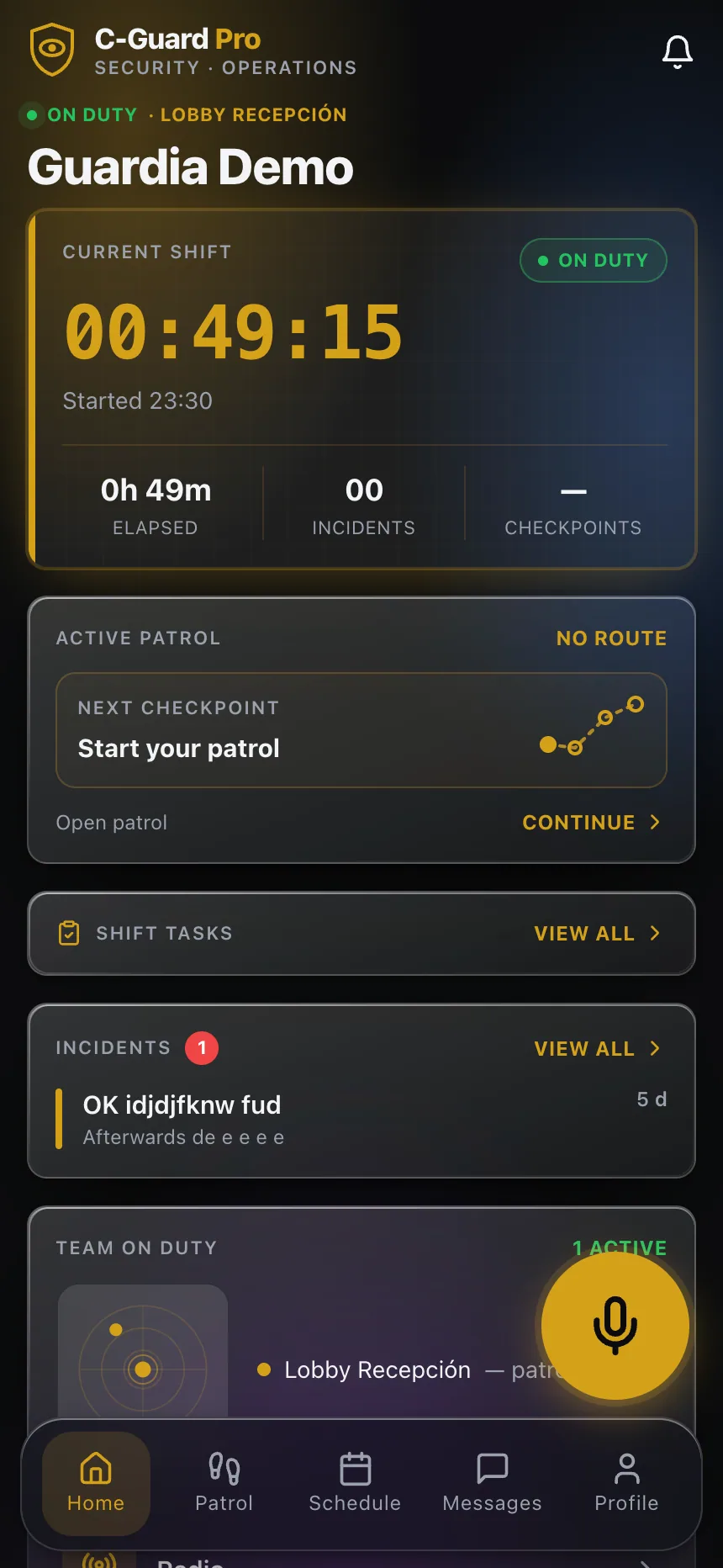
Where the channel runs through the officer’s phone rather than through leased hardware, some of this gets easier to manage. A push-to-talk system built into the app the officer already uses lets you put every officer on the right channel for the right account, add a new hire without issuing equipment, and keep a written record alongside the voice traffic rather than instead of it. The technology does not create discipline, but it removes the excuse that a post is too small to be on the channel.
Radio codes vs plain language: the test
Here is the question that settles it: if a police officer, a paramedic and your newest hire were all listening to your channel during a real emergency, would they know what to do?
Plain language passes that test by construction. Codes pass it only if everyone happened to learn the same list, which in contract security they did not.
If you want to see how live radio, alerts and written field records fit together in one operation, explore CGuardPro or get in touch.