Every security company has a radio channel. Very few have a dispatch communication protocol. The difference shows up the first night something real happens: a fire alarm at a distribution center, an officer who stops answering, a hostile subject in a lobby. On a channel with no protocol, six people key up at once, dispatch hears fragments, and the one transmission that mattered — the post number and the nature of the problem — gets stepped on. The channel becomes noise at exactly the moment it needs to be a tool.
A protocol is not a rulebook nobody reads. It is a small set of habits, drilled until they are automatic, that decide who talks, when, and in what order.
What a dispatch communication protocol actually has to do
Strip it down and a dispatch communication protocol serves four jobs, in this priority order:
- Know where everyone is. Dispatch should be able to say, without looking anything up, which posts are covered and who is on them.
- Get priority traffic through. When something is urgent, it must reach dispatch ahead of routine chatter, every time.
- Create a record. What was said, by whom, at what time — because it will be asked about later.
- Stay usable for hours. An incident is not a thirty-second burst. It is often a two-hour management problem on a shared channel.
Most protocols get written for job two and quietly fail at jobs one and four. That is why they collapse under load.
Plain language beats codes
There is a long-running argument in the trade about ten-codes. In a single-company operation with a stable roster, codes work fine. The moment you have a new hire, a fill-in officer from another branch, or a client contact listening on a lobby speaker, codes cost you. Worse, code sets are not standardized between agencies — the same number means different things in different counties, and if a police or fire unit ends up on your traffic, ambiguity is the last thing you want.
Plain language, spoken slowly, in a fixed order, is faster in practice than codes spoken by someone who half-remembers them. “Post 4, medical, conscious and breathing, main lobby, need EMS” is unambiguous to everyone who hears it, including a brand-new officer on day two.
Keep a very short code list if you must — a duress word, a status check, a code for “call me on the phone, do not say it on the air” — and let everything else be English.
Roll call: the five minutes that make the rest of the shift work
Roll call at the top of each shift is the single highest-value habit on the channel. It is not ceremony. It is dispatch building a mental map that it will need later.
A workable format: dispatch calls each post in a fixed sequence, always the same sequence. The officer answers with three things — post number, name, and status of the post. Status means anything already broken: a gate that will not close, a camera down, a stairwell door propped. Dispatch logs the exceptions.
Two rules make roll call worth doing. First, it happens at the same time every shift, so officers expect it. Second, a no-answer is escalated immediately, not “we’ll catch him later.” An officer who does not answer roll call is the first, cheapest signal you will ever get that something is wrong at a post.
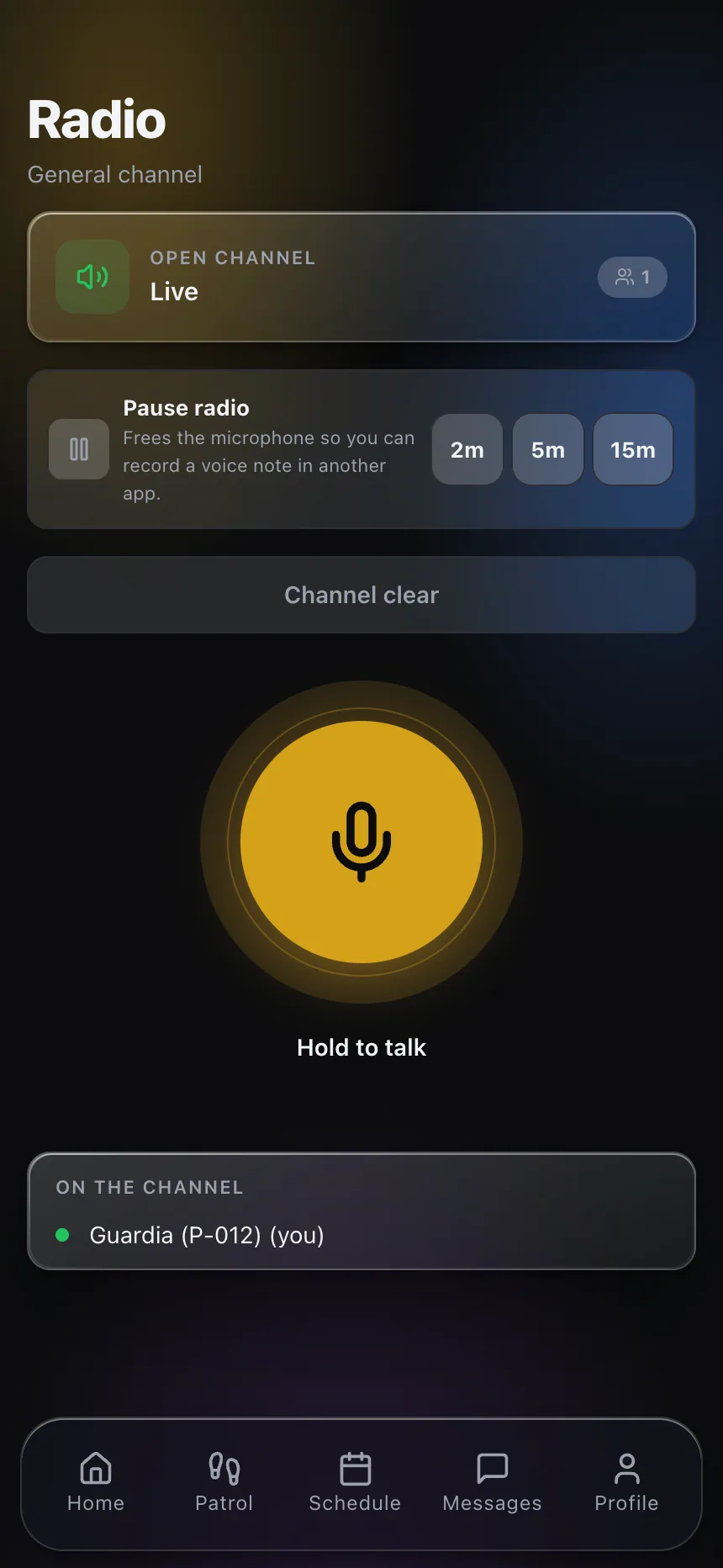
When the radio lives inside the officer’s phone rather than a separate handheld, roll call gets easier for a reason that has nothing to do with audio quality: dispatch can see who is actually connected to the channel before it starts calling names. A push-to-talk channel that runs through the guard app removes the “his battery died three hours ago and nobody knew” failure mode, because a device that is off the channel shows as off the channel.
Priority traffic and the discipline of shutting up
The hardest part of any protocol is not the emergency call. It is everyone else.
Adopt a single phrase that means “clear the channel.” It does not matter what it is — “emergency traffic,” “priority,” “break-break” — as long as every officer knows it and nobody uses it for anything else. When dispatch hears it, dispatch acknowledges and holds the channel for that unit. Everyone else waits.
That last clause is where protocols die. Officers who are not involved want to help, so they key up: offering to respond, asking what happened, confirming they heard. Each of those transmissions delays the information dispatch actually needs. Train it explicitly: if you are not the reporting officer and dispatch has not called you, you do not transmit. Supervisors have to model this hardest, because their instinct is to jump on the air and take charge.
Structure the emergency transmission
Give officers a fixed order to speak in, so they are not composing under stress:
- Who — post number first, always, before anything else
- What — nature, in three or four words
- Where — specific location within the site
- What you need — EMS, PD, supervisor, another officer, nothing
Post number first matters more than it sounds. If the transmission cuts out after two seconds, dispatch still knows where to send help.
The traffic that should never be on the channel
Names of victims. Medical details beyond what a responder needs. Anything about a client’s business. Anything an officer would not want read aloud in a deposition. Radio traffic is not private — clients monitor, phones record, and audio ends up in discovery. If it is sensitive, it goes to a phone call or into the written report, not on the air.
Radio is not the whole protocol
A radio channel is a real-time, low-detail medium. It is terrible at anything that needs to persist. So a protocol has to say which channel each kind of information travels on.
- Radio: anything time-critical and short. Status, dispatch, emergency traffic.
- Panic: anything where the officer cannot safely talk. A silent panic alert that pushes location to dispatch does something the radio cannot — it works when keying up would make things worse.
- Written report: anything that will be reviewed later. The daily activity report is where the narrative lives, with times, names and photos. Radio traffic is a pointer to a report, never a substitute for one.
- Phone: anything sensitive, long, or involving a client contact.
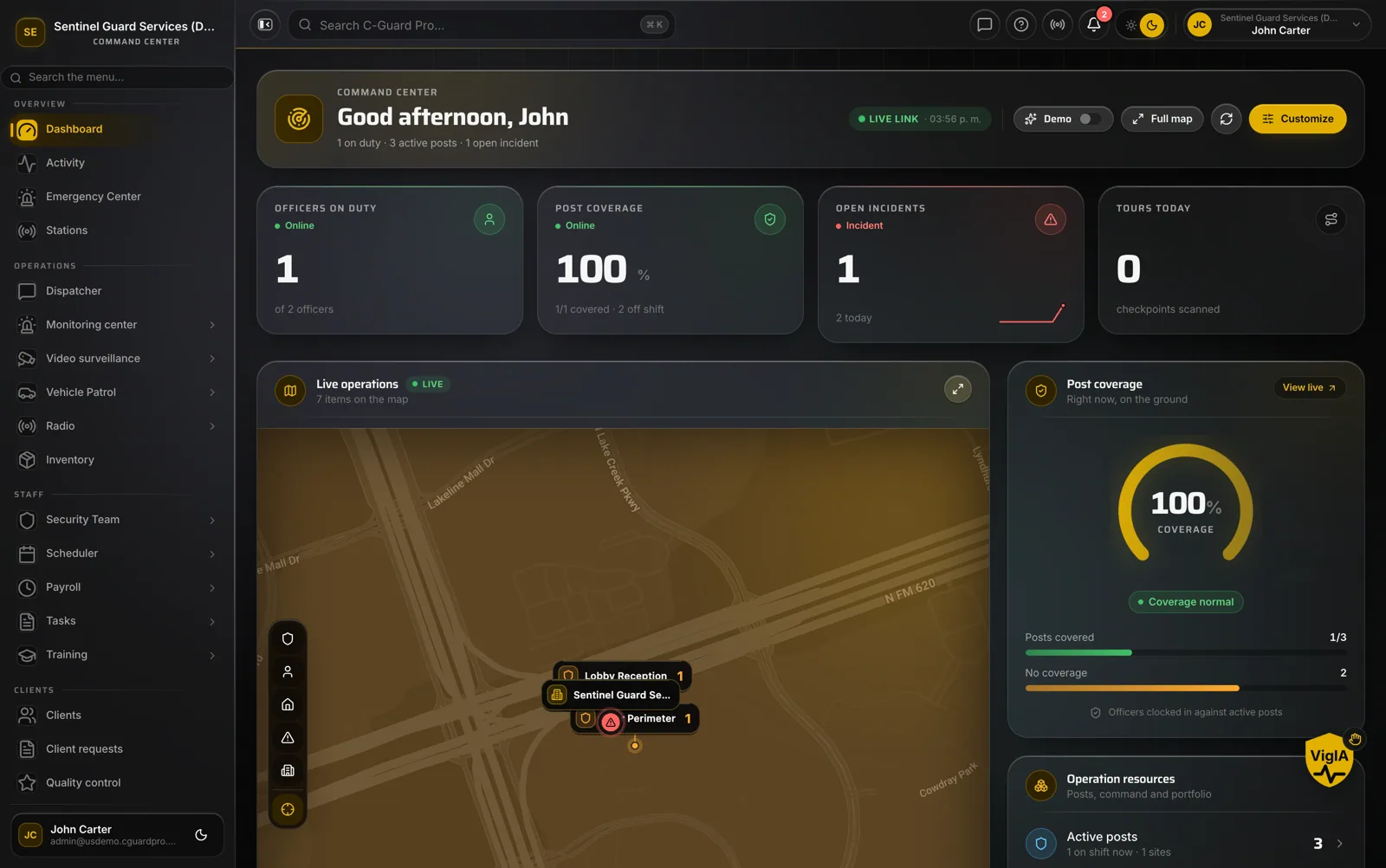
The reason this split matters is that dispatch has to hold all four at once during an incident. A dispatcher who can see officer positions on a map while talking on the channel is doing a fundamentally different job than one holding a handheld and a paper roster. Position awareness from GPS tracking answers the question dispatch asks most often — “who is closest?” — without a round of radio traffic to find out.
Keeping the protocol alive
Protocols decay. The way to stop it is to make small, boring parts of the protocol happen every shift, so the big parts are familiar when they are needed.
Drill the emergency transmission format monthly, on the air, on a quiet night. Dispatch calls a post, gives a scenario, and the officer transmits it in the four-part order. Two minutes.
Debrief real traffic. After any significant incident, pull the recording, listen to the first ninety seconds, and note one thing that would have made it clearer. Not blame — one improvement.
Update after turnover. A protocol that lives only in the heads of the three people who have been there five years is one resignation away from gone. Write it as a single page and attach it to the post orders at every site.
Watch for the slow slide back to chatter. Channels always drift toward conversation. A supervisor who says “channel discipline” once a week keeps it from getting to the point where someone has to shout over four people during a fire alarm.
The test
Here is the only test that matters. Pick a random officer, mid-shift, and ask: if you found an unresponsive person right now, what would you say on the radio, in what order, and what would you do if nobody answered you? If the answer comes back clean and fast, you have a protocol. If it comes back as “I’d call it in,” you have a channel.
If you want to see how radio, panic alerts, position and written reports work together in one dispatch view, explore CGuardPro or get in touch.