A supervisor pulls up to a client site at 2:40 in the morning. The officer is awake, the desk is tidy, the uniform is fine. Twenty minutes later the supervisor drives off having learned nothing, because the visit had no structure — just a look around and a chat. Two weeks later the same post has an incident, and it turns out the officer had no idea where the fire panel reset was, the flashlight had been dead for a month, and the emergency contact list on the desk was from a previous property manager.
A post inspection checklist exists to stop that. Not to add paperwork, but to make sure a twenty-minute visit reliably touches the handful of things that actually predict whether the post will hold up when something happens.
Below is a working checklist organized by category, with notes on what each item is really testing. Adapt it to your accounts — an armed post at a distribution center and an unarmed concierge desk need different specifics — but keep the five categories.
1. Appearance and bearing
The easiest category to check and the one most likely to be the only thing checked.
- Uniform complete, correct for the post and the season, clean and serviceable
- Company identification visible and current
- Grooming within the standard set in the employee handbook
- Footwear appropriate for a post that may require walking a property or standing for twelve hours
- No phone in hand while standing post, no earbuds, no personal reading material at a public-facing desk
- Officer is alert and demonstrably fit for duty
What this is really testing: whether the standard is being enforced when nobody is watching. A post where uniform standards have quietly relaxed is usually a post where several other standards have quietly relaxed too. Appearance is a leading indicator, which is why it is worth checking even though it is the least consequential item on its own.
One note on fitness for duty: a supervisor who suspects an officer is impaired needs a defined procedure to follow, and that procedure has legal and policy dimensions that vary by state and by employer. Work it out with counsel in advance rather than improvising at 3 a.m. Nothing here is legal advice.
2. Knowledge
The most diagnostic category and the one supervisors skip because quizzing an adult feels rude. Do it anyway, and frame it as a drill rather than a test.
Ask two or three questions drawn from the post orders, rotating them so they are not memorized:
- “Fire alarm goes into trouble at 3 a.m. Walk me through it.”
- “Someone is trapped in an elevator. Who do you call, in what order?”
- “A contractor shows up at the gate with no work order. What do you do?”
- “Medical emergency in the lobby. What is your first action, and what do you tell the 911 dispatcher about this address?”
- “Where is the nearest AED? Show me.”
- “You need to reach the on-call property manager right now. Where is that number?”
- “What is the escalation for a suspicious person on the property who has not committed a crime?”
What this is really testing: whether your post orders have been transmitted or merely handed over. Officers who cannot answer are almost never lazy — they were given a binder on day one and never walked through it. That is a training finding, not a discipline finding, and treating it as the latter guarantees the next officer will bluff instead of admitting the gap.
3. Equipment
Check function, not presence. Something existing on a shelf is not the same as it working.
- Radio: powered, on the correct channel, transmits and receives — actually key it
- Phone or duty device: charged, connected, the app loaded and logged in
- Flashlight: on, with usable battery, plus spares on site
- Keys and access credentials: complete against the key inventory, none missing, none unaccounted for
- Vehicle, where applicable: fuel, lights, tires, cleanliness, damage log current
- Personal protective equipment appropriate to the site
- First aid kit and AED: present, sealed, not expired
- Duty belt items complete and correctly worn, per the post’s armed or unarmed status
What this is really testing: whether equipment failures are being reported and repaired, or quietly absorbed by officers who assumed nobody would fix it. When you find a flashlight that has been dead for weeks, the finding is not “officer had a dead flashlight.” It is “we have no working process for an officer to get a flashlight replaced.”
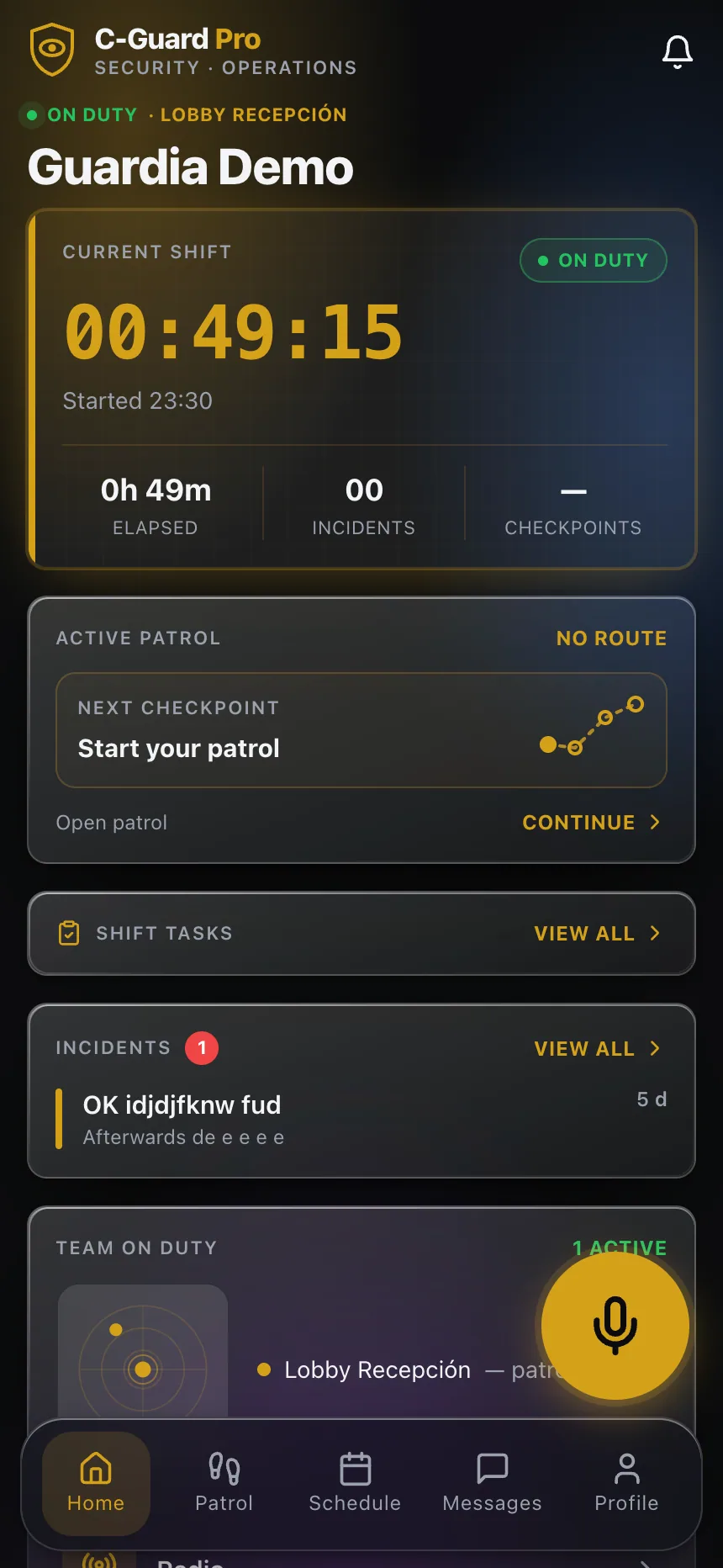
The duty device deserves particular attention. If the officer’s phone is dead, or the mobile app is logged out, then tours, reports, time records and the panic function are all offline for that shift, and nobody in the office knows it. Verify it on every visit.
4. Logs and documentation
- Daily activity report for the current shift is being written as the shift goes, not reconstructed at the end
- Recent DARs contain observations, not just “all clear”
- Visitor log, key log, vehicle log current and legible
- Tour scans completed on schedule for the last several shifts
- Any incident from the last visit has a written report on file
- Post order binder present, current revision, matches the physical site
- Emergency contact list current — call one number at random and see if it connects
- Pass-down from the previous shift is documented and was actually read
What this is really testing: whether the paper trail you would rely on in a claim actually exists. This is the category where digital tools change the answer most. Verifying “was the 3 a.m. tour walked” from a paper log means trusting a signature; verifying it from tour scan records means seeing timestamps and locations. The same is true of daily activity reports — a report filed from the post as events happen is a different evidentiary object from one written at the end of a shift from memory.
That random phone call to the emergency contact list is the single highest-value item in this section. Contact lists rot silently. Nobody discovers a disconnected number until the night they need it.
5. Site condition
- Exterior lighting: fixtures out, dark corners, timers functioning
- Doors and gates: latching, closing, not propped, hardware intact
- Fence line: cuts, gaps, damage, vegetation providing cover
- Cameras: present, aimed correctly, lenses clean, not obstructed
- Signage: trespass notices, parking rules, emergency information legible and posted
- Alarm and fire panels: no standing trouble conditions, clear access
- Housekeeping issues that create hazards or hiding places
- Anything the officer has reported previously that has not been fixed
What this is really testing: whether your service is producing value the client can see. Most items in this category are the property owner’s responsibility, and reporting them is a service — plus a documented record that you identified a condition, which matters if something later happens there.
The follow-up that makes it worth doing
An inspection with no closeout is a form-filling exercise. Three rules turn it into a program.
Every finding gets an owner and a date. Officer coaching goes to the supervisor. Equipment goes to whoever controls the equipment budget. Site conditions go to the client contact, in writing. Post order errors go to whoever maintains post orders.
The next inspection opens with the last one’s open items. This is the entire mechanism. Without it, the same broken light appears on twelve consecutive inspections and everyone learns that findings are decorative.
The officer sees the result. Same shift or next shift, in writing, including what was good. An inspection an officer never hears about again reads as surveillance.
Client-facing findings actually reach the client. Bundle site conditions into a short recurring summary. It converts your quality program from an internal cost into visible service.
Keep the checklist to one page. A three-page form guarantees a rushed visit and inflated checkmarks. Twenty minutes, five categories, real answers, and a closeout that produces change.
If you want to see how inspections, tour records and reports come together in one operation, explore CGuardPro or get in touch.