Turning on missed patrol alerts feels like progress. Within a week, dispatch is getting notifications every night, most of them for reasons nobody investigates, and within a month everyone has learned to swipe them away. You have not improved supervision. You have added noise and created a written record of alerts your company ignored — which is a worse position than never having enabled them.
An alert is not a control. The protocol behind it is the control.
What a missed tour actually means
Before designing a response, be precise about what triggered it, because the causes are wildly different in severity and they demand different actions.
Nothing is wrong. The officer is late because a tenant stopped them, an alarm sounded, or a truck needed to be signed in. The tour will complete, just outside the window.
The route is broken. A checkpoint was painted over, a door is locked at night, a tag was removed. The officer is doing the job; the system is measuring something that no longer exists.
The phone is the problem. Dead battery, no signal in a basement, an app that has not been opened since the last update. Common, unglamorous, and fixable.
The officer is not doing the tour. Sitting in the vehicle, sleeping, or gone. This is the case the alert exists for, and it is the least frequent.
The officer cannot do the tour. Medical event, assault, fall in a stairwell. Rarest of all, and the only one where minutes matter absolutely.
A protocol that treats all five identically will be tuned by your staff to the most common case — which is “nothing is wrong” — and will therefore fail in the case that matters.
Design the alert before you design the response
Most alert fatigue is a configuration failure, not a discipline failure.
Set the window to reality, not to the schedule. If the honest walk takes twenty-five minutes and the tour is scheduled hourly, a grace period measured in a few minutes will fire constantly. Time the route yourself, then set a window that a diligent officer clears comfortably and a disengaged one does not.
Alert on the tour, not on each point. A single missed checkpoint in an otherwise complete tour is a note for the supervisor’s review queue, not a page to dispatch. A tour that never started is a page.
Weight by site and by hour. A missed tour at a vacant construction site at 3 a.m. is not the same event as a missed tour at a staffed office lobby at 2 p.m. Sites with no other human present should escalate faster and further, because there is nobody else to notice that the officer has gone quiet.
Suppress the known-broken. If a checkpoint is confirmed unreachable, take it out of the route until it is fixed and log why. Leaving it in to “keep the record honest” produces a nightly false alert that trains everyone to disbelieve alerts.
The escalation ladder
Write this down, put it in the dispatch desk instructions, and make it identical across accounts unless a client contract says otherwise. Consistency is what makes it survive at 3 a.m. with a new dispatcher.
Step 1 — Automated nudge to the officer
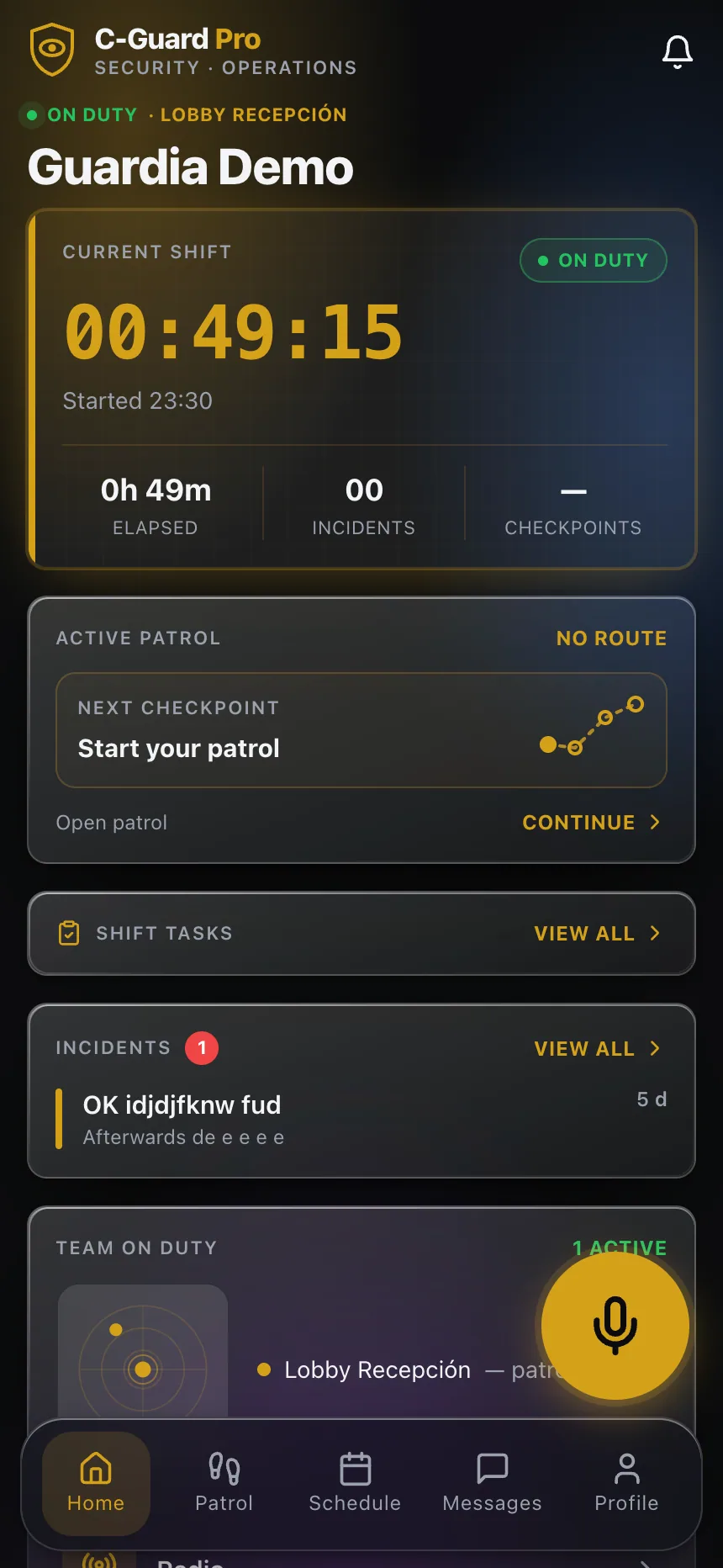
The first response should not consume a human. A notification to the officer’s phone — “tour due, not started” — resolves the majority of cases, because the majority of cases are an officer who lost track of time or is finishing something else. Give it a short, fixed interval before the next step. No judgment call, no dispatcher.
Step 2 — Voice contact from dispatch
If the tour still has not started, dispatch calls. Not a text. A voice contact is the first point where you learn something a system cannot tell you: whether the officer sounds fine, distracted, or in trouble. If your force uses push-to-talk radio, this is fast and does not depend on the officer having their phone in hand. Otherwise it is a phone call.
Dispatch logs the outcome in one of four ways: contacted and tour proceeding; contacted and route problem reported; contacted and officer requires relief; no contact.
Step 3 — No contact is a different event
The moment dispatch cannot reach an officer, this stops being a patrol compliance question and becomes a welfare question. Escalate immediately and treat it as such: attempt a second channel, check the officer’s last known position, and notify the field supervisor by phone rather than by message.
The reason to make this a hard rule is that dispatchers under load will otherwise keep trying the same channel for twenty minutes. Two failed contact attempts on separate channels should trigger the supervisor call automatically, with no discretion.
Step 4 — Field supervisor response
The supervisor decides whether to roll to the site. Two things make that decision better: knowing the officer’s last recorded position from GPS tracking, and knowing whether any panic or duress signal was raised. Absence of a panic signal is not evidence the officer is fine — an unconscious officer presses nothing — but combined with a stale position it sharpens the picture.
Step 5 — Client and emergency notification
Define in advance, per account, who at the client gets called and at what threshold. Most clients do not want a call because a tour ran late. Every client wants a call before they hear from a tenant that the guard shack has been empty for two hours. Put the threshold in the account file so the dispatcher does not have to guess.
What gets documented, and by whom
An alert that resolves without a record is an alert that never happened, and it is exactly the one you will be asked about six months later.
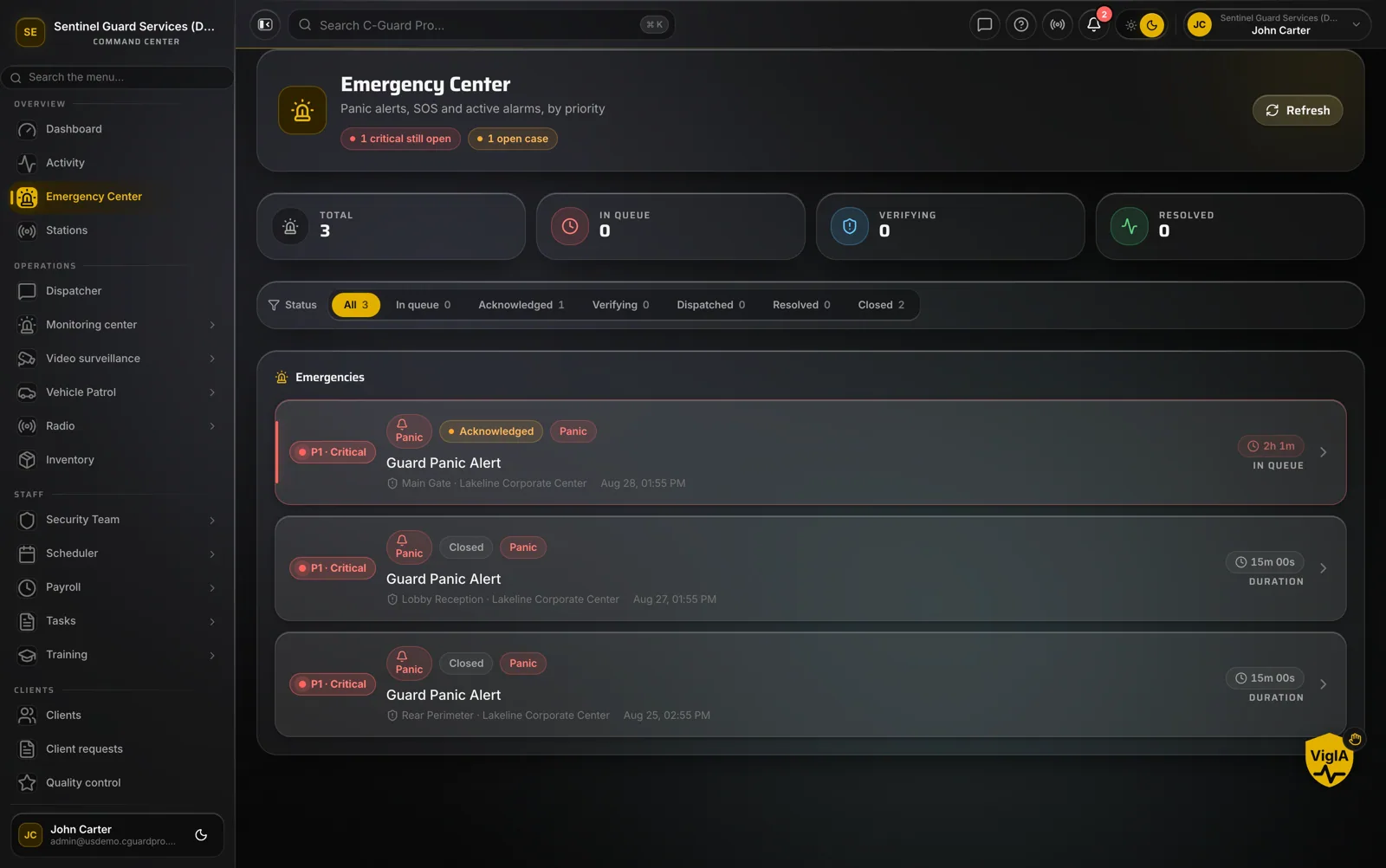
Every missed-tour alert should close with a documented disposition, written by whoever resolved it, containing: the time the alert fired, the contact attempts made and their outcome, the stated cause, the action taken, and whether the tour was subsequently completed. Two sentences is enough. The discipline is that the field is not optional.
Two additional records matter:
The officer’s own account. If the tour was missed for a legitimate operational reason — alarm response, medical assist, escorting a tenant — that belongs in the daily activity report in the officer’s words, filed the same shift. It is what turns a compliance exception into a documented service delivery.
The route defect. If the cause was a dead checkpoint or a locked area, it goes on a maintenance list with an owner and a date, not into a dispatcher’s memory. Unfixed route defects are the single largest source of recurring false alerts.
Reviewing the pattern, not just the events
Once a week, someone should look at missed-tour alerts in aggregate rather than one at a time. Three questions:
Which sites generate the most alerts, and why? A single site producing most of your alerts almost always has a route problem, a coverage problem, or a schedule that does not match reality.
Which alerts are being closed with no disposition? That is a supervision gap, and it is measurable.
How long from alert to first human contact? This is the number that tells you whether the protocol is real. If the median is measured in a handful of minutes, the ladder is working. If it is measured in tens of minutes, you have a notification system, not a response protocol.
The uncomfortable part
The point of missed patrol alerts is not to catch officers. If you frame it that way internally, your force will treat every alert as an accusation, disputes will multiply, and supervisors will stop escalating because the argument is not worth it.
Frame it the other way, and it holds up: nobody should be alone on a property with no one noticing that they have gone quiet. That framing makes the welfare escalation in step 3 the heart of the protocol rather than an afterthought — and, not incidentally, it produces exactly the accountability record the compliance framing was chasing.
If you want to see how tour exceptions, officer position and escalation records fit into one operations picture, explore CGuardPro or get in touch.