Two numbers describe every month of a guard contract. One is what you paid your officers. The other is what you invoiced the client. Everyone assumes the relationship between them is fixed, because that is how the account was bid. It is not fixed — it moves, every month, in small amounts, and the billable hours security companies invoice drift away from the hours they pay for reasons that never appear on a single report. By the time margin erosion shows up in the P&L, the shifts that caused it are four months old and unreconstructable.
Bill hours and pay hours are different animals
Start with the distinction, because a surprising number of operations run as if there is only one number.
Pay hours are what the officer worked, as recorded by the clock. They include hold-overs, training time where applicable, and any premium multiplier your obligations require.
Bill hours are what the contract entitles you to invoice. They are governed by the coverage schedule you sold — this post, these hours, these days — plus whatever the contract says about extras, minimums and holidays.
These two are related but not equal, and the terms that separate them are exactly the terms that get glossed over during a fast contract negotiation.
The terms that decide the gap
Minimum call-out hours. If a client requests a two-hour special event post, do you bill two hours or a stated minimum? If the contract is silent, you bill two and you pay your officer whatever your own minimum shift practice requires. That difference is a loss on every short assignment.
Holiday and premium billing. Does the bill rate change on holidays, and which holidays? If your pay obligations rise on a date and the bill rate does not, you are covering the difference. This has to be written into the contract, with the list of dates named.
Overtime pass-through. When a client requests coverage that forces premium hours — an extra post at short notice, an extension past shift end — does the contract allow you to bill at a different rate? Many contracts do not address it, which means the answer defaults to no.
Supervisor and dispatch time. Usually built into the bill rate as overhead rather than billed separately. Fine — as long as the rate was built assuming a normal amount, and not assuming a supervisor stands a post twice a week.
Training and orientation. Site-specific training required by the client is real cost. Whether the client pays for it, and at what rate, belongs in the contract.
Rounding and shift boundaries. If you bill in whole hours and pay in minutes, or the reverse, the mismatch accumulates quietly across hundreds of shifts.
The billable hours security companies never invoice
Here is the part that costs the most, and it has nothing to do with contract terms. It is coverage that happened and was never captured.
The pattern is always the same. Something happens outside normal process, it gets handled on the phone, and the paperwork never catches up:
- An officer holds over ninety minutes waiting for late relief. He gets paid for it because the clock caught it. Nobody bills it, because the client never got a request.
- A client calls Thursday afternoon and asks for an extra body Saturday for a vendor delivery. A supervisor says yes. There is no written order, no rate confirmation, and by Monday the only record is a text message.
- A shift gets split between two officers at 2 a.m. during a callout. Both are paid. The billing system sees one shift.
- A supervisor stands a post for three hours. That is coverage the client received. Whether it appears on an invoice depends on whether the supervisor thought to log it.
Every one of these is money the client would probably have paid without complaint. It is not lost to disputes — it is lost to never being asked for.
The fix is structural, not disciplinary. If the fill is entered in the schedule at the moment it is arranged, it is simultaneously a pay record and a bill record. If it is arranged verbally and entered later, it is neither, because “later” competes with the next emergency and loses.
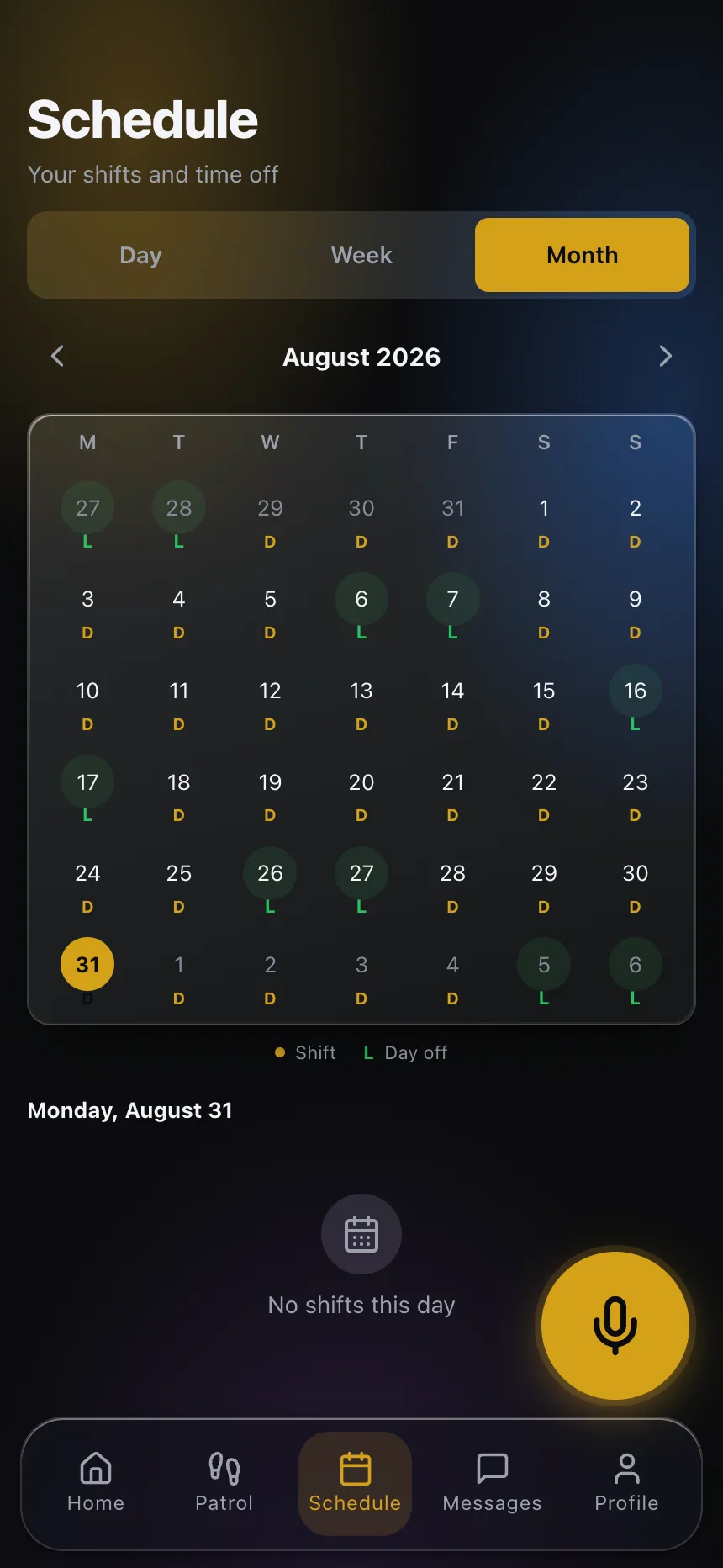
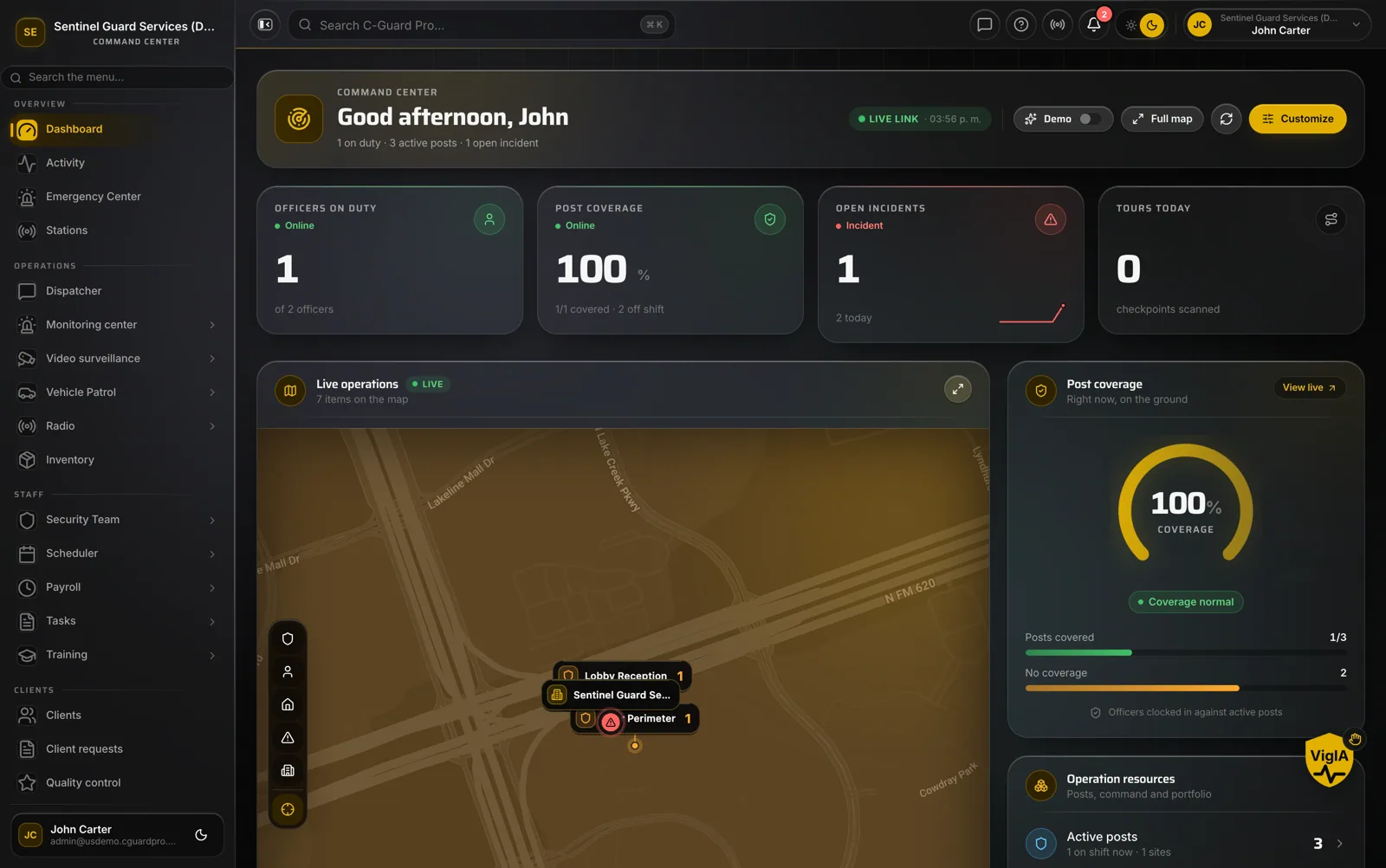
Running scheduling and attendance as one system rather than two is what makes this work: the assignment creates the expectation, the clock records the delivery, and both sides of the invoice come off the same set of shifts. That is the practical case for guard scheduling software over a spreadsheet — not the calendar view, the fact that nothing gets covered without existing somewhere.
The monthly reconciliation
Do this before you invoice, not after the client questions something.
Step 1 — Scheduled versus worked. Every scheduled shift should have a matching clock-in and clock-out or a documented reason it does not. Unfilled shifts are a coverage credit you may owe. Extra shifts are revenue you may be about to miss.
Step 2 — Worked versus billable. Apply the contract terms to the worked hours. Hold-overs, splits, extras, minimums, holiday rates. This is where you find the coverage that was delivered but never authorized in writing.
Step 3 — Billable versus billed. Compare against what the invoice actually says. Differences here are usually mechanical: a manual export missed a week, a new post was added but never added to the billing template.
Step 4 — Explain every variance. Not fix — explain. A variance you can explain is either a legitimate adjustment or a process gap you now know about. A variance you cannot explain means your records are not good enough to defend the invoice if anyone asks.
Do this per account, monthly. It is the difference between knowing your margin and hoping.
Give the client the evidence before they ask for it
Coverage disputes are rarely about money. They are about a property manager who cannot see what they bought and starts to wonder. The strongest position is one where the client has continuous visibility — the shifts covered, the tour rounds completed, the reports filed — so that the invoice confirms something they already believe rather than asserting something they have to take on faith.
A client portal that shows attendance and activity as it happens changes the tone of the billing conversation entirely. It also protects you in the other direction: when a client claims a post was empty, the record settles it in minutes rather than turning into a week of emails.
Fix the contract, not just the spreadsheet
Most billing leakage traces back to a contract that was silent on a situation the operation encounters weekly. When you renew, get these on paper: minimum billable increments, the named holiday list and the applicable rate, how client-requested short-notice coverage is authorized and priced, who on the client side can request extra coverage, and how hold-overs caused by access or relief issues are handled.
Contract terms, wage and hour obligations and any prevailing wage or state-specific requirements affecting security services vary by jurisdiction and change over time. Have counsel review your terms before you rely on them. This article is operational guidance, not legal advice.
The margin on a guard contract is thin enough that a few unbilled hours a week per account is a real number. You do not recover it with a rate increase — you recover it by making sure that everything you deliver is something you can prove and something you can bill. If you want to see how coverage records, attendance and client visibility come off one set of shifts, explore CGuardPro or get in touch.