The officer file is the most boring artifact in a security company and the first thing anyone reaches for when something goes wrong. A client asks who was on their site last Thursday and whether that person was properly registered. A regulator opens an audit. A plaintiff’s attorney sends a document request after an incident. In every one of those moments, security guard hiring paperwork stops being administrative overhead and becomes the entire defense — or the entire problem.
This is general orientation, not legal advice. Hiring and registration requirements for security officers vary by state and by role, and they change. What must be verified, what must be reported to the regulator, what background screening is required for armed versus unarmed work, what training must be completed before an officer stands a post, and how long records must be kept are all jurisdiction-specific. In Texas, the Texas Department of Licensing and Regulation (TDLR) is the regulator to verify with. Elsewhere it may be a state police agency, a private security board, or a city licensing office layered on top of the state. Confirm every specific with your regulator and with employment counsel before relying on it.
The file has to exist before you need it
The single most common failure is not a missing form. It is a file assembled retroactively. Somebody hires an officer on a Friday to fill a Monday post, the paperwork gets started and never finished, and eight months later nobody can find the signed acknowledgment of the drug policy — or worse, nobody can prove the officer was registered on the date of the incident.
Retroactive files have a particular smell. Dates cluster suspiciously. Signatures appear on documents the officer says they never saw. Photocopies of credentials are undated. An auditor or opposing counsel will notice, and the gap will be treated as evidence of a broader pattern rather than as a clerical miss.
The discipline that fixes this is unglamorous: nothing goes on post until the file is complete, and the file is complete when a checklist says it is, not when someone feels it is. If the operational pressure to fill a post is strong enough to break that rule, the rule is the problem you should be solving, not the file.
The four layers of the officer file
It helps to stop thinking of hiring paperwork as one pile and start thinking of it as four layers with different owners and different clocks.
Layer one: employment eligibility and tax
Every US employer has employment eligibility verification and tax withholding obligations. The specific forms, the timing of completion, the acceptable documents and the retention period are set by federal rules and administered with real consequences for sloppiness. Do not improvise here and do not rely on a template you found online — verify the current requirements and the current forms directly with the issuing agency, because both are revised periodically.
The security-specific wrinkle is volume and turnover. A guard company hires in bursts, often through supervisors rather than an HR department, and often for a start date that is uncomfortably close. That is exactly the environment where eligibility verification gets done late or done wrong. Centralize it. One person or one process owns it, regardless of who did the interview.
Layer two: state licensing and registration
This is the layer unique to our industry. Depending on the state, an individual officer may need to be registered or licensed before working, may need a separate endorsement to work armed, may need fingerprinting and a criminal history check processed through the state, and may need a specific training course completed before or shortly after being placed. Some states require the employer to notify the regulator when an officer is hired and again when they separate.
Two practical points. First, the state credential belongs to the officer, but the reporting obligation frequently belongs to you — which means an officer who quits without telling anyone can leave you with an unmet obligation. Second, application processing takes as long as it takes. Build the lead time into your hiring pipeline instead of pretending it does not exist, and never let “the application is submitted” be treated as equivalent to “the credential is issued.”
Layer three: qualification and training records
Beyond the state minimum, you have your own qualification record: orientation, use-of-force policy acknowledgment, report writing, first aid and CPR where applicable, defensive driving for officers running vehicle patrol, and any client-mandated training. Armed posts add firearms qualification and requalification with a documented date and result.
The reason this layer matters legally is negligent hiring and negligent retention exposure. If something goes badly at a post, the question is not only whether the officer was licensed but whether you trained and supervised them for the work you assigned. A training record with dates, content and a signature is a much better answer than a manager’s recollection.
Layer four: acknowledgments and policy
Handbook receipt, post orders acknowledgment, drug and alcohol policy, harassment policy, confidentiality and client information handling, uniform and equipment issue with a signed inventory, and consent forms for any monitoring you conduct — including GPS on duty and dashcam in patrol vehicles.
These are the documents nobody thinks about until they are needed, at which point they are needed badly. An officer terminated for a policy violation who never signed the policy is a much harder termination to defend.
The credential is not a one-time event
Hiring paperwork is often built as a one-time intake process, and that is the design flaw. Almost everything in layers two and three expires. The intake file is a snapshot; the compliance question is always about a specific date. “Was this officer properly registered on the night of the incident?” is not answered by a document collected at hire.
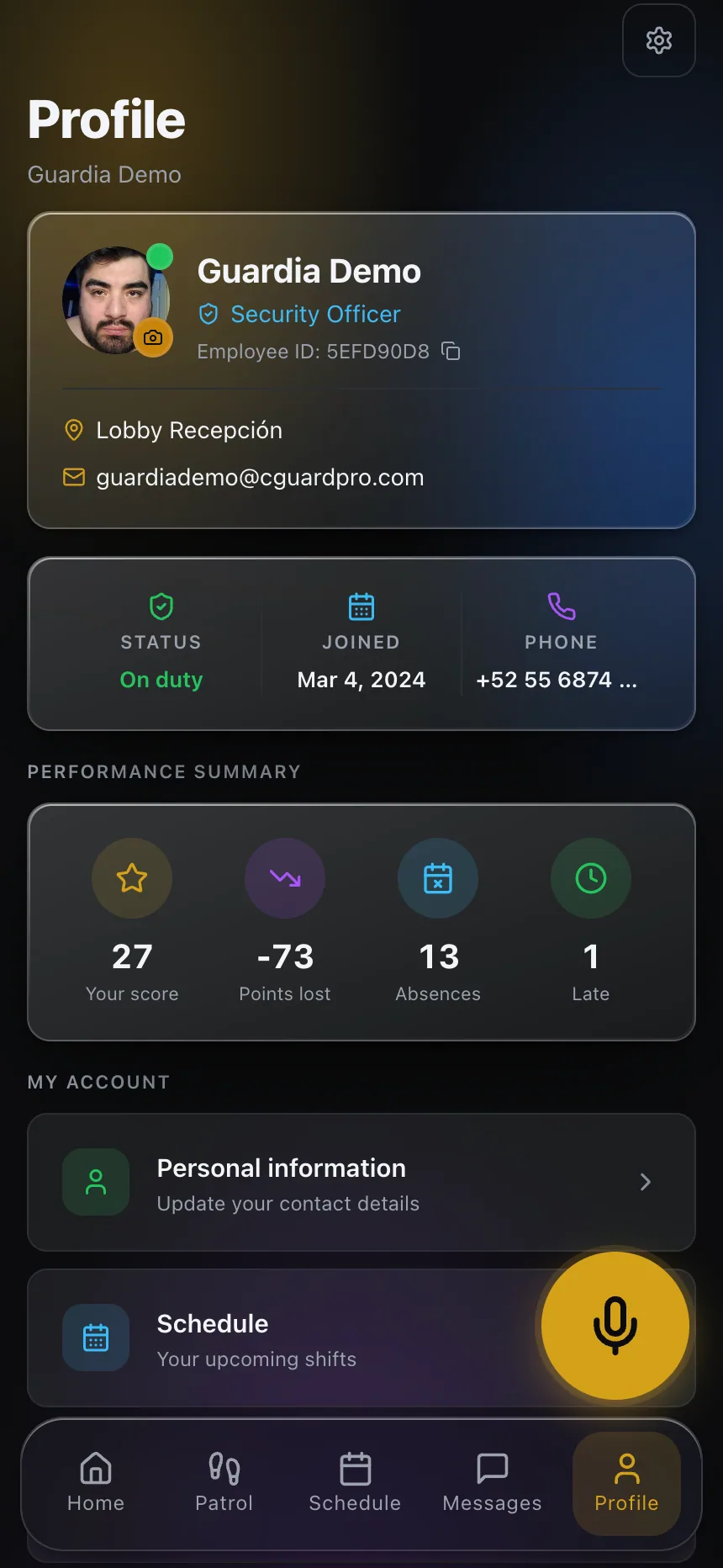
That means the officer record has to be living. Credential numbers with issue and expiry dates, training completions with dates, requalification history, and a clear status that says whether this person is currently eligible to work — and eligible to work armed, if that is a separate question at your company.
The reason to keep this inside the same system that runs your operation, rather than in a filing cabinet or a shared drive, is the callout. At nine at night, a supervisor filling an open post is not going to walk to a cabinet. If eligibility is visible in the same place the schedule is built, the check happens automatically. If it is not, it happens by memory, which is to say it does not happen.
Onboarding that ends at the app, not at the folder
There is a practical benefit to finishing hiring paperwork properly that has nothing to do with audits: the officer’s first day goes better. Their account works, their assignment is visible, their post orders are on their phone, and they can clock in without a phone call to a supervisor.
The last step of onboarding should be that the officer downloads the mobile app, signs in successfully, and sees their first assigned shift. That single test catches most of what intake missed — wrong email, wrong phone number, no assignment, missing site access. Better to catch it in the office than at the gate at 0600.
From there, the record feeds everything else. Scheduling reads eligibility. Time and attendance proves who was actually on post and when, which is the other half of the answer to any question an auditor or a client asks about a specific date.
A short standard to hold yourself to
Pick a random officer once a month and audit their file against your own checklist. Every item present, every date current, every acknowledgment signed, and the credential status matching what the state actually shows. If it passes, your process works under load. If it does not, you found the gap on your own terms rather than someone else’s.
Hiring paperwork is the cheapest insurance a guard company buys. It costs an hour per officer and it is the only thing standing between a bad night and a much worse year.
If you want to see how officer records, eligibility and scheduling connect in one operation, explore CGuardPro or get in touch.