The test of a visitor management program is not what happens on a Tuesday morning when a scheduled vendor arrives. It is what happens on Thursday afternoon when a tenant’s HR director calls the front desk and asks who visited the fourteenth floor between 3 and 5 p.m. on a specific date last month, and needs the answer today. Visitor management security is judged almost entirely on retrieval. Everything you do at the desk — the screening, the badge, the escort — is only as valuable as your ability to reconstruct it later for someone who is not asking casually.
What the visitor log is actually for
Front desk officers are trained to think of the visitor log as a control: it stops unauthorized people from getting upstairs. That is part of it, and it is the smaller part.
The log is primarily an investigative and evidentiary record. The situations where it earns its keep are not the ones where an officer turns someone away. They are these:
- Something was stolen from a suite and the tenant wants the list of everyone admitted that day.
- An employee reports being followed or harassed by a person who came to the building.
- A restraining order names someone and the tenant needs to know whether that person has been in the lobby.
- A fire alarm sounds and the incident commander asks how many non-employees are in the building.
- A lawsuit or an insurance claim requires establishing who had access to a floor on a particular date, months after the fact.
- A corporate security audit reviews the vendor’s controls and asks for a sample.
Every one of those is a retrieval problem. A paper logbook satisfies none of them well. It cannot be searched, it cannot be filtered by floor or by tenant, it is legible only if the visitor wrote clearly, and its worst feature is rarely discussed: an open paper log displays the names, companies and destinations of every prior visitor to whoever signs next. That is a privacy exposure your client may not have considered, and it is one of the more persuasive arguments for changing the process.
Screening: decide the rules before the person is standing there
The failure mode at a front desk is not rudeness or laziness. It is ambiguity. An officer facing a confident visitor with an unclear situation and no written rule will default to letting them through, because the social cost of refusing is immediate and the cost of admitting is deferred and invisible.
So the post orders have to answer the awkward cases specifically:
Who authorizes entry? Pre-registration by the host is the cleanest model — the host enters the visitor in advance and the desk verifies against the list. Where pre-registration is not universal, the desk calls up. Define who may be called, what happens when there is no answer, and whether a receptionist may authorize on the host’s behalf.
What identification is required, and what is recorded? Requirements differ enormously by property type and tenant. What you may record, photograph or retain about a visitor’s identification is subject to privacy and data-handling rules that vary by state and are actively evolving, and the tenant may have their own policy on top. This post is not legal advice — confirm with counsel and with the client what may be captured and how long it may be kept, and write that answer into the post orders rather than leaving it to each officer.
Deliveries and couriers. These are the highest-volume, lowest-scrutiny entries in most lobbies, and they are how people get upstairs. Decide whether couriers go past the desk at all, and if not, where packages are staged.
Contractors and after-hours access. Different standard, different escort rule, usually a different authorization chain. A contractor arriving at 9 p.m. with a work order is exactly the scenario where an officer alone will guess wrong.
Denied entry. The officer needs a script and a fallback. What to say, whom to call, and when to log it as an incident rather than a visitor record. Anyone refused entry should generate a record — the refusals are often the entries that matter most later.
The visitor who will not stop
Every front desk has this person: the one who walks past, badge in hand, on the phone, without breaking stride. Officers hesitate because stopping them feels like an accusation of a person who is very likely legitimate.
The answer is not to make officers more aggressive. It is to make the challenge routine and scripted, so it is not a confrontation. A standard greeting used with everyone, every time, converts the challenge from a judgment about that individual into a procedure the officer applies universally. Officers who apply it universally get far less pushback than officers who apply it selectively, because selective enforcement is what people actually resent.
Badging: temporary credentials that mean something
A visitor badge that any officer can hand out, that has no expiration and no destination on it, is decoration. Worse, it is decoration that grants social permission — a person wearing any badge reads as authorized to everyone upstairs.
Practical badge design principles:
- Time-limited and visibly so. Self-expiring badges that change color after a set period solve the reuse problem physically, without anyone having to check.
- Destination on the badge. Floor or tenant name, so anyone upstairs can tell whether the visitor is where they are supposed to be.
- Escort requirement stated on the badge, when one applies. A badge that says ESCORT REQUIRED lets employees enforce the rule for you.
- Return at exit is logged. Unreturned badges get recorded as such and the count reconciled each shift, the same way keys are.
Escorts are the control most often written into policy and least often executed. If a badge says escort required, someone must actually meet the visitor. Define who — the host, or an officer — and account for the case where the host does not come down. An escort policy with no answer for “the host is in a meeting” is a policy that will be waived every time.
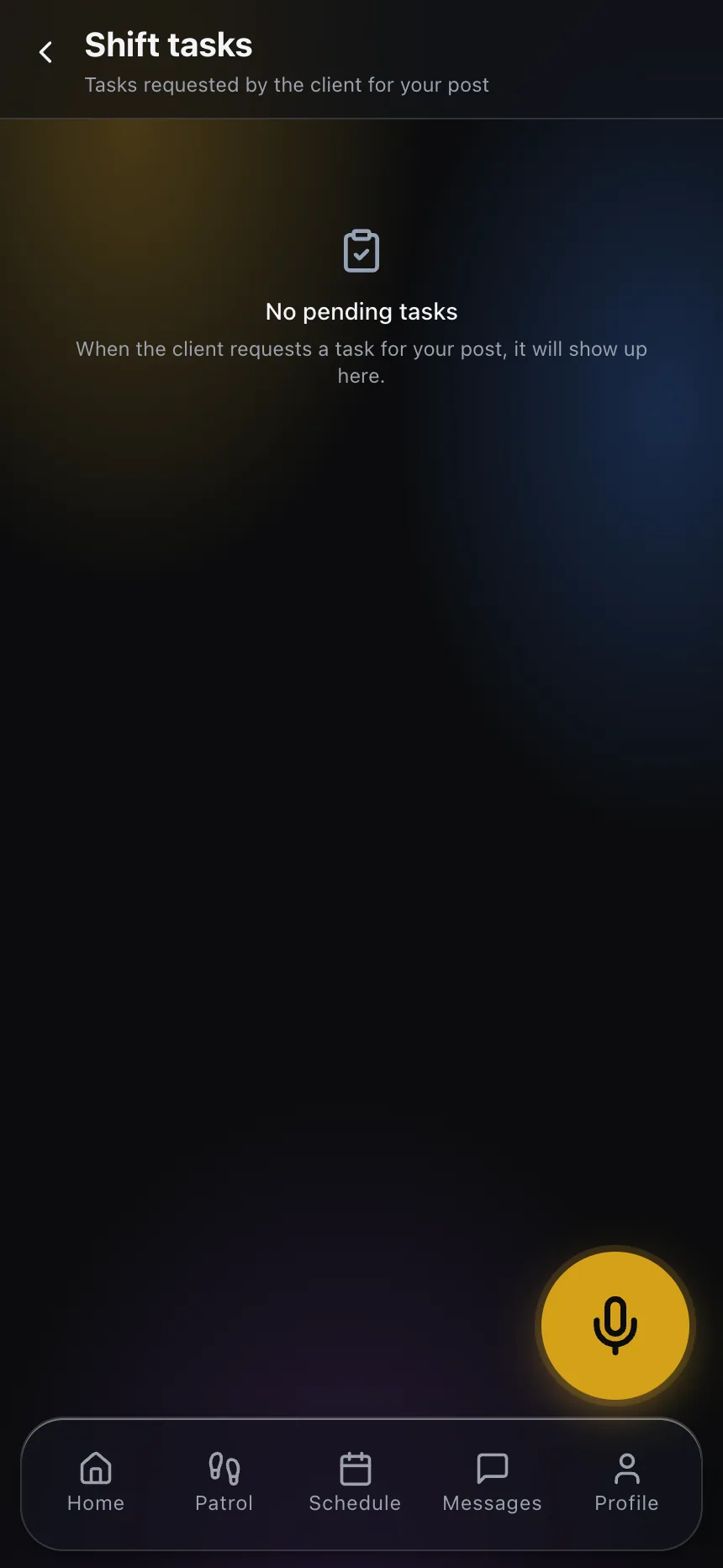
Escorts, badge audits, unreturned-badge reconciliation and lobby checks are all recurring shift tasks. Putting them on the officer’s task list with a required confirmation is how they survive the transition from a nicely written post order to something that happens on a slow Sunday when the regular officer is out and a relief officer is at the desk. The relief officer does not know the unwritten routine; the task list is the routine.
The log that answers questions
Design the visitor record around the questions you will be asked, not around what is easy to write down.
At minimum, each entry should carry: arrival time, name, company, host and destination (floor, suite or tenant), badge number issued, departure time, and the officer who processed the entry. Add a photo where the client permits it and the property type warrants it.
Then make it searchable by the dimensions people actually ask about — date range, tenant, floor, visitor name, host name — and exportable, because a tenant’s HR or legal department will want a document, not a screen.
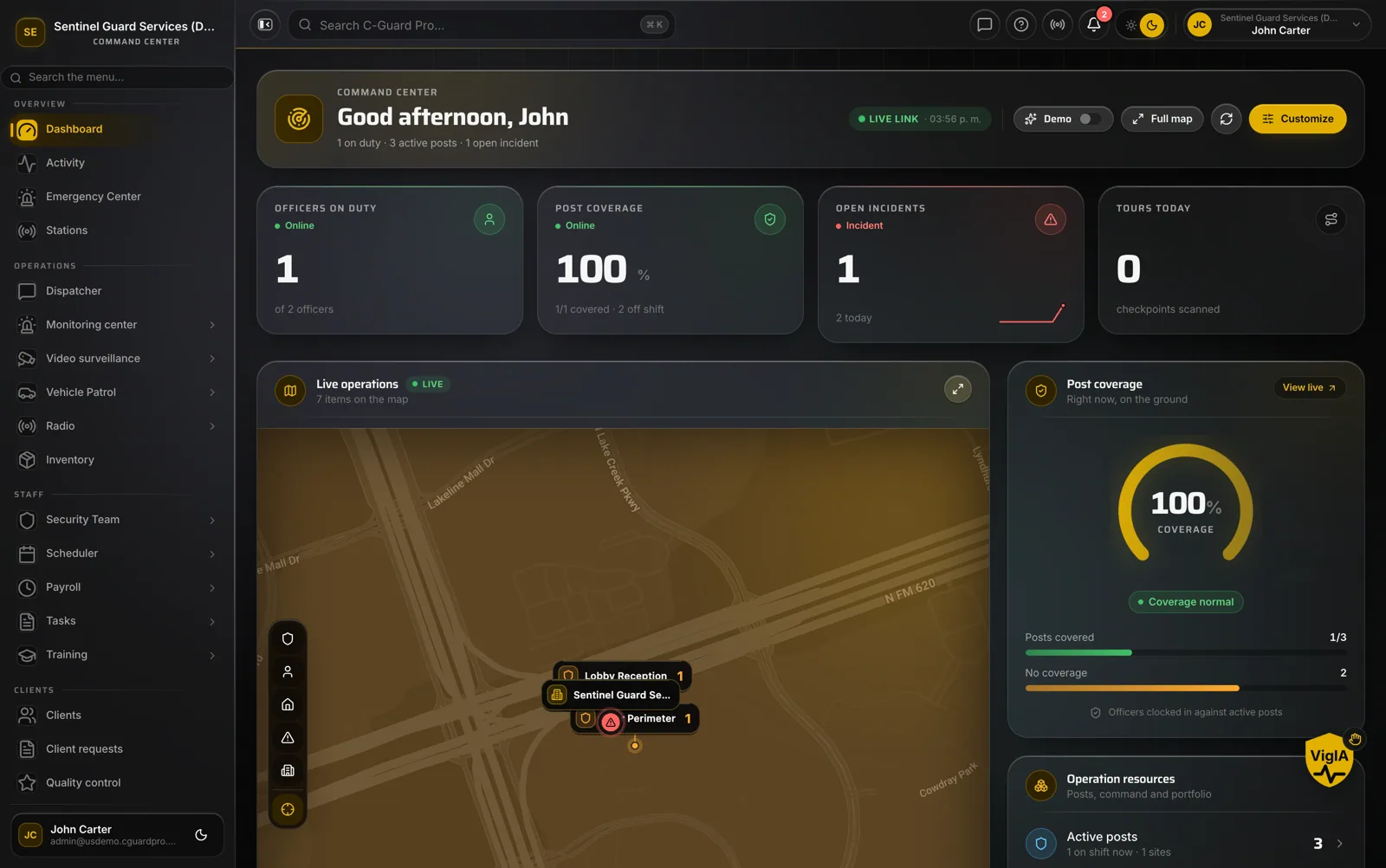
Two things separate a useful digital log from a paper one that has merely been retyped.
Departures are captured. Most logs record arrivals faithfully and departures haphazardly, which makes the fire-alarm question unanswerable and leaves everyone technically still in the building. Tie the departure to badge return and reconcile at shift change, so open entries are closed or explained rather than accumulating forever.
Anomalies surface without anyone hunting. A visitor still in the building at midnight. A name that has appeared repeatedly across different tenants. A badge issued and never returned three times this week. These are exactly the patterns a person reading a logbook will never notice and a supervisor reviewing a searchable record will catch in a minute.
Where it ties into the rest of the operation
A front desk does not exist in isolation, and the visitor log stops being an island when it shares a record with the rest of the post’s activity. A denied entry is a visitor record and an incident. An unreturned badge is a visitor record and an equipment issue. A suspicious visitor who leaves and returns twice is a visitor record and a BOLO worth passing to the next shift.
Keeping the desk’s work in the same stream as the officer’s daily activity report means the shift handoff carries the context, and the supervisor reviewing the account sees the lobby and the patrol as one operation rather than two.
The client should see it too. A property manager who can open a client portal and pull last month’s visitor activity for their tenant without calling your account manager is a client who experiences your service as infrastructure rather than as a cost. It also removes the most common source of friction in this service line — the tenant request that arrives on a Friday afternoon and requires someone to drive to a building and photograph pages of a logbook.
Start by fixing retrieval. Even if screening and badging stay exactly as they are today, making the log searchable and making departures reliable will answer nine out of ten of the questions you actually get asked. The rest of the program is easier to sell once the client has experienced getting a real answer in five minutes.
If you want to see how front desk records, tasks and reporting fit together in one operation, explore CGuardPro or get in touch.