A prospect calls and says a competitor pitched them “virtual guarding” and asked whether you can do the same thing for less. The honest answer is that the question of remote guarding vs on-site officers has no universal winner, and any vendor who tells you otherwise is selling rather than advising. Some sites are nearly perfect for camera-based monitoring with talk-down. Some sites will bleed a client badly if the human post goes away. The skill is knowing which is which before you sign a contract you have to live with for a year.
What remote guarding actually is
Strip away the marketing and remote guarding is a monitoring center watching video feeds from a client site, usually with analytics that flag motion in defined zones during defined hours, an operator who verifies the alert, a speaker for live talk-down, and a documented escalation path to law enforcement or a mobile patrol unit. The good implementations are engineered: camera placement chosen for detection rather than pretty views, lighting corrected, zones drawn tightly, escalation rules written down, and a real operator on the other end who has been trained to talk to a trespasser.
The weak implementations are a handful of existing cameras pointed at a parking lot, an analytic that fires on rain and cats, and an operator queue deep enough that the verification happens four minutes after the event. That version of remote guarding is not cheaper security. It is a slower version of a burglar alarm.
What an on-site officer actually is
The parallel honesty is required in the other direction. An on-site officer is not simply a pair of eyes. A post buys you presence, deterrence that works on people who never trigger a camera, the ability to physically intervene in a way no speaker can, a person who unlocks a door for a stranded employee, escorts at shift change, keeps a log, and notices the smell of an electrical fault or the drip in the mechanical room that no analytic is watching for.
A post also buys you a liability profile. A human on site can make a mistake a camera cannot make. Officers are subject to licensing and training requirements that vary by state and jurisdiction, and any comparison a client makes on price alone ignores what compliance actually costs to do properly. Nothing here is legal advice; verify licensing, training and insurance obligations with your state regulator (TDLR in Texas) and your own counsel before you commit to a staffing model in a proposal.
Remote guarding vs on-site: where remote genuinely works
Look for sites that share a specific shape.
Bounded perimeter, defined hours. A fenced equipment yard, a car dealership after close, a construction site with a single gate, a self-storage facility overnight. The area is enumerable, access points are few, and after a known hour anyone inside is unauthorized by definition. That last clause is what makes analytics viable, because the operator does not need to judge intent.
Low expected on-site service demand. Nobody needs a badge issued, a truck escorted, or a door opened at 2 a.m. If the client’s real need includes any of that, remote does not cover it and the conversation should say so.
Deterrence value from voice. Talk-down works on opportunists. A live voice naming the color of someone’s jacket ends a large share of trespass events without anyone dispatching, and that is a real capability, not a slogan.
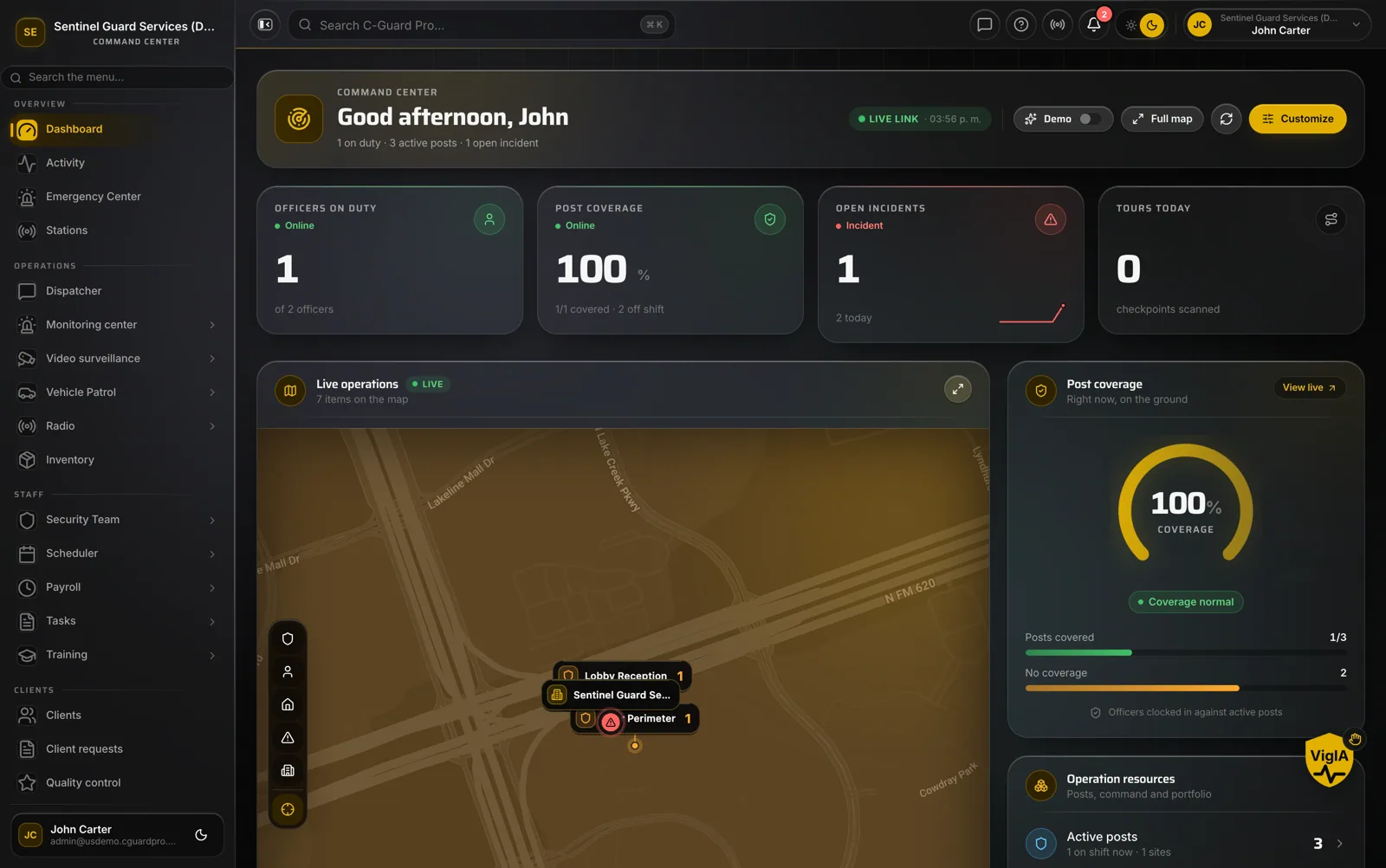
A working response layer. Remote guarding without a dispatchable unit is theater. If law enforcement response is uncertain in that area, the model needs a mobile patrol unit that can be at the gate on a defined commitment, and you need the tools to know where that unit is and to time-stamp the run.
Where remote fails and you should say so
Interior complexity. Multi-tenant office buildings, hospitals, campuses. Too many legitimate people, too many reasons to be there. Analytics cannot separate the visitor from the intruder and an operator watching thirty feeds cannot either.
Sites where the deterrent must be visible and continuous. Retail, lobbies, anywhere the client’s own staff need to feel covered. The comfort a uniform provides is not measurable, but it is why the contract exists.
Anywhere the value is service rather than detection. If half the post orders describe access, escorts, keys, packages and customer contact, a camera does not do that work.
Bad infrastructure. No reliable power or connectivity, no lighting, camera positions that cannot be changed. Remote guarding inherits every weakness of the site’s physical layer. Selling it into a site that cannot support it damages your reputation faster than losing the bid would have.
The hybrid most sites converge on
In practice the models blend. The pattern that holds up is a human presence during the hours where service and visibility matter, and camera-based monitoring with talk-down and a patrol response during the hours where the site is closed and access is by definition unauthorized. A dedicated officer covers the shift change window and the delivery window; overnight, the monitoring center covers detection and a mobile unit covers response.
That hybrid is also the easier sale, because it does not ask a client to give up something they can feel. It reallocates the hours nobody was getting value from into technology that is genuinely good at watching an empty yard at 3 a.m.
Making the hybrid provable
The hybrid only survives renewal if both halves produce evidence. That means the officer hours are documented as rigorously as the camera hours: verified time and attendance so the client can see the post was covered by the right person at the right time, scanned checkpoints from a QR guard tour so interior and perimeter rounds are timestamped rather than asserted, and daily activity reports written on site instead of reconstructed from memory at the end of the week.
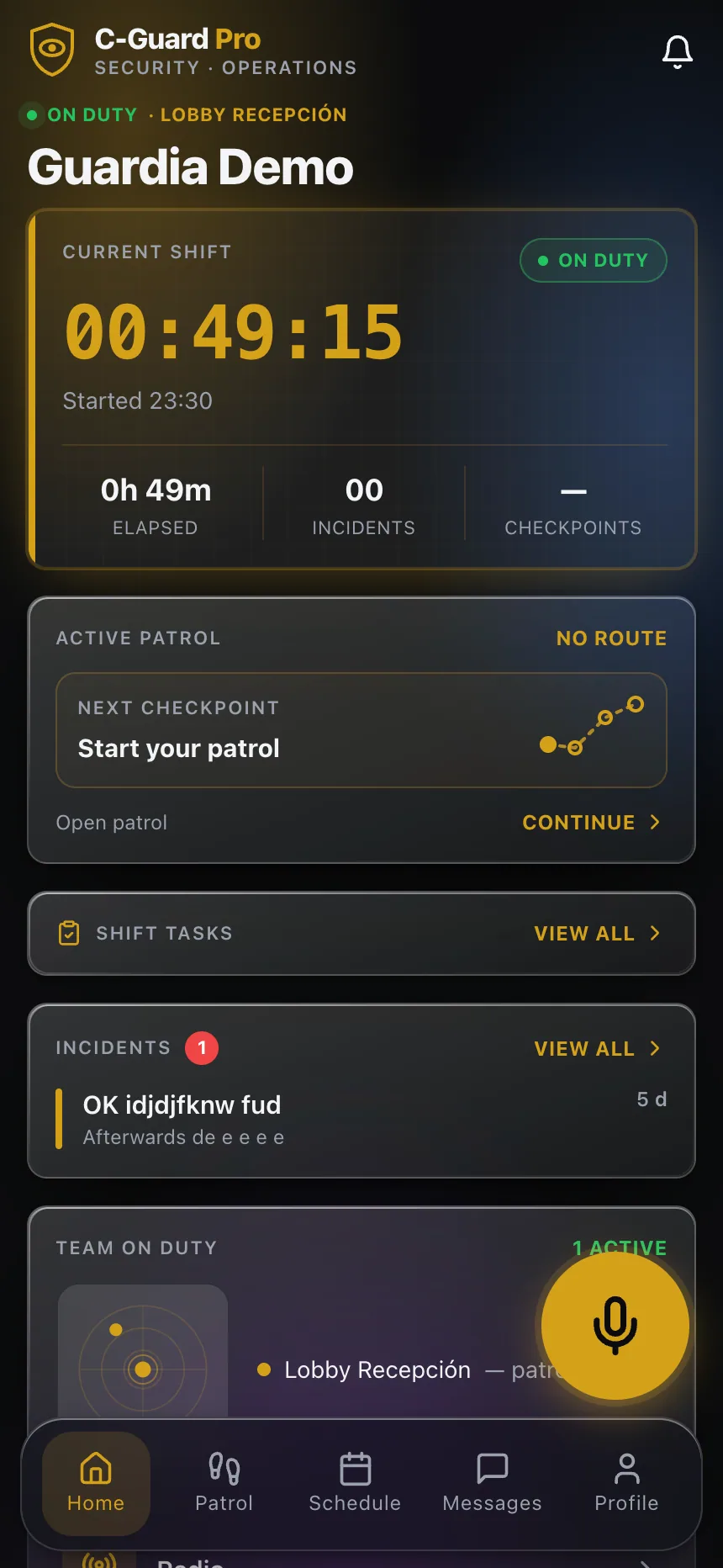
The response half needs the same treatment. When the monitoring center escalates, the run needs a location trail and an arrival time you can hand to the client without arguing about it. GPS supervision of patrol units turns “we responded promptly” into a record the client can read at 7 a.m. rather than calling your account manager about it.
How to have the conversation with a client
Ask what they are actually buying. Detection, deterrence, response, or service? Most clients have never separated those four, and once they do, the staffing model usually picks itself. A client who says “I need someone to open the gate for the 5 a.m. delivery and I need to know nobody is in the yard at midnight” has just described a hybrid, and you did not have to argue for it.
Then be explicit about limits. Say out loud that analytics generate false alerts, that weather and headlights and wildlife will trip zones, that verification takes seconds not milliseconds, and that a speaker cannot stop a determined crew. A client who hears the limits from you and then experiences them stays a client. A client who was promised a camera equals an officer calls you the first time something happens.
The bottom line
Remote guarding is a real capability with a narrow, well-defined sweet spot. On-site officers do work that no monitoring center performs. The companies that grow are the ones that can specify honestly, price both halves without hiding costs in each other, and prove performance on either side of the line with evidence the client can read.
If you want to see how covered posts, patrol response and client-facing evidence come together in one operation, explore CGuardPro or get in touch.