There is a specific moment when a security operation loses control of its alerting, and it is not dramatic. A dispatcher glances at a buzzing phone, sees the same kind of banner they have seen forty times that shift, and swipes it away without reading it. That swipe is now a habit. Security push notifications stopped being a tool the day everything became a notification, and the failure is not the dispatcher’s — it is a design failure that started when somebody turned on every alert because turning them on was free.
Alert fatigue is an operational risk, not an inconvenience. A team trained by experience to ignore interruptions will ignore the one that mattered.
Security push notifications: the only question that matters
Before any alert is configured, answer one thing: does a human need to change what they are doing right now?
If yes, it is a notification. If no, it is a record, and it belongs on a dashboard, in a report, or in a daily summary that someone reviews deliberately.
Almost every alerting problem in security operations comes from answering that question with “well, it might be useful to know.” Useful-to-know is not urgent. Useful-to-know goes in the morning review. The moment useful-to-know gets a push, the urgent items lose their meaning, because a notification’s power comes entirely from its scarcity.
Three tiers, and the discipline to keep them separate
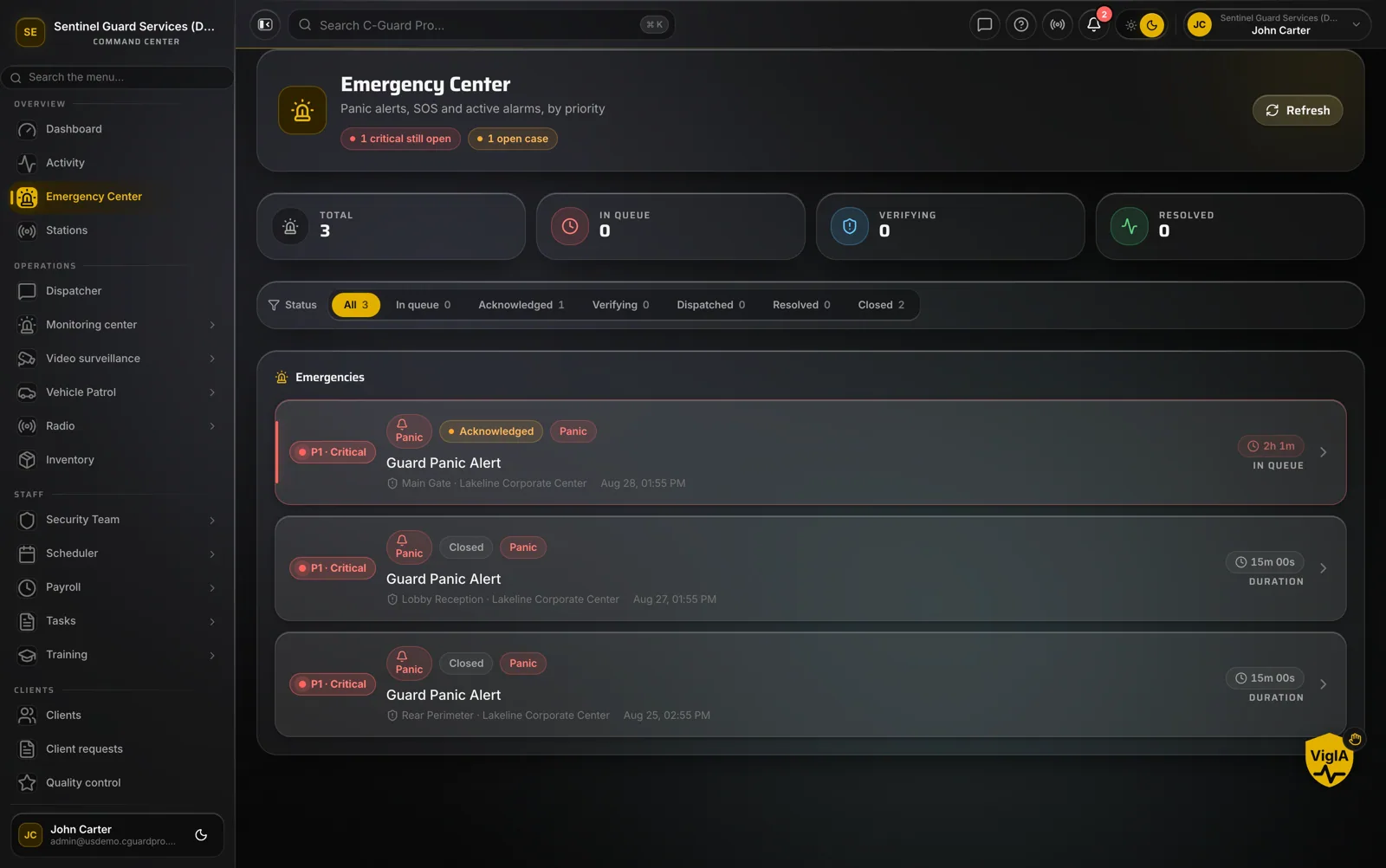
Interrupt. Something is happening that requires action within seconds or minutes. A panic activation. An officer who has not responded to a check-in on a lone post. A no-show at a post that is currently uncovered. These should be loud, distinct, impossible to confuse with anything else, and they must escalate if nobody acknowledges them.
The key word is escalate. An interrupt that fires once and disappears is not an interrupt, because the person may be on the phone, in the restroom, or driving. It must go to a second person and then a third, on a defined timer, until a human acknowledges it. Escalation is the part that gets skipped and the part that determines whether the alert did its job.
Attention. Something needs a human decision in the next hour or so. A shift starting soon with no assigned officer. A tour running well behind schedule. An incident report flagged as significant. These belong in a work queue that someone owns, visible in the dashboard, not competing with panic alerts for the same channel.
Record. Everything else. Scans completed, punches made, reports filed, routine activity. This is the material for the morning review and the client report, and it should never touch anyone’s phone.
The discipline is that tiers do not drift upward. Every operation experiences pressure to promote an attention item to an interrupt after one bad incident. Resist it, or in a year everything is an interrupt again and you are back where you started.
Routing: who gets it, not just what fires
Most operations configure what fires and forget who receives it. That is why supervisors end up with hundreds of daily notifications from sites they do not manage.
Route by ownership. A field supervisor receives alerts for their own posts. A dispatcher receives whatever the current shift generates. An account manager receives what is relevant to their clients, which is usually a daily summary rather than anything real-time. The owner receives almost nothing, and that is the correct design — an owner receiving live alerts either has too small an operation to need alerting or is about to stop reading them.
Route by time, too. An alert that fires at 3 a.m. should go to whoever is actually awake and on duty, not to the day-shift supervisor who will read it at seven and feel guilty. If your alerting does not know who is on duty right now, it is guessing, and guessing produces both misses and noise.
And route by acknowledgment. The system needs to know when a human took responsibility, because that is what stops escalation and that is what you look at afterward when someone asks why nobody responded.
The alerts worth having
A short list beats a comprehensive one. In most contract security operations, these earn their interruption:
- Panic activation. Nothing else in the operation should ever look or sound like this one. Everything about it should be distinct — the sound, the screen, the escalation path. It is the reason the panic button exists, and its value depends entirely on nobody having become numb to notifications.
- Uncovered post. The shift started, nobody clocked in, and a client is currently unprotected. This is a business-threatening event and it is also completely mechanical to detect.
- Missed check-in on a lone post. Especially overnight, especially at sites with dead zones.
- A tour that has not progressed. Not “a checkpoint was late” — a tour that has stopped, which may mean an officer who has stopped.
- An incident the officer flagged as serious. Let the officer make that call. They are standing there.
Notice what is not on the list: individual late scans, routine reports filed, ordinary clock-ins, and every automated summary. Those are records.
Notifications are not a communication system
A recurring mistake is trying to run coordination through alerts. Notifications are one-way and they carry almost no context. A dispatcher who needs to redirect an officer, clarify a post order, or coordinate a response needs a conversation, not a banner.
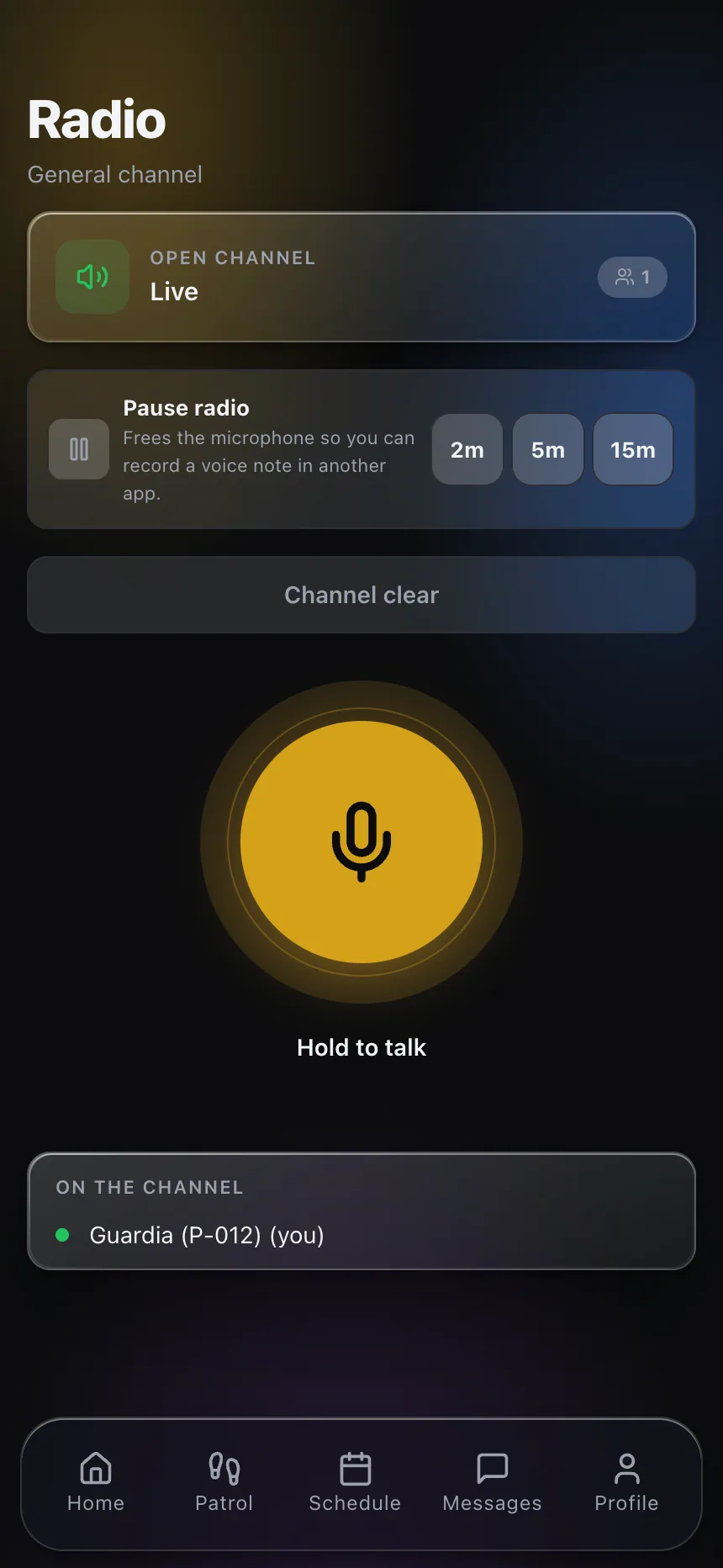
That is what voice is for. Push-to-talk radio is a channel where a real exchange happens in seconds, and a good operation uses it for coordination and reserves notifications for state changes that a human must know about. When you find yourself designing an alert to tell somebody something, you probably wanted to talk to them.
The corollary: alerts should be readable and actionable at a glance. Site, post, what happened, what to do. An alert that requires opening the app to understand is a worse alert, because it costs the dispatcher the very seconds it was supposed to save.
Measuring whether it works
The metric is not how many alerts fired. It is acknowledgment time on interrupt-tier alerts — how long from firing to a human taking responsibility. Watch that number over weeks. When it starts climbing, your team is going numb, and the cause is almost always that noise has crept back in.
The companion measure is the ratio of interrupts to real events. If your interrupt tier fires constantly and most of them turn out to be nothing, the thresholds are wrong. Do not train people to tolerate false alarms; fix the source.
Review alerting on a schedule — monthly is reasonable. For each alert type ask three questions: how many fired, how many produced an action, and would anyone notice if we turned it off? An alert that produces no action is not a safety net, it is a tax on attention, and turning it off makes the remaining alerts more powerful.
Officers get notifications too
The same discipline applies pointing outward. An officer’s phone should interrupt them for a dispatched assignment, a post order change that affects them right now, and a shift they need to acknowledge. Not for every routine update, not for company announcements, and not for anything the office simply wanted to feel confident about.
An officer who has learned that their phone buzzes constantly for nothing will silence it. Then the one time dispatch needs them urgently, nothing happens — and the post-incident review will conclude the officer ignored a notification, when the real cause was three months of noise that taught them to.
The bottom line
Security push notifications work when they are scarce, routed to whoever is actually on duty, escalated until acknowledged, and actionable without opening anything. Sort every alert into interrupt, attention or record, keep the tiers from drifting, and measure acknowledgment time instead of alert volume. Use voice for coordination and notifications for state changes.
If you want to see how alerting, panic response and dispatch fit together in one operation, explore CGuardPro or get in touch.