Every gate contract eventually produces the same conversation. The client has read about license plate recognition security systems, priced a camera, and arrived at a conclusion that sounds reasonable: if the camera reads the plate and opens the arm, why is there an officer standing there? It is a fair question, and the honest answer is more interesting than either the vendor pitch or the reflexive defense of the post.
What LPR is actually good at
License plate recognition does one narrow thing extremely well: it turns vehicles into searchable records without anyone writing anything down.
That matters more than it sounds. A guarded gate with a paper log produces a stack of handwritten plates that nobody reads until something goes wrong, and by then the writing is illegible or the entry was skipped during a rush. The same gate with a working camera produces a queryable history. When a tenant reports a vehicle break-in on Tuesday night, you can answer which vehicles entered and when — in seconds, without a supervisor driving out to collect a logbook.
The second genuine strength is the watch list. A vehicle associated with a prior incident, a terminated employee, a disputed contractor: the camera does not get tired, does not forget the description from three shifts ago, and does not have to recognize a face. This is the use case where LPR consistently outperforms a human, because it is a memory problem rather than a judgment problem.
The third is throughput at a residential or business park entry where the same few hundred vehicles come and go daily. Reading a known plate and lifting an arm is exactly the kind of repetitive task that should not consume an officer’s attention.

The plate conditions that quietly defeat it
Vendors demonstrate LPR in a parking lot at midday with a clean rental car. Your gate is not that.
Angle and speed. Cameras are aimed for a specific approach. A driver who swings wide, stops short of the reader, or rolls through faster than the capture window produces a miss or a partial read. Every gate has a geometry problem somewhere, and it is usually the lane where trucks have to swing.
Dirt, weather and glare. A plate coated in road film after a storm is unreadable to a camera long before it is unreadable to a person leaning out of a booth. Low winter sun straight into the lens, headlight bloom at night, a plate frame that clips a character — each one produces either a miss or, worse, a confident misread.
Plate variety. Specialty plates, dealer tags, temporary paper tags, plates from other states with different fonts and layouts, motorcycles mounted low and at an angle. Temporary tags in particular are a persistent weak point, and they are common on exactly the vehicles you would most want identified.
Deliberate defeat. Obscured, bent, missing or swapped plates are trivially easy and require no technical sophistication. Someone who intends to enter your site improperly is not going to present a clean, well-lit plate to the camera.
None of this makes LPR useless. It makes the error rate real, and the error rate is the whole design problem.
The false positive is the operational cost
The number that determines whether an LPR deployment succeeds is not the read accuracy in the brochure. It is what happens on a miss.
If a missed read means the arm stays down and the driver waits for an officer to look and wave them through, the system degrades gracefully. The camera handles the easy majority, the officer handles the exceptions, and nobody is stranded.
If a missed read means the driver sits at a closed gate with no human present, you have not automated the post — you have created a queue, a phone call, and a tenant complaint. Unmanned LPR gates fail in a specific and predictable way: they work beautifully for months and then fail on a rainy Friday evening with fifteen cars backed up onto a public road.
The misread is worse than the miss. A camera that confidently reports the wrong plate writes a false record. If that record is ever used to establish who was on site at a given time, a single transposed character undermines the credibility of the entire log. This is why the read should be treated as evidence to be reviewed, not as an established fact.
How it fits a manned entry
The productive framing is not LPR instead of an officer. It is LPR removing the clerical half of the officer’s job so the judgment half gets full attention.
An officer at a gate is doing several things at once: reading the plate, checking the vehicle against an expected list, looking at the occupants and the load, deciding whether the story matches, and logging it. LPR takes the first and the last. What remains is precisely what a camera cannot do — noticing that the delivery driver is nervous, that the truck bed is covered when it never has been, that the contractor’s vehicle is arriving at an hour that does not match the work order.
That division of labor also changes what the officer should be trained on. When plate capture is automatic, the value of the post shifts toward observation and toward the exceptions the system flags. Post orders should say what happens on a miss, on a misread, and on a watch-list hit — in that order of frequency, because that is the order in which they will occur.
Where the data has to land
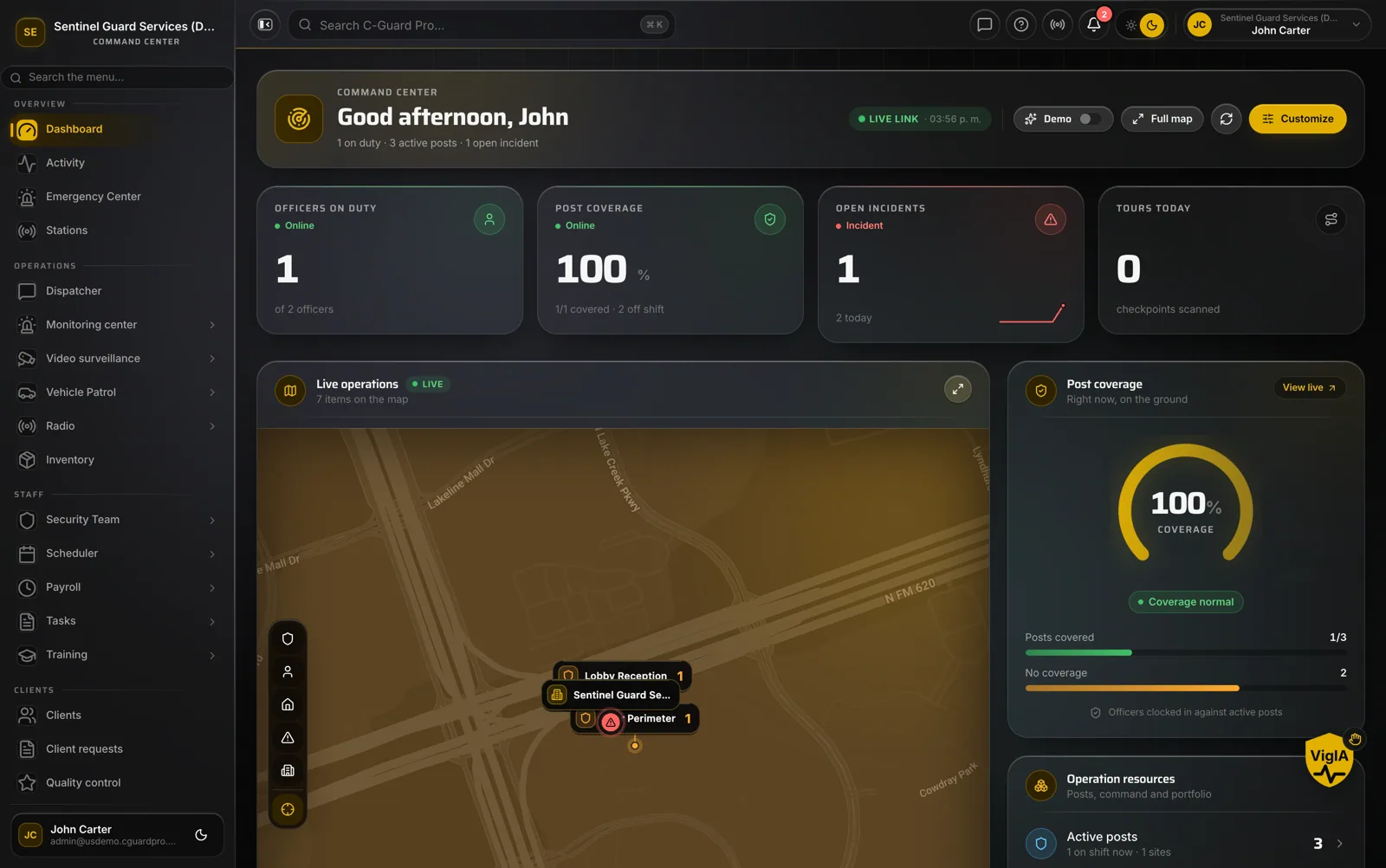
An LPR system that keeps its records inside its own appliance solves half the problem. The gate log becomes useful when it sits next to everything else that happened at the site: the daily activity reports the officer filed, the tour scans that show the perimeter was walked, and the incident entries from the same shift. A vehicle entry at 02:14 is a fact; a vehicle entry at 02:14 with no corresponding activity report and a missed checkpoint at 02:20 is a question worth asking.
That is also how the record becomes something a client can see. When gate activity, patrols and incidents live in one place, the client portal turns a tenant’s “who came in last night?” into a question they answer themselves rather than a call to your dispatcher.
Questions worth asking before you buy
Before the camera, settle the operating decisions. Most failed deployments were decided here, not in the hardware.
- What happens on a miss? Write the answer into post orders before installation, not after the first backup.
- Who reviews watch-list hits, and how fast? An alert nobody sees is a liability, because the record shows you were told.
- How long is footage and plate data retained, and who can access it? Retention obligations and privacy rules for recorded data vary by state and by what your client contract says. This is general orientation, not legal advice — confirm with counsel and with the client before you set a retention period.
- Does the client understand the accuracy is not absolute? Setting that expectation during the sale prevents a credibility problem later.
- Can the data be exported? If it can only be viewed inside the vendor’s interface, it will not survive a system change or an audit request.
The honest recommendation
License plate recognition at a guarded gate is worth doing where vehicle volume is high, the population is largely repeat, and there is an officer present to absorb the exceptions. It is worth being skeptical where the plan is to remove the post entirely, where the approach geometry is awkward, or where the client’s real problem is not vehicle identification but response time.
The technology is genuinely useful and genuinely limited, and both halves of that sentence matter. A camera that reads most plates most of the time is an excellent clerk and a poor gatekeeper. Staff accordingly.
If you want to see how gate activity, patrols and incident records come together in one operational picture, explore CGuardPro or get in touch.