Somewhere in most multi-building accounts there is a badge system the client owns, a camera system a different vendor installed, and your guard management software, and none of the three know the others exist. Every proposal cycle someone asks whether they can be joined together. Security software integration is a reasonable ambition, but it is oversold constantly, and the version that gets pitched in a sales meeting is rarely the version that survives contact with a real client site.
What integration means in practice
When people say “integrate the guard app with access control,” they usually mean one of four very different things, and naming which one you want is most of the work.
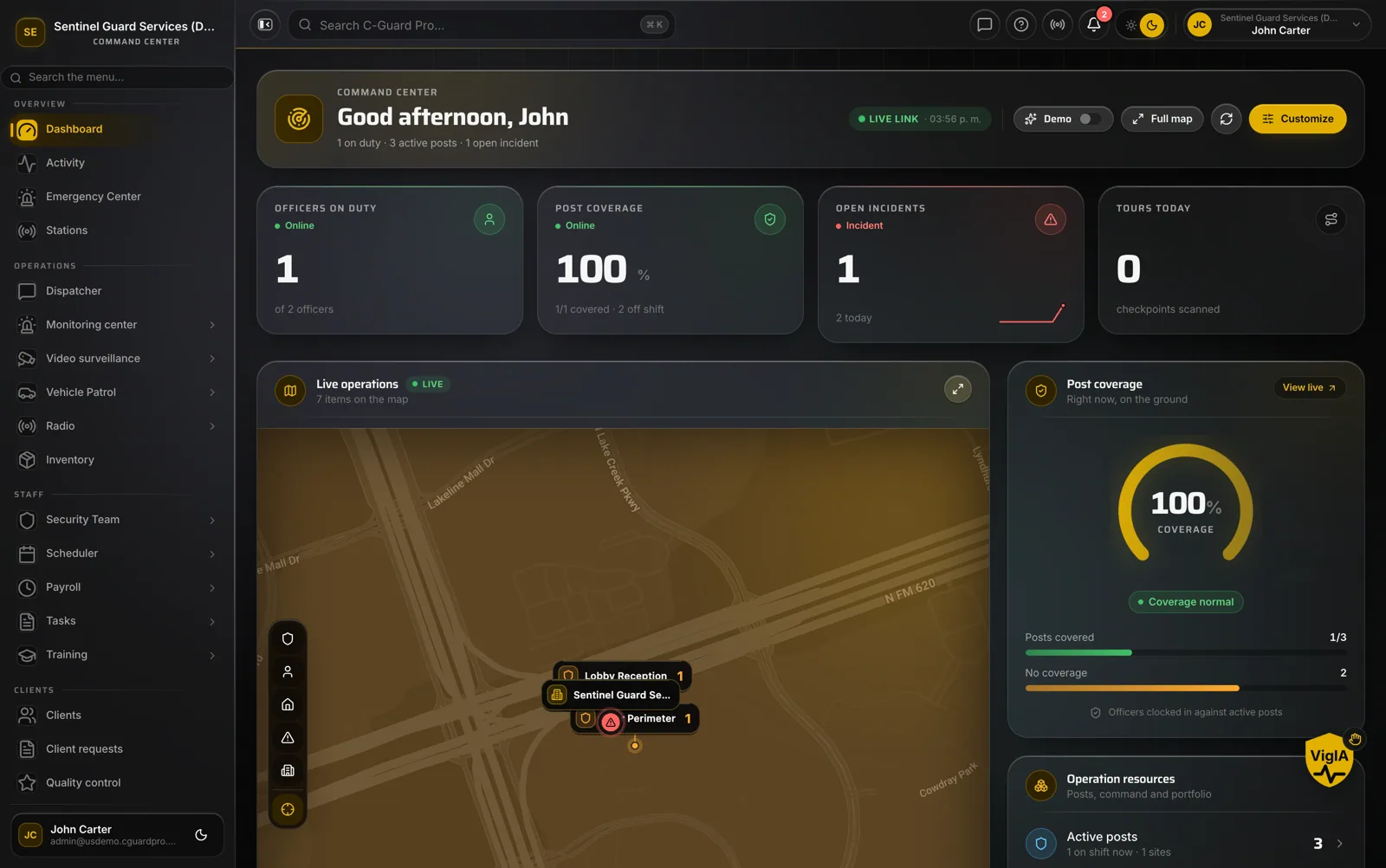
Read-only awareness. Door events from the client’s badge system become visible alongside your operational record, so the dispatcher sees that the loading dock door was forced open at 02:14 in the same place they see the officer’s tour and the incident log.
Alarm routing. A door-held or door-forced event from the access system creates an assignment for the on-duty officer rather than dying in a log nobody reads.
Identity synchronization. Badge holders and officers exist as one list rather than two, so a terminated employee loses building access and system access on the same day.
Control. Your dispatcher can unlock a door from the operations screen. This is the one everybody asks about and the one that carries real risk.
These are not degrees of the same feature. They have different costs, different failure modes and radically different liability. A company can get most of the operational value from the first two and never touch the fourth.
What security software integration genuinely buys you
The honest benefit is not automation. It is correlation and time.
Correlation: a forced-door event alone is noise, and an officer’s tour scan alone is routine, but the two together tell you whether the door opened before or after the officer walked past it. Investigations that used to require pulling three systems and reconciling three clocks become one timeline. That is genuinely valuable, and it is the reason the request keeps coming up.
Time: an alarm that turns itself into a dispatched assignment saves the seconds between something happening and someone being told. Not minutes — seconds, usually. But at the specific events where minutes matter, those seconds compound because the officer starts moving before the phone call would have ended.
There is also a quieter benefit nobody puts in a proposal: integration forces two organizations to agree on what an event means. Half the value of the project is the meeting where the client’s facilities lead and your operations manager finally define which doors are alarm-worthy at which hours.
What integration does not buy you
It does not fix bad post orders. If the officer does not know what to do when a door alarm fires, routing it to their phone faster produces a faster shrug. Write the response first, connect the systems second.
It does not reduce false alarms. It relocates them. A badge system that reports a door-held event every time a delivery driver props the dock will now report it into your officer’s pocket. Unless somebody tunes the source, integration converts a log nobody reads into an interruption everybody learns to ignore, which is worse. Alert fatigue is a real operational risk, not a theoretical one.
It does not survive the client changing vendors. Access control systems get replaced. The connection you built will need rebuilding, and whoever paid for it will ask why. Scope integration projects with a lifespan assumption, not as permanent infrastructure.
It does not transfer accountability. If your dispatcher can unlock a door, your company now owns the consequences of every unlock. Make sure the contract and the insurance conversation caught up with the feature. Requirements around access, monitoring and liability vary by client, by facility type and by jurisdiction, and nothing here is legal advice — get the scope in writing and reviewed by counsel before the first door is wired.
The realistic sequence
Projects that succeed follow roughly this order. Projects that fail skip to step five.
1. Decide who owns the access system. Almost always the client, not you. That means you are asking for permission to consume information from a system you do not control, maintained by a vendor with no contract with you. Everything downstream depends on whether that vendor cooperates. Find out in week one, not month three.
2. Agree on the event vocabulary. Which door states matter, at which hours, at which doors. Get it to a written list. Most sites discover that fewer than a dozen door events out of hundreds are worth an officer’s attention.
3. Define the response for each one. For every event on the list, what does the officer do, what evidence do they capture, and what closes it? This is post orders work, and it belongs in your existing post orders, not in a separate document that lives with the integration.
4. Start read-only. Bring events in and look at them for a full billing cycle before anything creates an assignment. You will find the noisy doors, the clock drift, the sensor that reports every time the HVAC cycles. Fix those at the source.
5. Then route. Turn the surviving events into real assignments with a real acknowledgment, so dispatch knows the officer received it and dispatch knows when it closed.
6. Consider control last, or never. Remote unlock is the smallest amount of convenience for the largest amount of exposure. Many mature operations deliberately stop at step five.
The unglamorous prerequisites
Two things sink these projects more often than technology does.
Clocks. If the access system’s timestamps and your operational record’s timestamps disagree by even a couple of minutes, correlation becomes an argument. Establish, in writing, what time source each side uses and what time zone events are recorded in. Sites that span a time zone boundary or that use local time inconsistently will burn a week of somebody’s life on this.
Names. The client calls it “Door 14.” Your post orders call it “the north dock.” The camera system calls it “CAM-NDK-02.” Until one naming convention wins, every report requires a translation step and every new officer gets it wrong. Standardize names before you connect anything; it is free and it pays off even if the integration never happens.
If you cannot integrate, do this instead
Most guard companies will not get access to a client’s access control system, and that is fine. Nearly all of the operational value is reachable without it, because the point was never the wiring — it was verified presence, a defined response and a shared record.
Verified time and attendance tells you the post was covered by the right officer. A QR guard tour puts a timestamp on the officer standing at the north dock, which is the same evidence a door reader would give you for the officer’s half of the timeline. Structured daily activity reports capture what the officer found, with photos, at the moment they found it — and when the facilities lead can read that record themselves, they usually discover it was what they actually wanted when they asked for integration in the first place.
The bottom line
Treat security software integration as an operations project with a technology component, not the reverse. Name which of the four kinds you want, agree on the event list and the response before anyone connects anything, run read-only long enough to see the noise, and be genuinely reluctant about remote control. Done in that order, integration makes investigations faster and shift handovers cleaner. Done in reverse, it produces a very expensive way to ignore alerts.
If you want to see how verified presence, dispatched assignments and client-facing evidence fit together in one operation, explore CGuardPro or get in touch.