The cloud vs on-premise security software question used to be a genuine fork in the road for a guard company. Today it is mostly settled for operations work, but it is settled for reasons worth understanding rather than because everyone else did it. If a client with a procurement department asks you where their site data lives, or if you inherited an office machine humming in a closet that runs your scheduling, you need a clearer answer than “it’s in the cloud.”
Cloud vs on-premise security software: what the two models mean
On-premise means the software runs on equipment your company owns, physically located in your office, and your company is responsible for keeping that equipment powered, patched, backed up and reachable. Someone has to own that job. In most small and mid-size security companies, that someone is the operations manager who also handles callouts, or a part-time contractor who answers when he answers.
Cloud means the vendor runs the system and your people reach it through a browser and a phone app. Your responsibility shifts from keeping machines alive to managing accounts, permissions and the contract with the vendor.
That is the real difference, and it is an operations difference more than a technology one. The question is not which model is more modern. It is which failure modes you are equipped to absorb at 3 a.m. on a holiday weekend.
Uptime is about who answers the phone
Every system fails eventually. What matters is the shape of the recovery.
On-premise, when the office loses power or connectivity, your dispatch board goes dark and your field officers cannot check in. The fix depends on whoever maintains the equipment being reachable and awake. A small company’s honest answer is often that recovery takes hours, and that the last known-good backup is whatever the automated job produced last night, assuming anyone verified it ran.
Cloud, when the vendor has an outage, your dispatch board also goes dark. The difference is that the vendor has staff whose only job is restoring it, and the outage is visible to every customer, which creates pressure your closet machine never generates. The tradeoff is that you cannot do anything except wait and communicate.
The practical middle ground for field operations is neither model, it is offline tolerance in the phone app. An officer in a parking garage has no signal regardless of where the system runs. A tour scan, a time punch and an incident report should be captured on the device and sync when coverage returns. When you evaluate any product, this matters more to your daily reality than the hosting model does, because dead zones happen every single shift and hosting outages do not.
Data ownership is a contract question, not a hosting question
The most common assumption is that on-premise means you own your data and cloud means you do not. That is not how it works. Ownership is established by what your agreement says, and by whether you can actually get your records out in a usable form whenever you want.
The questions that settle it:
- Can we export our complete operational history ourselves, on demand, without asking anyone for help or paying a fee?
- What format does the export come in, and does it include the attachments — the incident photos, the signed reports, the tour records — or only rows of text?
- If we terminate, how long do you retain our records, and what proves they were deleted?
- Who inside the vendor can see our data, under what circumstances, and is that logged?
Notice that all four apply equally to an on-premise product, because most on-premise products still lock their records inside a format only that product can read. An operator with an old on-premise system and no export path is more trapped than a cloud customer with a clean export button.
The cost shape, without naming a number
Neither model is inherently cheaper. They have different shapes, and the shape is what matters for a company that is growing.
On-premise concentrates cost up front and then hides the rest. You pay once for the software and the equipment, and then you pay continuously in ways that never appear on an invoice: the hours someone spends maintaining it, the replacement hardware when it ages out, the upgrade project every few years, the specialist you call when it breaks, and the version you eventually stop updating because updating is disruptive. That last one is the expensive one, because a frozen system is the one that fails an insurance review or cannot connect to anything new.
Cloud spreads cost into a recurring fee that scales with the size of your operation. It is predictable and it appears on a line item you can see, which cuts both ways: it is easier to budget and easier for a nervous owner to resent. The costs it hides are different — the internal effort to keep account lists accurate, and the exit cost if you ever move.
A useful exercise before you decide: write down every cost category for both models over three years, including labor hours you would not invoice anyone for, and only then compare. Do not compare a purchase price to a subscription price. They are not the same kind of number.
What actually decides it for most guard companies
Three things, none of them ideological.
Your field is mobile and your office is not the center of gravity. Officers, field supervisors and patrol drivers are the primary users. They are on phones, spread across a metro, and they need to work whether or not your office is functional. A system reachable only from inside your office network is the wrong shape for that reality.
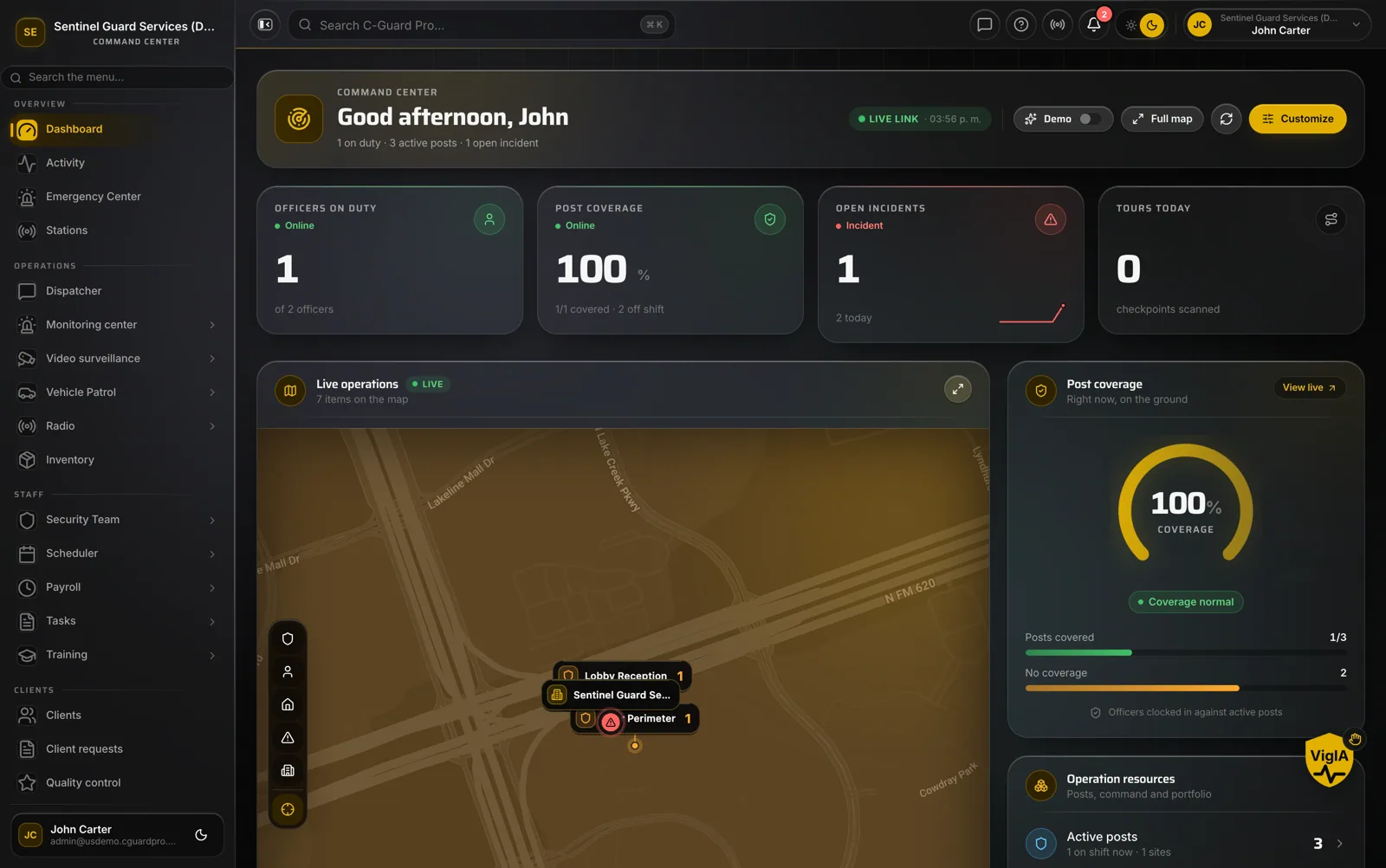
Clients increasingly want their own window. A property manager who can open a client portal and read last night’s reports without emailing anyone is a client who renews. Publishing that securely to the outside world is exactly the problem a hosted product solves and an office machine does not.
You do not have a technology department, and you should not build one. Every hour spent keeping infrastructure alive is an hour not spent on recruiting, scheduling and client retention, which is where a guard company actually wins.
When on-premise still has a case
Be fair about it. A client contract or a specific facility environment may impose requirements that constrain where information can be stored or how it must be handled. Requirements of that kind vary by client, by industry and by jurisdiction, and this article is not legal advice — read the contract and check with counsel rather than assuming. If a specific site genuinely imposes that constraint, the honest answer is to scope that one site accordingly rather than to reshape your whole company around it.
Questions to ask either kind of vendor
Ask them the same list and compare the answers, not the marketing:
- What happens to my field officers when connectivity drops mid-shift, and what happens to the data they captured?
- Show me the export. Right now, in the demo.
- Where do I see who accessed what, and can I get that history myself?
- What is your maintenance window, and how are we told before it happens?
- What does an upgrade cost me in disruption, and who does the work?
- If I want to leave in two years, describe the steps.
A vendor who answers all six directly is telling you how year two will feel. A vendor who redirects any of them to “our team handles all of that” is telling you something else.
The bottom line
For a contract security company, cloud vs on-premise security software is decided by where your people work and who is going to keep the lights on. The field is mobile, clients want visibility, and nobody in your office should be a part-time systems administrator. Choose the model that lets your app work in a basement, your export work on demand, and your operations manager stay focused on posts and scheduling.
If you want to see what that looks like end to end, explore CGuardPro or get in touch.