Every operations manager who has rolled out a tracking app has had the same conversation. An officer three hours from end of shift says the phone died, so there are no tour scans after 22:00 and no clock-out at all. Guard app battery drain is one of those problems that looks like a complaint and is actually a data-integrity issue, because a dead phone breaks your evidence chain at exactly the hours a client cares about most. It is worth understanding what really drains the battery, because the usual fixes people reach for are aimed at the wrong things.
What actually causes guard app battery drain
Four things dominate, and they are not equally guilty.
The location radio. Getting a position is not free, and getting a precise one is much more expensive than getting a rough one. Asking the phone for a high-accuracy fix means waking the satellite receiver, keeping it awake long enough to lock, and doing that over and over. Ask for that every few seconds all shift and you are running the most power-hungry sensor in the device continuously for twelve hours.
The cellular radio searching for signal. This is the one nobody predicts. A phone with good coverage sipping data uses far less power than a phone with no coverage. When a device loses the network, it does not go to sleep — it climbs to full transmit power and keeps hunting. An officer patrolling a concrete parking structure or a rural yard is carrying a device that is effectively running its radio flat out for the entire round.
The screen. Brightness at maximum, outdoors, for hours. Officers turn it up because they cannot read the screen in daylight and then never turn it back down.
A poorly behaved app doing work in the background. Waking constantly to check something, retrying failed uploads with no backoff, or keeping a live connection open the whole shift regardless of whether anything is happening.
Then there is the factor that has nothing to do with software at all: battery age and cold. A phone in its third year holds a fraction of the charge it did new, and cold weather makes a healthy battery report a false low and shut down early. If your night officers in January are dying at hour eight on two-year-old handsets, no setting is going to save you.
What a well-built app does differently
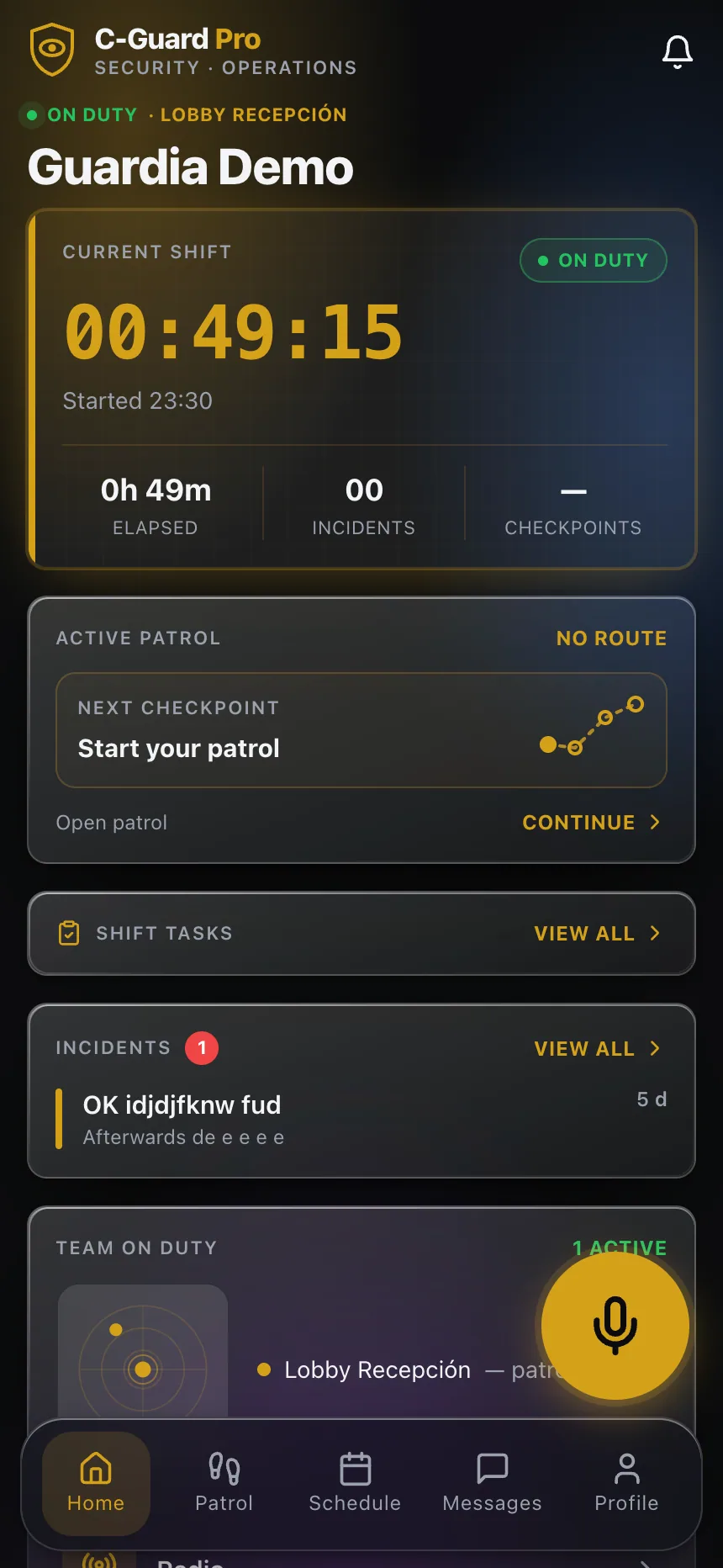
The difference between an app that lasts a shift and one that does not is mostly a set of design decisions the officer never sees.
Adaptive location instead of a fixed interval. A stationary officer at a static post does not need a new position every ten seconds. Good tracking backs off when the device is not moving and tightens up when it detects motion, so the expensive sensor runs during the parts of the shift that produce meaningful data and idles during the parts that do not.
Distance-based updates rather than time-based. Recording a point when the officer has actually moved a meaningful distance produces a cleaner trail and uses less power than sampling on a clock, because a parked patrol vehicle stops generating requests entirely.
Batching, with backoff. Positions and reports should queue on the device and go up in groups rather than one at a time, and when the network is unreachable the app should stop hammering it and retry on a widening schedule. An app that retries a failed upload every few seconds in a dead zone is the worst possible combination: no data captured and the radio at full power.
Tracking that is tied to shift state. The app should be recording position while the officer is on the clock and stop when they are not. This is both a battery decision and a privacy decision, and it is the single most important question to ask a vendor.
Genuine offline capture. Scans, reports and punches recorded on the device with no signal, synced later. Beyond the obvious operational benefit, it removes the panic-retry loop that eats the battery in exactly the places officers work.
Privacy is part of this conversation
Continuous location on a personal device is not a neutral technical setting. Officers notice, and they are right to ask. The defensible position is narrow: track while on shift, at a resolution that serves the operational purpose, with the officer able to see that tracking is active, and stop at clock-out. Tell people plainly what is recorded and how long it is kept.
Rules about employee monitoring, personal device use and recorded location vary by state and by jurisdiction, and this is not legal advice — have your policy reviewed by counsel and put it in writing before the rollout, not after the first grievance. A written policy also reduces battery complaints, because a fair share of them are really consent complaints wearing a costume.
The settings and habits that actually move the needle
In rough order of impact:
1. Turn off aggressive battery optimization for the app. This is the top cause of “the app stopped reporting.” Phone makers put apps to sleep in the background to preserve battery, and the officer never knows it happened — the app looks fine when opened, but nothing was recorded for four hours. Every rollout should include an explicit step to exempt the app, and it should be verified on the device rather than assumed. This one setting causes more support tickets than everything else combined.
2. Fix the screen. Auto-brightness on, screen timeout short. Officers can read a notification without leaving the display lit for two minutes.
3. Kill the other apps. A personal phone running social media, streaming and a dozen background services will not survive a shift no matter how efficient your tracking is. If you allow personal devices, this is a conversation, not a setting.
4. Issue a charging cable per patrol vehicle. Unglamorous and the highest return of anything on this list. A patrol driver charges between stops and the problem disappears.
5. Audit device age. Keep a note of which handsets are in year three. Replace them before the winter shift complaints start rather than after.
6. Airplane mode is not the answer. People suggest it for dead zones. It stops the radio hunting, but it also stops the panic button and every other real-time function, which is not a trade any operations manager should accept.
Diagnosing a real complaint
When an officer reports drain, separate three cases before you blame the software.
Is it one officer or the post? If it is everyone at the same site, you have a coverage problem, not an app problem — the phones are burning power hunting for a signal in a structure. The fix is offline tolerance and charging, not settings.
Is it one handset? Check the phone’s own battery health screen and its per-app usage breakdown. That screen tells you honestly which app is consuming the power, and it frequently is not yours.
Did the app actually run? Look at whether the record has a continuous trail that ends abruptly, or a trail with gaps throughout. An abrupt end is a dead phone. Scattered gaps are almost always background optimization killing the app, which is a settings fix on the device.
That distinction matters because the two problems have completely different remedies, and treating a background-restriction problem as a battery problem means buying chargers that will not fix anything.
The bottom line
Guard app battery drain is rarely a mystery. It is high-accuracy location running on a clock instead of on motion, a radio at full power in a dead zone, a bright screen, an aging battery, and a phone that quietly suspended the app in the background. Choose software that adapts its sampling, batches its uploads, works offline and tracks only while the officer is on the clock — then handle the device-level settings during rollout instead of discovering them in a support ticket at 2 a.m.
If you want to see how GPS supervision and the guard mobile app are built to survive a full shift, explore CGuardPro or get in touch.