A property manager forwards a vendor’s brochure to your account manager and asks the question every contract security company is now getting: if the cameras can detect people, do we still need the officer? AI video analytics security is being sold on exactly that premise, and the honest answer — the one that keeps the account and keeps your credibility — is more interesting than either yes or no. Detection genuinely works now in a way it did not a few years ago. It also creates a category of work that did not exist before, and that work lands on somebody. Usually your officer.
What the technology is actually good at
Strip away the marketing and modern video analytics does a small number of things reliably.
Object classification. Distinguishing a person from a vehicle from an animal from a wind-blown branch, in a defined area of a frame, is a solved problem under reasonable conditions. This is a real advance over the old motion-detection generation, which fired on anything that changed pixels and trained an entire industry to ignore camera alarms.
Line crossing and zone intrusion. Draw a boundary, get an event when a classified object crosses it. Combined with reliable classification, this is the workhorse capability and the one that produces most of the genuine value.
Loitering and dwell time. An object of a given class remaining in a zone longer than a threshold. Useful at ATMs, entrances, loading docks and vacant properties.
Vehicle and plate reads at controlled points, under controlled conditions — a separate topic with its own constraints.
Search over recorded video. This one is undersold and is often the highest-value feature in practice. Being able to ask a system for every person in a red shirt in the west lot between midnight and 4 a.m., and get results in seconds instead of an afternoon of scrubbing, changes what an investigation costs. Even if you never enable a single live alert, that alone can justify a system.
What it is not good at, and will not be soon
Be equally specific about the limits, because your client’s expectations are being set by a sales deck.
Intent. No system knows whether a person walking through a lot is a resident taking a shortcut or someone checking door handles. It knows there is a person. The interpretation is human work, and pretending otherwise is where deployments go wrong.
Adverse conditions. Heavy rain, fog, snow, glare at dawn and dusk, headlights sweeping a camera, spiders building webs across a lens at night — all degrade performance, and the degradation is not graceful. A system that performs well in a demo on a clear afternoon behaves differently in a February storm at 3 a.m.
Bad camera placement. Analytics inherit the camera. A camera mounted too high, aimed into the sun, with a field of view covering a parking lot four hundred feet deep, will not be rescued by better software. A meaningful share of disappointing deployments are camera problems misdiagnosed as software problems, and the fix is a ladder, not a license.
Anything outside the frame. This is obvious and constantly forgotten. Analytics cover the areas cameras cover. Officers cover the property.
Recognition claims. Systems that claim to identify specific individuals raise legal and privacy questions that vary substantially by state and by locality, and the rules in this area are changing. Some jurisdictions regulate biometric data collection specifically. This post is not legal advice — before your company deploys, recommends or operates anything that identifies individuals, verify the applicable requirements with counsel and with your client’s legal team.
The false-positive tax
Here is the part no brochure quantifies, and the part that determines whether a deployment succeeds.
Every analytics system produces alerts that are not real events. The rate depends on the site, the camera, the weather, the season and how aggressively the zones were drawn. What matters operationally is that each of those alerts consumes a response — someone looks at it, decides, and dismisses it. That someone is a person, and their attention is finite.
There is a threshold effect that anyone who has worked a console will recognize. Below a certain alert volume, an operator treats every alert as potentially real. Above it, the operator starts pattern-matching and dismissing, and once that habit forms, the real event gets dismissed with the rest. The system is then worse than no system, because it produced a record showing the event was detected and nobody acted.
This is the central design constraint, and it leads to three rules.
Tune ruthlessly and continuously. A deployment is not finished at commissioning. Zones need adjusting as landscaping grows, as traffic patterns change, as seasons change the light. Budget for someone to own tuning at each site, ongoing. If nobody owns it, alert volume drifts upward until the system is ignored.
Match alert volume to available attention. Decide how many alerts per hour a post can actually absorb given everything else the officer does, and configure to that number. It is far better to detect fewer things well than to detect everything and respond to nothing.
Schedule alerting. Most sites do not need intrusion alerts during business hours when the lot is full of legitimate people. Turning analytics on only during the hours where an alert would actually mean something eliminates a large share of noise for free.
What it does to the officer’s job
The claim that analytics reduce headcount is usually wrong in the way it is stated, and it is worth understanding why.
Analytics do not patrol. They do not lock a door, escort an employee to a car, respond to a medical, deter by presence, or make a judgment call about an agitated person in a lobby. They generate events. Events require response, and response requires a person on or near the property.
What analytics genuinely change is where officer attention goes. Before analytics, an officer at a large site allocates attention by routine: a tour every hour, a camera sweep now and then, a fixed pattern that an observer could learn in two nights. After analytics, attention becomes partly event-driven: the routine still runs, but the officer is directed to the northeast fence at 2:14 a.m. because something crossed it.
That is a real improvement in effectiveness. It is not the same as needing fewer officers, and a company that sells it as headcount reduction is setting up a conversation it will lose in twelve months when the client discovers the alerts still need somebody.
There is a second, subtler change: analytics create documentation obligations. Every alert should have a recorded disposition — what it was, what was done, who did it. Without that, you cannot tune the system, you cannot defend the response, and you cannot demonstrate value at renewal.
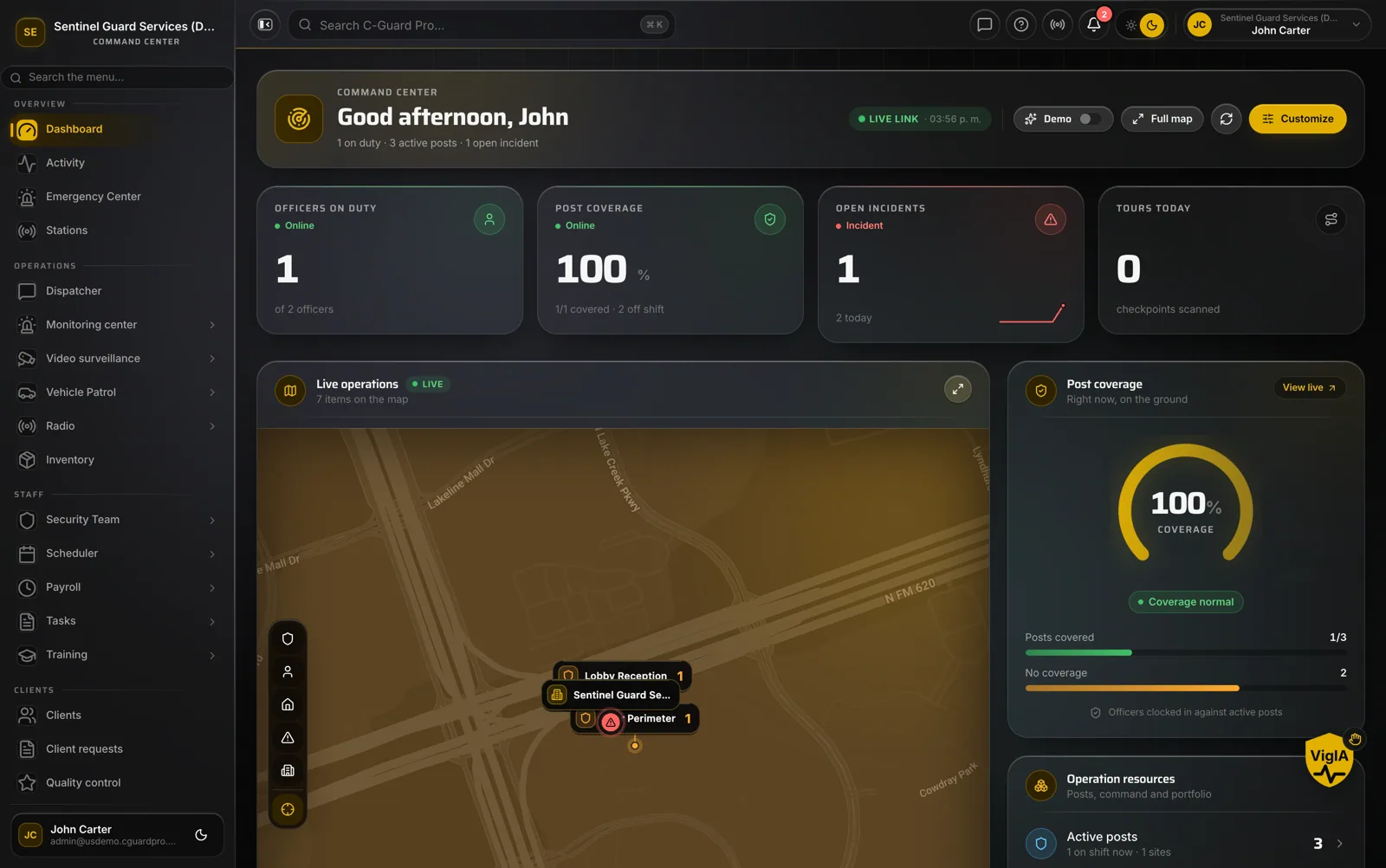
The disposition record is where the guard company’s own system matters more than the analytics vendor’s. Alerts arrive from the camera platform; the response is your product. Logging each response in the officer’s shift record — with time received, time on scene, what was found, and photos — turns a stream of camera events into a defensible service record. Pushing that into the same daily activity report the client already reads means the analytics investment shows up in a document the property manager is already looking at.
Where analytics fit best
Some deployments consistently work better than others. The pattern is not about the technology; it is about the site.
Perimeters with clear boundaries. Fenced yards, construction sites, equipment storage, substations, vacant buildings. Clean lines, few legitimate people after hours, high-consequence intrusions. This is the strongest use case in the industry.
Vacant or low-occupancy property. Where the baseline is “nobody should be here,” classification alone carries most of the value and the false-positive rate is manageable.
After-hours coverage of an occupied property. Same idea, applied to hours instead of the whole day.
Large sites where an officer cannot see everything. Analytics extend one officer’s reach; they do not replace the officer.
Where it works poorly: busy public spaces during operating hours, retail sales floors, anywhere the normal state of the world is dozens of people moving unpredictably. In those environments the alert volume is unusable and the value is mostly in search after the fact rather than live alerting.
Response is the part that has to work
An alert with no defined response is a notification, not security. Before commissioning, write the response for each alert type at each site: who receives it, what they verify, what they do, whom they notify, and what happens if they are already occupied.
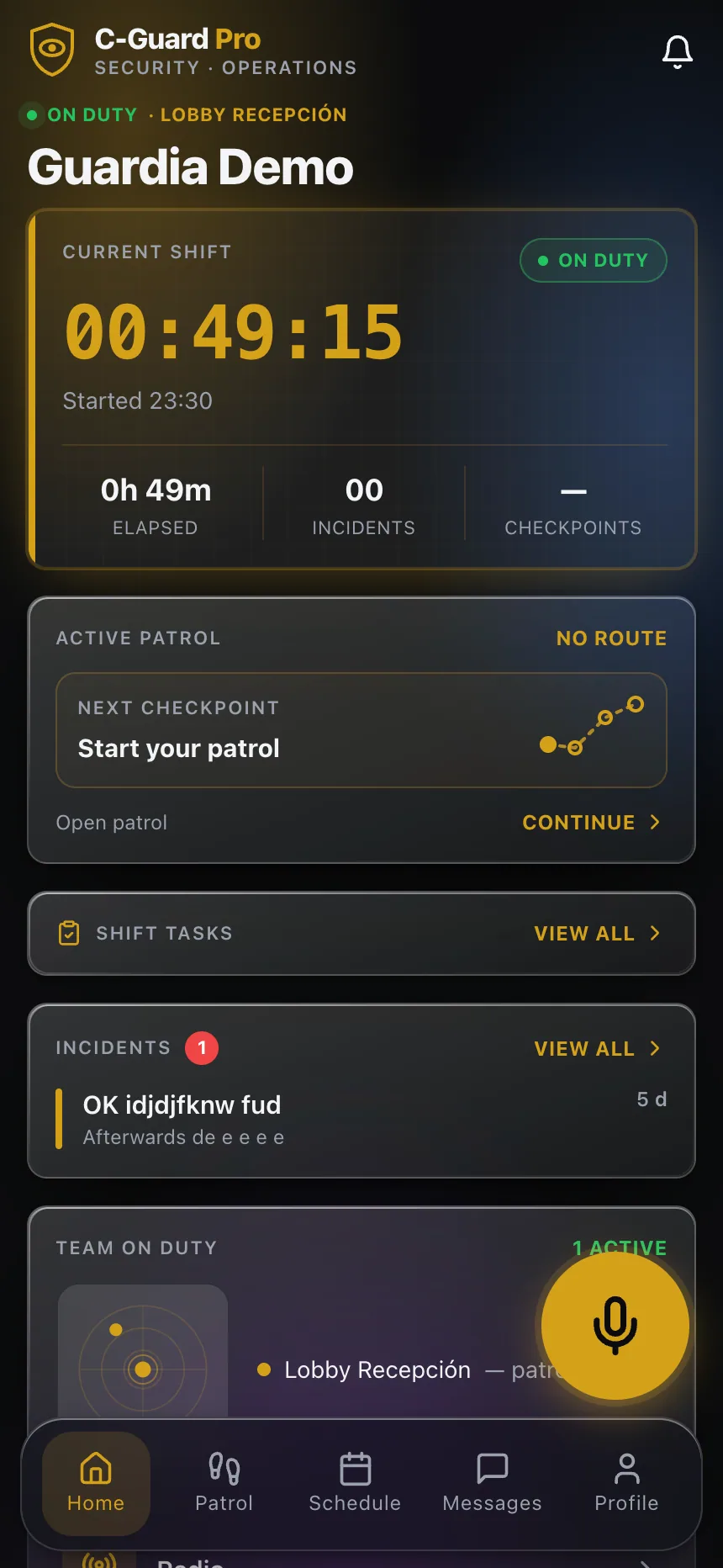
The mechanics matter here. If an alert reaches a remote monitoring center and the officer on site learns about it through a phone call that goes to voicemail, the response time is whatever the phone tag takes. A push-to-talk channel between dispatch and the officer, or a direct notification to the officer’s phone, is the difference between a two-minute response and a fifteen-minute one — and on a perimeter alert, that gap is the entire value of the detection.
Run the response drill before go-live and again a month in, unannounced. Most systems that “do not work” are systems whose response path was never tested with a real person at 3 a.m.
How to talk to the client about it
If a client asks whether analytics let them cut the officer, do not get defensive and do not oversell. Explain the mechanism: detection generates events, events require response, response requires people, and the honest gain is faster and better-directed response, plus a dramatically cheaper investigation capability, plus documentation of what happened.
Then offer to run it. Propose that your officers handle alert response and disposition, that you own tuning at the site, and that the monthly report shows alert volume, dispositions and findings. That converts a technology purchase that could have displaced you into a service line where your officers are the reason the investment pays off.
If you want to see how alert response, shift records and field communication fit into one operation, explore CGuardPro or get in touch.